


 Svenska

 News
 Botanical Blends
 Mitragyna
 Kanna (sceletium tortuosum)
 Akuamma (Picralima nitida)
 Tongkat Ali (Eurycoma longifolia)
 Blue Lotus (Nymphaea caerulea)
 Sakae Naa
 Wild Lettuce (Lactuca virosa)
 Damiana (turnera diffusa)
 Zornia latifolia (Maconha Brava)
 CBD products
 Aromatherapy
Botanicals
3% or 5% Kanna Extract? Standardisation, Alkaloid Profile and COA
Aug
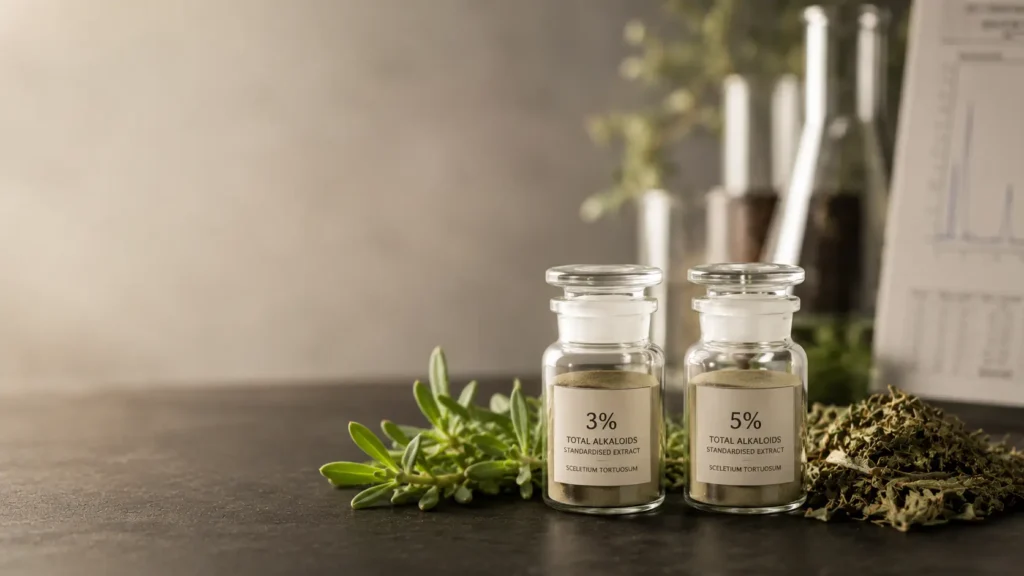
3% and 5% Kanna extract normally describe the total alkaloid content of a standardised extract. However, the percentages do not automatically show the amount of mesembrine, and on their own they do not say everything about the quality of the raw material. A proper comparison also requires reviewing the alkaloid profile, the analytical method, the carriers and the current certificate of analysis.
The difference between 3% and 5% Kanna extract
To begin with, the direct difference lies in the specified concentration of total alkaloids. An extract standardised to a minimum of 3% must meet a minimum analytical value of 3% total alkaloids. Likewise, an extract standardised to a minimum of 5% must meet a minimum value of 5%.
Consequently, the 5% extract contains a larger analysed proportion of alkaloids per unit of weight than the 3% extract. However, the figure does not on its own describe:
- which alkaloids the analysis covers,
- how the alkaloids are distributed,
- how the extract was produced,
- which carriers the product contains,
- or how the batch in question performed in other quality analyses.
For that reason, you need to read both the product specification and its batch-specific COA.
What does total alkaloid content mean in Kanna?
Chemically, Kanna, commonly known as Sceletium tortuosum, contains several naturally occurring alkaloids. Botanical and chemical studies have identified several compounds within different structural groups. Mesembrine-type alkaloids usually receive the most attention in analyses of standardised Kanna extracts.
The term total alkaloid content describes the combined amount of alkaloids that a specific analytical method includes. The producer may, for example, report mesembrine, mesembrenone, Δ7-mesembrenone and a group of other alkaloids.
The laboratory then adds the relevant analytical values together into a total result. The documentation must therefore clearly state which compounds are included in the total.
Why does 3% not mean 3% mesembrine?
Among the alkaloids, mesembrine is often the dominant one in standardised Kanna extracts. Even so, the total alkaloid content usually consists of several compounds.
An extract with 3% total alkaloids may therefore contain less than 3% mesembrine. The remaining share may consist of mesembrenone, Δ7-mesembrenone and other alkaloids included in the producer’s specification.
Similarly, 5% total alkaloid content does not automatically mean 5% mesembrine. To determine the mesembrine content, you need to read the separate analytical value for mesembrine itself.
This distinction matters because expressions such as “Kanna extract 5%” can otherwise easily be misread as meaning that the product contains 5% of a single alkaloid.
Kanna Solace 3%: standardisation and documentation
Kanna Solace 3% is a standardised extract of Sceletium tortuosum. The product page states that the producer uses the aerial parts of the plant and vacuum-dries the extract.
For Solace, the specification states a total alkaloid content of at least 3%. The reported product profile contains the following approximate values:
| Analytical parameter | Reported value for Solace |
|---|---|
| Total alkaloid content | At least 3% |
| Measured total content | Approx. 3.22% |
| Mesembrine | Approx. 2.43% |
| Mesembrenone | Approx. 0.29% |
| Δ7-mesembrenone | Approx. 0.18% |
| Other alkaloids | Approx. 0.32% |
In addition, the product information lists tapioca and amorphous silica as ingredients or technical aids. Here, amorphous silica acts as a flow agent that helps the powder keep a manageable consistency.
In summary, the figures above describe documented chemical composition. They should not be interpreted as descriptions of effects or as instructions for use.
Kanna Embrace 5%: standardisation and documentation
Kanna Embrace 5% is also a standardised, vacuum-dried extract from the aerial parts of Sceletium tortuosum.
For Embrace, the specification states a total alkaloid content of at least 5%. The reported product profile contains the following approximate values:
| Analytical parameter | Reported value for Embrace |
|---|---|
| Total alkaloid content | At least 5% |
| Measured total content | Approx. 5.58% |
| Mesembrine | Approx. 4.23% |
| Mesembrenone | Approx. 0.16% |
| Δ7-mesembrenone | Approx. 0.16% |
| Other alkaloids | Approx. 1.26% |
According to the product information, Embrace also contains tapioca and amorphous silica. The finished powder therefore does not consist solely of identified alkaloids. The extract’s other plant constituents and technical aids make up most of its weight.
Comparing 3% and 5% Kanna extract
In comparison, Solace and Embrace are, according to the product information, based on the same botanical species and the same type of aerial starting material. They differ, however, in standardisation level and reported alkaloid profile.
| Property | Solace 3% | Embrace 5% |
|---|---|---|
| Botanical species | Sceletium tortuosum | Sceletium tortuosum |
| Plant part | Aerial parts | Aerial parts |
| Minimum total alkaloid content | 3% | 5% |
| Reported total content | Approx. 3.22% | Approx. 5.58% |
| Reported mesembrine content | Approx. 2.43% | Approx. 4.23% |
| Drying method | Vacuum drying | Vacuum drying |
| Analytical principle | HPLC-based testing | HPLC-based testing |
| Technical ingredients | Tapioca and amorphous silica | Tapioca and amorphous silica |
As the table shows, Embrace has a higher analysed concentration of total alkaloids and mesembrine. However, the products should not be described as better or worse based on the percentage alone.
For a proper technical comparison, you also need to take into account:
- the actual analytical results for the batch,
- the profile across different alkaloids,
- the product’s identity and traceability,
- microbiological quality,
- heavy metals and other contaminants,
- and the laboratory’s analytical methods and detection limits.
How is HPLC used for Kanna extracts?
The abbreviation HPLC stands for high-performance liquid chromatography. Laboratories use the method to separate different compounds in a sample and measure their amounts.
During the analysis, the sample passes through a chromatographic system. Different compounds move through the system in different ways. The instrument can therefore distinguish between, for example, mesembrine and mesembrenone, provided the method has the right reference standards and validation.
In this way, HPLC mainly provides two types of information:
- Identification: the analysis helps the laboratory determine which defined compounds are present in the sample.
- Quantification: the analysis helps the laboratory calculate how much of each compound the sample contains.
As a concrete example, a scientifically published method has used HPLC to quantify several alkaloids simultaneously in Sceletium material. The study illustrates why a defined analytical method provides more information than an unspecified concentration figure. Read the study via PubMed Central.
How to read a COA for Kanna extract
To begin with, COA is short for Certificate of Analysis. The document should link a test result to a specific raw material or batch.
First, check the following details:
1. Product name and botanical identity
First, the document should state the product name and the botanical species. Sceletium tortuosum is still widely used, while Kew treats the name as a synonym of Mesembryanthemum tortuosum.
2. Batch number
Next, the batch number on the certificate should match the batch on the product or its packaging. A COA for a different batch does not automatically show the result for the raw material in question.
3. Specification and result
Furthermore, the specification states the requirement the product must meet. The result states what the laboratory actually measured. For Solace, for example, the specification may state at least 3% total alkaloid content, while an actual batch result lies above this limit.
4. Analytical method
As for the analytical method, check whether the document states HPLC or another relevant method. A clearer document also includes a method number or a reference to the laboratory’s analytical procedure.
5. Dates
Also check the sampling date, analysis date, issue date and any best-before or retest date. The dates help you assess how the document relates to the batch in question.
6. Laboratory and signature
In addition, a COA should clearly show who performed or approved the analysis. Check the laboratory’s name, contact details and any accreditation.
7. Other quality parameters
Finally, an alkaloid analysis is only one part of quality assurance. More complete documentation may also report:
- lead, cadmium, mercury and arsenic,
- total microbial count,
- yeast and mould,
- Salmonella and Escherichia coli,
- pesticide residues,
- mycotoxins,
- residual solvents,
- and moisture content.
Is 5% Kanna extract better than 3% Kanna extract?
No. A 5% standardisation does show a higher total alkaloid content than a 3% standardisation. However, it only shows part of the quality picture.
Two examples illustrate the difference:
On the one hand, a 5% extract may meet its requirement for total alkaloid content while lacking clear documentation for, say, heavy metals, microbiology or batch traceability.
On the other hand, a 3% extract may have a lower alkaloid concentration but more complete documentation, clearer laboratory methods and better traceability.
Quality should therefore be assessed on several points:
- correct botanical identity,
- defined plant part,
- traceable origin,
- standardised alkaloid content,
- a clear alkaloid profile,
- a validated analytical method,
- purity analyses,
- and batch-specific documentation.
In summary, the percentage helps the reader understand the concentration. It does not replace a full quality assessment.
Manufacturer information about the standardised extracts
According to the manufacturer information, Kanna One describes 0.4%, 3% and 5% as different standardisation levels within the same product family. The company lists South African raw material, aerial plant parts and HPLC verification as central elements of its product information.
Since this information comes from the manufacturer, it should be read as manufacturer information. It should be supplemented with batch-specific certificates of analysis and independent laboratory results.
Read more directly at Kanna One.
Summary: 3% or 5% Kanna extract?
In summary, 3% and 5% Kanna extracts differ mainly in the stated minimum level of total alkaloid content. An extract standardised to 3% should contain at least 3% total alkaloids according to the defined analytical method, while a 5% extract should likewise contain at least 5%.
At the same time, the percentage describes total alkaloid content and should not be confused with the amount of mesembrine. Both Solace and Embrace report mesembrine as the dominant alkaloid, together with mesembrenone, Δ7-mesembrenone and other alkaloids.
By comparison, Embrace has a higher standardised and measured alkaloid concentration than Solace. This does not automatically make the product qualitatively better. Quality also depends on botanical identity, plant part, analytical method, purity testing, carriers and batch traceability.
Finally, to compare two standardised Kanna extracts, you should therefore read both the product specification and the current certificate of analysis.
Frequently asked questions about 3% or 5% Kanna extract
What does 3% mean in a Kanna extract?
It means standardisation to at least 3% total alkaloid content according to the analytical method and specification used by the producer.
Does 3% Kanna mean the product contains 3% mesembrine?
No. The percentage refers to total alkaloid content. Mesembrine makes up part of the total together with other alkaloids.
What does 5% Kanna extract mean?
It means standardisation to at least 5% total alkaloids.
What is the technical difference between Solace and Embrace?
Technically, Solace is standardised to at least 3% total alkaloid content, while Embrace is standardised to at least 5%. The products also report different measured amounts of mesembrine and other alkaloids.
Is 5% twice as much as 3%?
No. Mathematically, five is about 1.67 times three. The actual ratio between two batches also depends on their measured analytical values, not just on the minimum specification.
What is mesembrine?
Mesembrine is a naturally occurring alkaloid in Kanna and often serves as an important analytical marker in standardised extracts.
What is a COA?
A COA is a certificate of analysis that shows specifications and measured results for a specific product or batch.
What does HPLC mean?
HPLC is a chromatographic laboratory method used to separate, identify and measure different compounds in a sample.
Are the products intended for consumption?
No. Aromexperten sells the products as ethnobotanical raw materials for technical and research purposes.
Sources and documentation
- Aromexperten: Kanna Solace 3%.
- Aromexperten: Kanna Embrace 5%.
- Analytical documentation for Kanna Solace 3%, part 1.
- Analytical documentation for Kanna Solace 3%, part 2.
- Analytical documentation for Kanna Embrace 5%, part 1.
- Analytical documentation for Kanna Embrace 5%, part 2.
- Published HPLC method for quantifying alkaloids in Sceletium material.
- Kanna One: technical manufacturer information.
- Aromexperten: What is Kanna?

 Best Sellers
