
 News
News Botanical Blends
 Mitragyna
 Kanna (sceletium tortuosum)
 Akuamma (Picralima nitida)
 Tongkat Ali (Eurycoma longifolia)
 Blue Lotus (Nymphaea caerulea)
 Sakae Naa
 Wild Lettuce (Lactuca virosa)
 Damiana (turnera diffusa)
 Zornia latifolia (Maconha Brava)
 CBD products
 Aromatherapy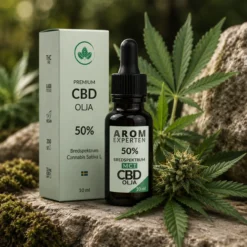
What Does the Percentage in CBD Oil Mean?
Compare 10%, 25%, and 50%, as well as the difference between concentration, bottle volume, and total declared amount.
CBD products from Aromexperten are collected on this category page. The range includes CBD oil blends with different declared concentrations as well as technical hemp flowers, often called CBD buds. On each product page you’ll find information on contents, volume, raw material type, product specifications, and available documentation.
Start by choosing a product category, or compare the options directly in the product list below. More in-depth information about CBD isolate, concentrations, and lab analyses is further down the page.
✓ Fast delivery ✓ Secure payment ✓ Swedish company
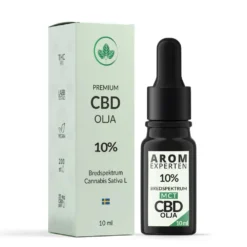
CBD oil in 10 %, 25 % and 50 %
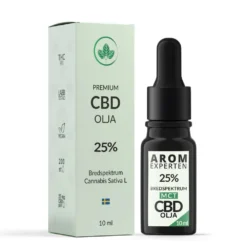
CBD oil in 10 %, 25 % and 50 %

CBD oil in 10 %, 25 % and 50 %
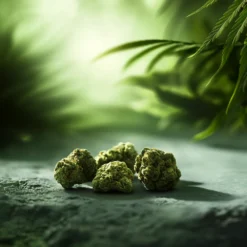
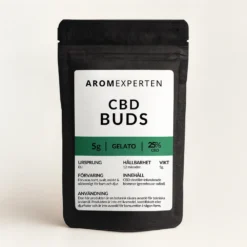
CBD Buds
CBD is short for cannabidiol, a cannabinoid that occurs naturally in Cannabis sativa. However, a finished CBD product can be made from different types of raw materials and have different technical properties.
For an overall scientific description, you can read the WHO report on cannabidiol.
At the same time, Aromexperten’s collection category includes both oil blends and hemp flowers. Therefore, you should compare product form, ingredients, declared concentration, volume, and available analysis information before choosing an option.
| Product form | Description | Important to compare |
|---|---|---|
| CBD oil blend | CBD raw material blended with a carrier oil, for example MCT coconut oil | Concentration, total declared amount, bottle volume, and ingredients |
| CBD buds | Dried botanical plant material from hemp | Product specification, plant profile, storage, and stated intended use |
| CBD isolate | Highly purified raw material consisting mainly of cannabidiol | Purity, cannabinoid profile, and which sample the analysis applies to |
For the oil blends, the product specifications state CBD isolate and MCT coconut oil. The products come in 10 ml bottles with declared concentrations of 10%, 25%, and 50%.
In addition, according to the product specifications, the options correspond to a declared total amount of 1000 mg, 2500 mg, and 5000 mg CBD per bottle, respectively. The percentage describes the concentration, but it is not a standalone measure of quality.
Therefore, also compare ingredients, bottle volume, raw material type, and the documentation available for the product.
Also read the guide onwhat the percentage in CBD oil means.
Furthermore, CBD buds is a common commercial term for dried hemp flowers. Unlike a purified CBD isolate, the product consists of botanical plant material with several natural constituents.
Because the plant material and batch can differ, the product’s profile can also vary. Therefore, always read the product-specific information on contents, documentation, storage, and stated intended use.
On each product page, Aromexperten presents its buds for the technical and aromatic intended use stated on that product page. The category text provides no advice on consumption or inhalation.
Unlike botanical plant material, a CBD isolate consists mainly of highly purified cannabidiol. Broad-spectrum is commonly used for extracts that contain multiple cannabinoids or other plant compounds, while full-spectrum typically describes a broader botanical extract.
However, not all companies use the terms in the same way. Therefore, the product designation should match the actual cannabinoid profile and available documentation.
In Aromexperten’s published lab report, the laboratory analyzed a CBD isolate. Products consisting of this isolate and MCT coconut oil should therefore be described as isolate-based oil blends, unless separate documentation shows a different raw material profile.
Read the full comparison betweenCBD isolate, broad-spectrum, and full-spectrum.
In addition, a certificate of analysis, often called a COA, shows what a laboratory has examined in an identified sample. The document may report cannabinoids, analysis method, analysis date, reporting limits, and the sample’s identity.
Above all, you should check whether the certificate applies to the raw material or the finished product. A certificate for CBD isolate describes the isolate’s cannabinoid profile, but it does not automatically verify the concentration in a finished oil blend.
In the available raw material report, the laboratory states 99.37% CBD in the analyzed isolate sample. The report also states that delta-9-THC, delta-8-THC, and total THC are below the laboratory’s quantification limit of 0.05% by weight in this specific raw material sample.
Open the certificate of analysis for the CBD isolate raw material
Also read our guide on how to review a CBD certificate of analysis.
First, choose the product form that suits the technical or aromatic intended use the product is intended for. Then compare the product-specific details.
Finally, the product name alone doesn’t give the full picture. Exact specifications and relevant documentation make the comparison clearer.
Compare 10%, 25%, and 50%, as well as the difference between concentration, bottle volume, and total declared amount.
Read about differences in cannabinoid profile, raw material type, and which documentation should support the product name.
Understand cannabinoid profile, LOD, LOQ, batch number, and the difference between raw material analysis and finished product.
The category includes oil blends with different declared concentrations as well as technical hemp flowers, often called CBD buds.
The product pages state CBD isolate and MCT coconut oil. Always check the ingredient list on the relevant product page.
The different percentages describe declared concentrations. The product pages also state the total declared amount and the bottle’s volume.
The currently available certificate of analysis applies to CBD isolate. Therefore, the oil blends should be described as isolate-based, unless a separate analysis shows a broad-spectrum profile.
No, not automatically. The raw material certificate describes the analyzed isolate sample and does not, on its own, verify the concentration of the finished blended oil.
No. The category text describes product forms, specifications, and documentation without providing consumption, dosage, or medical advice.


 Best Sellers