


 Svenska

 News
 Botanical Blends
 Mitragyna
 Kanna (sceletium tortuosum)
 Akuamma (Picralima nitida)
 Tongkat Ali (Eurycoma longifolia)
 Blue Lotus (Nymphaea caerulea)
 Sakae Naa
 Wild Lettuce (Lactuca virosa)
 Damiana (turnera diffusa)
 Zornia latifolia (Maconha Brava)
 CBD products
 Mushroom Extracts
 Aromatherapy
Mushroom Extracts
Mushroom Extracts
Mushroom extracts differ from ordinary dried mushroom powder in that the producer uses a separate extraction process. At Aromexperten, we therefore focus on botanical mushroom raw materials with a clearly documented origin, a defined part of the mushroom, specified analytical parameters and transparent information about how the extracts are made.
The range currently includes Lion’s Mane (Hericium erinaceus) and Chaga (Inonotus obliquus). Both raw materials go through a documented process at KÄÄPÄ Biotech involving cell processing, water extraction and freeze-drying. At the same time, they differ clearly in terms of mushroom structure, geographical origin and chemical analytical markers.
Clear information about the species and which part of the mushroom is used.
KÄÄPÄ Biotech uses purified water during the extraction process.
The specifications state minimum values for selected raw material parameters.
KÄÄPÄ Biotech carries out extraction, freeze-drying and quality control in Finland.
What is a mushroom extract?
An ordinary mushroom powder is normally made by drying and milling mushroom material. A mushroom extract, on the other hand, undergoes further processing in which the producer uses a separate extraction process.
The cell walls of mushrooms contain, among other things, chitin and complex polysaccharide structures. That is why extraction and physical cell processing can create a different type of raw material than finely milled mushroom alone.
In other words, the word “powder” mainly describes the physical form of the product, while the term “extract” also tells you something about how the producer has processed the raw material.
| Product form | Processing | Description |
|---|---|---|
| Dried mushroom raw material | The producer dries the material | Mushroom raw material with relatively limited further processing |
| Mushroom powder | The producer dries and mills the mushroom | Finely divided mushroom raw material |
| Mushroom extract | The producer carries out an extraction process | The raw material is processed further beyond milling |
| Water-extracted extract | Cell processing, water extraction and freeze-drying | Processed extract powder with specified analytical parameters |
The part of the mushroom matters
The term mushroom extract does not automatically tell you which part of the mushroom the producer uses. That is why the botanical and mycological identity of the raw material plays an important role when comparing different products.
In addition, different parts of a mushroom can have different chemical profiles. A clear product description should therefore state whether the raw material comes from, for example, the fruiting body, the mycelium or another mushroom structure.
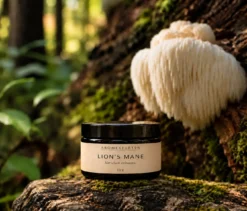
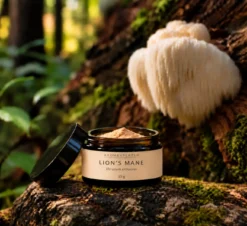
LION’S MANE
Hericium erinaceus
The Lion’s Mane extract consists of 100% fruiting body.
The manufacturer does not state any mycelium as raw material.
- ≥18% 1,3:1,6-beta-glucans
- ≥0.05% total hericenones/hericenes
- EU organic raw material
- Water-extracted
- Manufactured in Finland
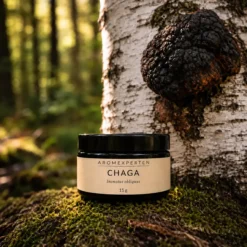
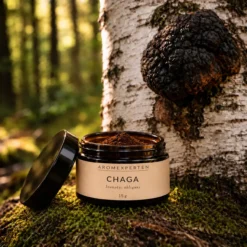
CHAGA
Inonotus obliquus
The Chaga extract consists of 100% Chaga conk.
The characteristic Chaga conk is not the actual fruiting body of the mushroom.
- ≥5% 1,3:1,6-beta-glucans
- ≥0.6% inotodiol
- ≥0.05% betulinic acid
- Organic raw material from Finnish forests
- Water-extracted and manufactured in Finland
Fruiting body, mycelium and Chaga conk
Different parts of a mushroom can have a different chemical composition. For example, the Lion’s Mane raw material in the range consists exclusively of fruiting bodies of Hericium erinaceus.
Chaga, on the other hand, requires different terminology. The black structure normally called Chaga is a sterile conk or sclerotium-like mushroom structure formed by Inonotus obliquus.
That is why the Chaga conk should not be described as an ordinary fruiting body. Instead, the product information needs to use a term that better describes the raw material in question.
Taken together, information about the part of the mushroom provides considerably more knowledge about the identity of the raw material than the species name alone.
How are the mushroom extracts made?
KÄÄPÄ Biotech processes the mushroom raw materials using a process that combines physical cell processing with water extraction and subsequent freeze-drying.
First, the producer dries the mushroom raw material. This is followed by cell-disrupting milling and water extraction. Finally, the producer freeze-dries and finely divides the extract before third-party laboratories carry out quality controls.
Drying
Cell-disrupting milling
Water extraction
Freeze-drying
Milling
Third-party testing
In other words, the products are not simply a matter of the producer milling dried mushroom into powder. Instead, the raw material goes through a defined extraction and processing method.
Why are beta-glucans of interest in raw material analysis?
Beta-glucans are polysaccharides that occur naturally in the cell walls of mushrooms. Laboratories can, for example, use specific analytical methods to determine the content of certain beta-glucan structures in a raw material.
At the same time, it is important to distinguish beta-glucans from the broader term polysaccharides. A general polysaccharide value does not automatically tell you how much of the content consists of beta-glucans.
The Lion’s Mane extract has a specified minimum content of 18% 1,3:1,6-beta-glucans. For Chaga, the corresponding specification states at least 5%.
However, the percentages should not be used as a simple measure of which mushroom raw material is “strongest”. Lion’s Mane and Chaga are different species with different raw material profiles and different analytical markers.
Consequently, each raw material needs to be assessed on the basis of its own documentation rather than by comparing a single percentage.
More than just beta-glucans
Different mushrooms can be characterised by different chemical markers. That is why the same analytical package is not necessarily used for all mushroom raw materials.
For Lion’s Mane, for example, the raw material specification states a minimum content of total hericenones/hericenes.
For Chaga, the specification also uses inotodiol and betulinic acid as defined parameters.
In this way, the chemical profile of the raw materials can be described more precisely than with a general statement that refers only to mushroom powder.
Analytical markers are not measures of effect. The values describe chemical properties of the raw material and should not be interpreted as a measure of physiological effect or medicinal action.
How do we assess the quality of mushroom extracts?
A high extraction ratio or a marketing name says relatively little about quality on its own. Instead, several types of documentation need to be weighed together when assessing a mushroom raw material.
- correct scientific species name
- clearly stated part of the mushroom
- geographical origin of the raw material
- extraction method
- which extraction liquid the producer uses
- specified analytical markers
- relevant laboratory method
- microbiological control
- heavy metal specification
- traceability and manufacturing information
In addition, a distinction should be made between a general raw material specification and an individual batch result. The specification states the limits the raw material must meet, while a batch-specific certificate of analysis shows results from a particular delivery.
That is why the product information for the mushroom extracts is based on documented raw material specifications rather than general assumptions about each mushroom species.
Mushroom extracts with clear documentation
Our current range consists of two documented mushroom extracts: Lion’s Mane and Chaga.
Lion’s Mane offers a clearly defined Hericium erinaceus raw material from 100% fruiting body. Chaga, by contrast, consists of a Finnish Inonotus obliquus raw material from organically certified forests.
What they have in common is water extraction, freeze-drying, manufacturing at KÄÄPÄ Biotech in Finland and defined quality parameters.
At the same time, each mushroom keeps its own raw material profile and its own relevant analytical markers.
The range may be expanded with more mushroom extracts in the future when we find raw materials that meet the same requirements for identity, documentation and analysis.
In this way, the category can grow without compromising on the basic principle of transparent product information.
Product classification: The products in this category are presented as botanical mushroom raw materials for technical and raw material purposes. Aromexperten does not sell them as food or food supplements, and the products are not intended for consumption.
Documentation
The product information for Lion’s Mane and Chaga is based on the respective raw material specifications from KÄÄPÄ Biotech / Nordic Mushrooms. In addition, the individual product pages contain more detailed information about the raw material, analytical parameters and the respective specification documents.
 Best Sellers
