Svenska
 News
News Botanical Blends
 Mitragyna
 Kanna (sceletium tortuosum)
 Akuamma (Picralima nitida)
 Tongkat Ali (Eurycoma longifolia)
 Blue Lotus (Nymphaea caerulea)
 Sakae Naa
 Wild Lettuce (Lactuca virosa)
 Damiana (turnera diffusa)
 Zornia latifolia (Maconha Brava)
 CBD products
 Aromatherapy
Botanicals
CBD Oil 10%, 25%, or 50% – What Does the Percentage Mean?
Jul
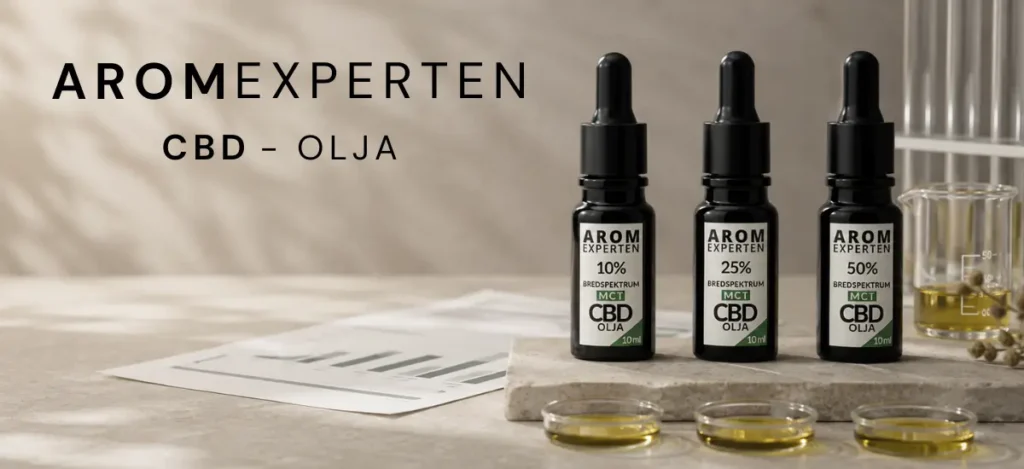
CBD oil percentage describes the declared concentration of CBD in a product. In Aromexperten’s 10 ml bottles, the product specifications correspond to 1000 mg CBD for 10%, 2500 mg for 25%, and 5000 mg for 50%. However, the percentage alone does not indicate how a product is manufactured or documented.
In this guide, we compare the concentrations without providing dosage or consumption advice. Additionally, we explain the difference between percentage, total amount of CBD, raw material analysis, and analysis of the finished product.
Quick Comparison
| Concentration | Bottle Volume | Declared Amount of CBD | Raw Material Type |
|---|---|---|---|
| 10% | 10 ml | 1000 mg | CBD isolate in MCT coconut oil |
| 25% | 10 ml | 2500 mg | CBD isolate in MCT coconut oil |
| 50% | 10 ml | 5000 mg | CBD isolate in MCT coconut oil |
The information follows the declared specification of each product. At the same time, the table is not a dosage instruction and does not describe medical use.
Contents
What Does the Percentage in CBD Oil Mean?
First, the percentage indicates how concentrated the product is according to the manufacturer’s or seller’s specification. A product labeled 10% therefore has a lower declared concentration than a product labeled 25% or 50%.
At the same time, the percentage does not tell the whole story about the product’s quality. For example, it does not automatically indicate which type of CBD raw material has been used, how the raw material has been analyzed, or whether the laboratory document applies to the finished blend.
For this reason, the percentage should always be read together with the bottle’s volume, the declared total amount, the ingredient list, and available documentation.
The Difference Between Percentage and Milligrams
Percentage and milligrams describe related but different information. The percentage indicates the concentration, while the milligram figure indicates the declared amount of CBD in the entire package.
More specifically, the following is stated for Aromexperten’s 10 ml bottles:
- 10%: 1000 mg CBD per bottle according to product specification.
- 25%: 2500 mg CBD per bottle according to product specification.
- 50%: 5000 mg CBD per bottle according to product specification.
However, the same percentage can yield a different total amount if the bottle’s volume changes. Therefore, it is not sufficient to compare the percentage alone when two products have different package sizes.
Why Should You Check Both Figures?
Two products can have the same concentration but different volumes. In that case, the larger package normally contains a larger declared total amount.
Conversely, two equally sized bottles can contain different total amounts when the concentrations differ. Overall, the combination of percentage, volume, and total amount therefore provides a clearer product description than any of the figures individually.
Comparison: CBD Oil 10%, 25%, and 50%
| Variant | Volume | Declared Amount | Product |
|---|---|---|---|
| 10% | 10 ml | 1000 mg CBD | View 10% variant |
| 25% | 10 ml | 2500 mg CBD | View 25% variant |
| 50% | 10 ml | 5000 mg CBD | View 50% variant |
CBD Oil 10%
To begin with, the product with 10% has a declared amount of 1000 mg CBD in 10 ml. According to the product specification, it consists of CBD isolate and MCT coconut oil.
CBD Oil 25%
Next, the product with 25% has a declared amount of 2500 mg CBD in 10 ml. This variant also consists of CBD isolate and MCT coconut oil according to the product specification.
CBD Oil 50%
Finally, the product with 50% has a declared amount of 5000 mg CBD in 10 ml. This is the highest declared concentration among the three compared products.
For a complete overview, you can find all options in Aromexperten’s CBD range.
What Is CBD Isolate?
CBD isolate is a purified raw material consisting primarily of cannabidiol. Aromexperten’s available raw material certificate reports 99.37% CBD in the analyzed isolate sample. Additionally, smaller amounts of CBDV and CBDB are reported.
An isolate differs from a broad-spectrum extract. Broad-spectrum is normally used for extracts where several cannabinoids occur in measurable amounts. In contrast, an isolate consists primarily of CBD.
Important terminology: if a product consists of CBD isolate and MCT oil, the designation “CBD isolate in MCT oil” is more precise than “broad-spectrum.”
What Is MCT Coconut Oil?
MCT oil serves here as a carrier oil. It gives the product its liquid form and makes it possible to blend the declared amount of CBD raw material in a defined product volume.
The abbreviation MCT stands for medium-chain triglycerides. Additionally, the product description should indicate that the oil is sourced from coconut, particularly for individuals who wish to verify ingredients and raw material origin.
However, the carrier oil alone does not indicate anything about the product’s cannabinoid content. Instead, that information must be supported by product specification and, when available, analysis of the finished blend.
Is a Higher CBD Percentage the Same as Higher Quality?
No. A higher percentage only means that the product has a higher declared concentration. However, quality must be assessed based on several factors simultaneously.
Therefore, it is advisable to check, among other things:
- that the product name and ingredient list describe the same raw material type
- that percentage and total amount are consistent throughout the page
- that the product volume is clearly stated
- that the certificate of analysis can be linked to the correct raw material or product batch
- that the laboratory’s method, date, and reporting limits are indicated
- that storage information is clear
- that the product’s intended use is stated without contradictions
Additionally, it should be clear whether the analysis applies to the raw material or the finished blended product. This is an important distinction because a raw material certificate does not automatically verify the declared concentration of the final product.
How to Interpret the Certificate of Analysis
A certificate of analysis is often called a COA, which stands for Certificate of Analysis. The document shows which analyses the laboratory has performed on a specific sample.
The available certificate applies to the CBD isolate raw material. The analysis reports 99.37% CBD. At the same time, delta-9-THC, delta-8-THC, and total THC are reported below the laboratory’s limit of quantification of 0.05% by weight.
Below the limit of quantification does not necessarily mean absolute zero. It means that the laboratory has not been able to quantify a content above the stated reporting limit.
The certificate does not apply to the finished blended oil. Therefore, the document should be presented as a raw material certificate and not as a batch-specific certificate for the final products. In this way, it becomes clear what the laboratory analysis actually verifies.
View the certificate of analysis for the CBD isolate raw material
What Should a Certificate for the Final Product Show?
A separate certificate for the finished product should ideally identify the relevant batch and report the measured CBD content in the blend itself.
Furthermore, the documentation may, depending on the product and quality program, include other cannabinoids and relevant purity parameters.
Regulations and Intended Use
The regulations for CBD products in Sweden depend on, among other things, the product’s composition, product form, intended use, and marketing. Therefore, product texts should avoid medical claims, dosage advice, and general statements that all CBD products are covered by the same regulatory framework.
The Swedish Medical Products Agency describes how cannabidiol may be covered by pharmaceutical legislation depending on the product’s use and marketing.
At the same time, the Swedish Food Agency publishes information about hemp, cannabinoids, and regulations for food products.
Read current regulatory information from
the Swedish Medical Products Agency on cannabidiol
and
the Swedish Food Agency on hemp and CBD
.
In summary, this article provides general product and analytical information. It is not medical advice, consumption guidance, or a definitive legal assessment.
Frequently Asked Questions About CBD Oil and Percentage
What Does 10% CBD Oil Mean?
In Aromexperten’s 10 ml product, the specification means that the bottle has a declared amount of 1000 mg CBD.
What Does 25% CBD Oil Mean?
For the 10 ml product, the specification corresponds to a declared amount of 2500 mg CBD.
What Does 50% CBD Oil Mean?
In the 50% variant in 10 ml, the specification corresponds to a declared amount of 5000 mg CBD.
Is 50% Higher Quality Than 10%?
Not automatically. The percentage describes the concentration. However, quality also depends on raw material, documentation, traceability, and analytical evidence.
Is CBD Isolate the Same as Broad-Spectrum?
No. An isolate consists primarily of CBD, while a broad-spectrum extract normally contains several cannabinoids in measurable amounts.
Does the Raw Material Certificate Apply to the Finished Oil?
No. The available certificate applies to the CBD isolate raw material. Therefore, it does not verify the concentration in the finished blended final product on its own.
What Does THC Below LOQ Mean?
It means that the laboratory has not quantified THC above the stated reporting limit. Consequently, the information should not automatically be interpreted as a guaranteed absolute zero content.
Summary
CBD percentage describes the product’s declared concentration. For Aromexperten’s 10 ml bottles, 1000 mg is stated for 10%, 2500 mg for 25%, and 5000 mg for 50%.
However, the percentage is not a complete quality measure. Therefore, you should also check volume, ingredients, raw material type, analytical documentation, and batch information.
According to the specifications, the compared products consist of CBD isolate in MCT coconut oil. It is also important that the available laboratory document applies to the isolate raw material and not the finished blended oil.
Compare CBD Products
View declared concentration, amount, ingredients, and available raw material documentation for each product.
Sources and Further Reading
-
Certificate of Analysis for CBD Isolate Raw Material
-
Swedish Medical Products Agency – Cannabidiol, CBD
-
Swedish Food Agency – Hemp, Cannabis sativa
-
European Commission – Novel Food Status Catalogue
Last fact-checked:

 Best Sellers