Svenska
 News
News Botanical Blends
 Mitragyna
 Kanna (sceletium tortuosum)
 Akuamma (Picralima nitida)
 Tongkat Ali (Eurycoma longifolia)
 Blue Lotus (Nymphaea caerulea)
 Sakae Naa
 Wild Lettuce (Lactuca virosa)
 Damiana (turnera diffusa)
 Zornia latifolia (Maconha Brava)
 CBD products
 Aromatherapy
Botanicals
Broad-spectrum CBD, full-spectrum, and CBD isolate – what is the difference?
Jul
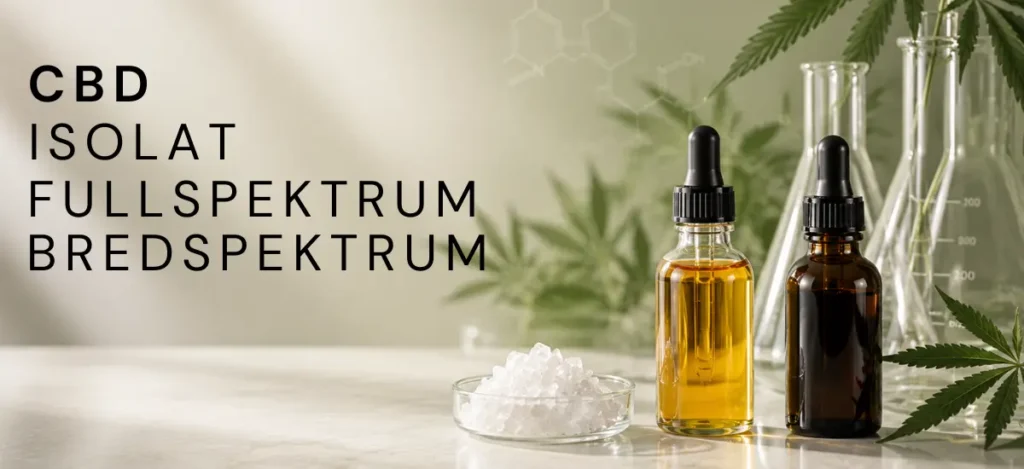
Companies use broad-spectrum CBD, full-spectrum, and CBD isolate as designations for different types of cannabinoid raw materials and extracts. An isolate consists primarily of purified cannabidiol, while spectrum extracts normally contain several substances from the plant. However, these designations are not sufficient to prove the actual content of the product – that requires relevant laboratory data.
In this guide, we examine how the product forms differ chemically, what a cannabinoid profile shows, and why the label, ingredient list, and certificate of analysis need to correspond. Furthermore, the article describes product chemistry and documentation without providing advice on dosage, consumption, or medicinal use.
Quick Comparison
| Product form | Composition | THC | What should be verified? |
|---|---|---|---|
| CBD isolate | Primarily purified CBD | Assess against analysis results and reporting limit | Purity, identity, and any other cannabinoids |
| Broad-spectrum | CBD and several other plant substances or cannabinoids | The producer usually removes or reduces THC | Cannabinoid profile and actual THC level |
| Full-spectrum | A broader selection of the plant’s natural constituents | THC may be present and needs to be quantified | Full cannabinoid profile, concentration, and relevant documentation |
Companies use these terms commercially, but not all manufacturers define them in exactly the same way. Therefore, laboratory data provides a more reliable picture than the designation alone.
Contents
What Is CBD Isolate?
To begin with, CBD isolate consists primarily of highly purified cannabidiol. Cannabidiol is a cannabinoid that occurs naturally in Cannabis sativa. The WHO scientific review describes CBD as a chemical compound with the molecular formula C21H30O2.
In the next step, the producer separates and purifies CBD from a plant extract. For example, the producer may use chromatographic methods to separate CBD from other cannabinoids.
A scientific study shows how researchers have used centrifugal partition chromatography to isolate CBD and CBDA from plant material.
Consequently, an isolate should not be described as a broad plant extract. At the same time, an actual raw material sample may contain small amounts of closely related substances. Therefore, the laboratory measures the purity and reports which other cannabinoids are present in the sample.
Read more in the WHO Critical Review of Cannabidiol and in the openly published study on chromatographic isolation of CBD and CBDA.
What is broad-spectrum CBD?
Companies usually use broad-spectrum CBD as a designation for an extract where the producer retains several cannabinoids or other plant substances but removes or reduces THC.
Unlike an isolate, such an extract should normally show more than a single dominant cannabinoid in the analysis.
At the same time, there is no completely uniform international definition that all producers and retailers follow. Therefore, two products with the same designation can have different cannabinoid profiles.
For example, one product may contain several minor cannabinoids, while the other in practice consists almost entirely of CBD.
In a 2024 study, researchers analyzed commercial CBD products with labels such as “full spectrum”, “broad spectrum”, and “CBD isolate”. The researchers compared the product claims with laboratory results and found that the labeling did not always correspond to the measured composition.
Important principle: relevant product-specific analytical documentation should support the designation on the label.
Read the study on labeling accuracy and contamination in commercial CBD products.
What is full-spectrum?
Companies use full-spectrum for extracts where the producer attempts to retain a broader selection of the plant’s original constituents.
This may, for example, include CBD, minor cannabinoids, terpenes, and other substances that the extraction process carries over from the plant material.
Unlike broad-spectrum, full-spectrum products may also contain measurable amounts of THC. However, the exact content varies with the raw material, extraction method, and subsequent purification.
For that reason, each product needs to be assessed based on its own analysis and the documentation applicable to the relevant market.
A scientific article on the difference between botanical full-spectrum extracts and CBD isolates also describes plant extracts as complex mixtures, while isolates consist of a highly purified individual constituent.
Read the scientific review Differentiating Full-Spectrum Hemp Extracts from CBD Isolates.
Comparison between CBD isolate, broad-spectrum, and full-spectrum
| Property | CBD isolate | Broad-spectrum | Full-spectrum |
|---|---|---|---|
| Main raw material type | Purified individual cannabinoid | Processed extract with multiple substances | Broader botanical extract |
| CBD | Dominant and often very high concentration | Usually dominant | Can be dominant depending on the raw material |
| Minor cannabinoids | Usually very low or not quantified | Normally expected in measurable amounts | Normally expected in a broader profile |
| THC | Checked against LOD or LOQ | Usually removed or reduced | May remain |
| Important documentation | Purity and identity | Multi-substance profile and THC results | Full profile, THC concentration, and batch data |
Overall, the table describes typical differences. However, the laboratory result determines how a specific product should be described. Therefore, a name on the label cannot replace an actual analysis.
What does a cannabinoid profile show in broad-spectrum CBD?
A cannabinoid profile shows which cannabinoids the laboratory has examined and what concentrations are present in the analyzed sample.
Common analytes may include, for example, CBD, CBDA, CBDV, CBG, CBGA, CBN, delta-9-THC, delta-8-THC, and THCA.
Above all, the profile is important when a product is marketed as broad- or full-spectrum. To support the designation, the analysis should show the composition that the product name implies.
If almost the entire cannabinoid content consists of CBD and other substances are below the reporting limit, the profile instead resembles an isolate.
Laboratories often use liquid chromatography to separate and measure cannabinoids. AOAC International has, for example, approved an LC-DAD method for the quantification of cannabinoids in plant materials, concentrates, and oils.
At the same time, sample preparation, calibration, reference standards, and reporting limits affect how the laboratory can interpret the result.
Read more about the AOAC official method of analysis for cannabinoids in hemp.
What do LOD and LOQ mean?
Firstly, LOD means limit of detection. It describes the lowest level at which the laboratory can distinguish an analyte’s signal from background noise with sufficient certainty.
Secondly, LOQ means limit of quantification. It describes the lowest level at which the laboratory can state a quantity with sufficiently good precision and accuracy.
Below LOQ does not automatically mean absolute zero. It means that the laboratory has not been able to quantify the substance above the specified limit.
Because of this, the phrasing “not quantified above LOQ” is more precise than a categorical statement that a product is completely free of the substance.
Eurachem publishes internationally used guidance on method validation, detection limits, and quantification limits. Read the Eurachem guide to the validation of analytical methods.
How to check a COA for CBD
COA stands for Certificate of Analysis. A useful certificate should clearly show which sample the laboratory analyzed, which method was used, and which results were reported.
Check the following in particular:
- sample name or product name
- batch number or other sample identification
- analysis date
- laboratory name
- analysis method
- analyzed cannabinoids
- units of results
- LOD and LOQ
- whether the certificate applies to the raw material or the finished product
The last point is especially important. A certificate for pure CBD isolate shows the composition of the isolate, but it does not automatically verify the concentration in a finished oil blend.
When product labeling and analysis do not match
Several studies show that commercial cannabinoid products sometimes deviate from the declared concentration or the label description.
For example, a systematic research review identified labeling discrepancies and contaminants in cannabinoid products in regulated markets.
Furthermore, researchers have analyzed commercial products and compared both potency claims and the categories of isolate, broad-spectrum, and full-spectrum.
Against that background, it is better to support the product category with analytical control when the composition is important for the product description.
Read the systematic review on cannabinoid product labeling accuracy.
Aromexperten’s CBD raw material and product descriptions
Aromexperten’s published certificate of analysis applies to a CBD isolate. The laboratory reports 99.37% CBD in the raw material sample. In addition, the analysis reports 0.36% CBDV and 0.17% CBDB.
At the same time, the document shows delta-9-THC, delta-8-THC, and total THC below the laboratory’s quantification limit of 0.05 percent by weight.
However, the certificate applies to the isolate raw material and not the pre-mixed oil.
Terminology: if a product consists of this isolate and MCT coconut oil, the designation “CBD isolate in MCT oil” is more precise, unless a separate analytical basis shows that an actual broad-spectrum extract is also included.
See the certificate of analysis for the CBD isolate raw material.
For a more practical comparison, you can read our guide on how 10%, 25%, and 50% differ or compare the products in the entire CBD range.
Frequently asked questions about broad-spectrum CBD, full-spectrum, and isolate
Is CBD isolate the same thing as broad-spectrum CBD?
No. An isolate consists primarily of purified CBD, while a broad-spectrum extract normally contains several cannabinoids or other plant substances.
What is the difference between broad-spectrum and full-spectrum?
Both are more complex than an isolate. Companies usually use broad-spectrum for extracts where the producer has removed or reduced THC. In contrast, full-spectrum may contain measurable amounts of THC.
Are the designations legally standardized?
Not in a completely uniform way for all product categories and markets. Therefore, the product name needs to be supported by analysis results and correct labeling.
Can an isolate contain small amounts of other cannabinoids?
Yes. An actual raw material sample may contain minor amounts of closely related substances. The laboratory analysis shows which substances can be quantified in the sample.
Does the text “THC-free” prove that the concentration is zero?
No. Instead, one should check the certificate of analysis. A result below LOD or LOQ does not prove an absolute zero concentration.
Can a raw material COA be used for the finished oil?
The document can describe the raw material used. However, it does not automatically verify the concentration or complete composition of the finished oil.
Summary: broad-spectrum CBD, full-spectrum, and isolate
In summary, CBD isolate consists primarily of purified cannabidiol. Companies normally use broad-spectrum CBD for extracts with several cannabinoids where the producer has removed or reduced THC.
Full-spectrum instead describes a broader botanical extract that may contain THC.
At the same time, the market does not always use these designations consistently. Therefore, a clear cannabinoid profile, correct sample identification, and relevant reporting limits provide more information than the product name alone.
Aromexperten’s available certificate applies to a CBD isolate with 99.37% reported CBD. Consequently, the document should be presented as a raw material certificate for isolate and not as proof of a broad-spectrum profile or for the final concentration of the pre-mixed oil.
Compare CBD product specifications
See declared concentration, ingredients, raw material type, and available analysis information for each option.
Sources and Further Reading
-
World Health Organization – Cannabidiol (CBD): Critical Review Report
-
Marinotti & Sarill – Differentiating Full-Spectrum Hemp Extracts from CBD Isolates
-
Gidal et al. – Product labeling accuracy and contamination analysis
-
Systematic review of labeling accuracy for cannabinoid products
-
Scientific study on chromatographic isolation of CBD and CBDA
-
AOAC International – Official Method of Analysis for cannabinoids in hemp
-
Eurachem – The Fitness for Purpose of Analytical Methods
-
Aromexperten – certificate of analysis for the CBD isolate raw material
Last fact-checked:

 Best Sellers