Svenska
 News
News Botanical Blends
 Mitragyna
 Kanna (sceletium tortuosum)
 Akuamma (Picralima nitida)
 Tongkat Ali (Eurycoma longifolia)
 Blue Lotus (Nymphaea caerulea)
 Sakae Naa
 Wild Lettuce (Lactuca virosa)
 Damiana (turnera diffusa)
 Zornia latifolia (Maconha Brava)
 CBD products
 Aromatherapy
Botanicals
CBD Certificate of Analysis: How to Read a COA for CBD Oil
Jul
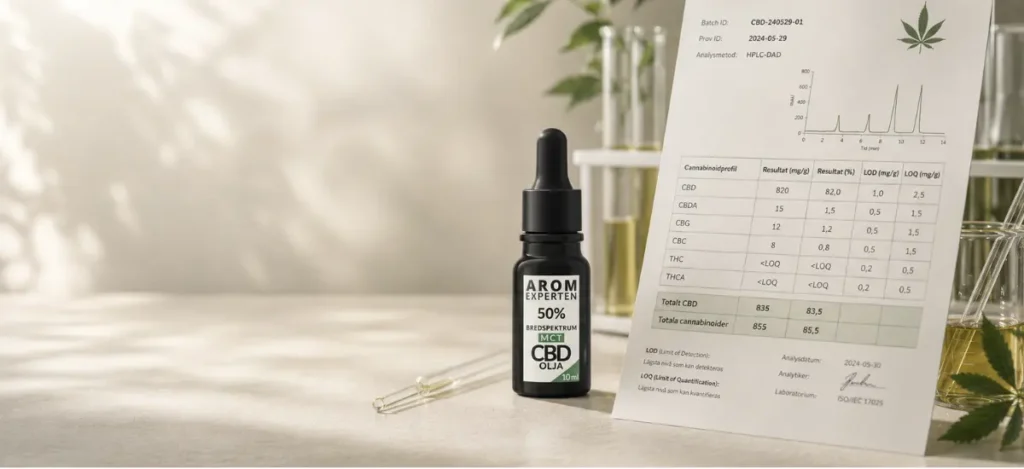
CBD Certificates of Analysis, often called COAs, show what a laboratory has examined in a specific sample. The document can report cannabinoids, analysis methods, reporting limits, and the identity of the sample. Subsequently, you need to check whether the certificate applies to the raw material or the finished product to interpret the results correctly.
In this guide, we go through the most important parts of a COA. Furthermore, we explain how to read CBD content, THC results, LOD, LOQ, batch numbers, and analysis dates without confusing laboratory data with product claims.
Quick Facts About COAs
| Abbreviation | COA, Certificate of Analysis |
|---|---|
| Main Purpose | Report analysis results for an identified sample |
| Key Identification | Sample name, batch number, or laboratory sample number |
| Common Analysis | Cannabinoid profile including, for example, CBD and THC |
| LOD | Limit of Detection |
| LOQ | Limit of Quantification |
| Critical Check | Whether the certificate applies to the raw material or the finished product |
Contents
- What is a COA?
- Verify the Sample Identity
- What Does the Batch Number Show?
- How to Read the Cannabinoid Profile
- Understanding Percentages, mg/g, and mg/ml
- What Do LOD and LOQ Mean?
- How to Interpret the THC Result
- Check the Analysis Method
- Raw Material COA or Finished Product?
- What Other Analyses Might Be Needed?
- Aromexperten’s Raw Material Certificates
- Practical Checklist
- Frequently asked questions
What is a CBD Certificate of Analysis?
COA stands for Certificate of Analysis. In Swedish, the term ‘analyscertifikat’ or ‘CBD-analyscertifikat’ is often used when the sample concerns a CBD raw material or product.
The laboratory uses the document to report the results from an identified sample. For example, the certificate can show which cannabinoids the laboratory has measured and in what quantities.
Furthermore, the document may contain information regarding the analysis date, method, sample number, and reporting limits.
A COA, however, only shows the parameters that the laboratory has actually investigated. Therefore, you should not interpret a cannabinoid analysis as proof that the product has also been tested for, for example, heavy metals, microorganisms, or pesticide residues.
In short: a COA describes the laboratory results for the sample identified by the document – not automatically all properties of the product.
Verify the Sample in Your CBD Certificate of Analysis
Start by verifying the identity of the sample. Look for the sample name, product name, laboratory sample number, and any batch code.
Together, these details show which material the laboratory actually received and analyzed.
Next, you should compare the certificate’s details with the label and the product page. If the certificate specifies “CBD isolate,” for example, but the product page describes a finished oil blend, the analysis likely applies to the raw material and not the oil in the bottle.
Also check who submitted the sample. A laboratory analyzes the material provided, but the analysis does not automatically confirm the entire production chain or that subsequent production batches have the same composition.
What Do Batch Numbers and Sample Numbers Show?
A batch number identifies a specific production run. In this way, the manufacturer can link raw material, production, and documentation to the same series of products.
The laboratory may also create its own sample number. This number identifies the analysis assignment in the laboratory’s system but does not necessarily replace the manufacturer’s batch number.
For best traceability, the certificate and the product label should share a clear identifier. If the link is missing, it becomes harder to determine if the analysis applies to the goods actually in stock.
Is an Old COA Still Relevant?
An older certificate may describe a previous raw material delivery or production run. However, the document does not automatically verify a new batch.
Therefore, the seller should clearly state which certificate belongs to the current raw material or product.
How to Read the Cannabinoid Profile in a CBD Certificate of Analysis
The cannabinoid profile lists the substances the laboratory has searched for. Common analytes can include, for example, CBD, CBDA, CBDV, CBG, CBGA, CBN, delta-9-THC, delta-8-THC, and THCA.
First, you should read each line separately. The result may be shown as a numerical value, “not detected,” “under LOD,” or “under LOQ.”
Subsequently, you need to read the laboratory’s explanations and method notes to understand exactly what the designations mean.
For a CBD isolate, a very high CBD content and low levels of other cannabinoids are normally expected. A spectrum extract, on the other hand, should show a broader profile if the product name suggests that several cannabinoids remain.
A 2024 study analyzed 202 commercial CBD products and reported discrepancies between product category, declared content, and measured composition. Therefore, the laboratory result is more important than the product name alone.
Read the scientific study on
labeling and laboratory content in commercial CBD products
.
Understanding Percentage by Weight, mg/g, and mg/ml
Laboratories can report cannabinoids in several different units. Therefore, you must read both the figure and the unit before comparing two results.
Percentage by Weight
Percentage by weight, often written as % w/w, describes how much of the sample’s weight consists of the substance.
A result of 99% CBD in an isolate does not, therefore, mean that a finished oil automatically contains 99% CBD.
Milligrams per Gram
Mg/g indicates the amount of substance per gram of sample. Laboratories often use this unit for solid raw materials, extracts, and concentrates.
Milligrams per Milliliter
Mg/ml describes the amount of substance per milliliter of liquid and can therefore be relevant for finished oil blends.
However, it is not always possible to convert directly between percentage by weight and mg/ml without information about the density of the mixture.
Important: do not compare a raw material analysis in percentage by weight with a product declaration in milligrams per bottle as if the figures describe the same thing.
What Do LOD and LOQ Mean in a CBD Certificate of Analysis?
LOD means limit of detection. It describes the lowest level at which the laboratory can distinguish the substance’s signal from background noise.
LOQ means limit of quantification. It describes the lowest level at which the laboratory can state a quantity with sufficient precision and accuracy.
When a result is below LOD, the laboratory cannot detect the substance with the current method above this limit.
If the result is below LOQ, a signal may, however, be below the level where the laboratory can state a sufficiently certain quantity.
Below LOQ does not, therefore, automatically mean absolute zero. The result must always be interpreted together with the laboratory’s reporting limit.
Eurachem’s guidance for method validation describes how laboratories assess, among other things, detection and quantification limits.
How to Interpret the THC Result
First, check which form of THC the laboratory has analyzed. A certificate may, for example, report delta-9-THC, delta-8-THC, THCA, and total THC on separate lines.
Next, you need to compare the result with the reporting limit. The phrases “below LOQ” and “not detected” do not automatically mean the same thing as a guaranteed absolute zero content.
It is therefore better to reproduce the laboratory’s results exactly.
Example of exact wording:
“Delta-9-THC was reported below the laboratory’s quantification limit of 0.05 percentage by weight in the analyzed raw material sample.”
At the same time, a raw material result should not be automatically transferred to a finished product without separate analysis or relevant documentation.
For current Swedish authority information, you can read
The Medical Products Agency’s information on cannabidiol
.
Check Which Analysis Method the Laboratory Used
The analysis method affects which substances the laboratory can separate and measure. For cannabinoids, laboratories often use liquid chromatographic methods, such as HPLC or UPLC.
AOAC International has, for example, approved an LC-DAD method for the analysis of cannabinoids in cannabis plant material, concentrates, and oils.
A validated method should demonstrate sufficient selectivity, precision, and accuracy for its intended use.
At the same time, laboratories may use different sample preparation, instruments, reference standards, and reporting limits. Results from two laboratories may therefore differ even when they analyze similar material.
Read more about
AOAC’s official cannabinoid method for hemp
.
Does the CBD Certificate of Analysis Apply to the Raw Material or the Finished Product?
This question determines how much the certificate can actually substantiate.
A raw material COA describes the material before mixing or manufacturing. A finished product certificate, on the other hand, describes the sample the laboratory took from the finished product.
An isolate certificate can verify the isolate’s purity and cannabinoid profile. However, it does not automatically confirm that a finished bottle contains exactly 1000, 2500, or 5000 mg of CBD.
To verify the content of the finished product, the laboratory needs to analyze the pre-mixed oil. Alternatively, the manufacturer needs to have documentation showing a controlled manufacturing process with correct weighing and homogeneous mixing.
This difference is central because research has repeatedly shown discrepancies between the label and the measured content in commercial CBD products.
Read the
systematic review on the labeling of cannabinoid products
.
What Other Analyses Might Be Needed?
A cannabinoid profile only describes the cannabinoids that the laboratory investigates. Therefore, a broader quality program may require several separate analyses.
Examples of other parameters include:
- heavy metals, such as lead, cadmium, arsenic, and mercury
- pesticide residues
- solvent residues
- microbiological parameters
- mycotoxins
- water content or water activity
- foreign substances and other contaminants
A study of commercial CBD products reported, among other things, heavy metals, solvents, and pesticides in some analyzed samples.
Altogether, this shows why a cannabinoid result alone does not provide a complete picture of the product’s technical quality.
How Aromexperten’s Raw Material Certificates Should Be Described
Aromexperten’s published documents apply to a CBD isolate. The laboratory reports 99.37% CBD in the raw material sample.
Furthermore, the document reports 0.36% CBDV and 0.17% CBDB.
Delta-9-THC, delta-8-THC, and total THC are, according to the report, below the laboratory’s quantification limit of 0.05 percentage by weight.
The certificate, however, does not apply to the pre-mixed oil.
Correct designation: Certificate of Analysis for the CBD isolate raw material.
The document should not be described as a batch certificate for the finished pre-mixed product.
Open the Laboratory Report for the CBD Isolate Raw Material
Read also our guide on the
difference between isolate, broad spectrum, and full spectrum
and the article on
how the concentrations 10%, 25%, and 50% differ.
Checklist for CBD Certificates of Analysis
Please review the document in the following order:
- Identify the sample name, product name, and sample number.
- Check the batch number or other traceable code.
- Look for the analysis date and the laboratory’s name.
- Determine if the sample is a raw material or a finished product.
- Read which cannabinoids the laboratory has analyzed.
- Check both the result and the unit of measurement.
- Note the method’s LOD and LOQ.
- Compare the THC forms and any total THC.
- Check which analysis method the laboratory used.
- See if the document also covers contaminants and other purity parameters.
- Compare the result with the product’s label and description.
Finally, you should avoid conclusions that go further than the analysis. A CBD Certificate of Analysis shows what the laboratory measured in the sample identified by the document – not automatically every product using the same trade name.
Frequently Asked Questions About COAs and CBD Analyses
What does COA mean?
COA stands for Certificate of Analysis. In Swedish, the word ‘analyscertifikat’ is often used.
Is a COA the same thing as a laboratory test?
A COA reports results from one or more laboratory tests that the laboratory has performed on an identified sample.
What does ‘below LOQ’ mean?
It means that the laboratory cannot state a sufficiently certain quantity above the established limit of quantification.
Does “not detected” prove absolute zero content?
No. The phrasing means that the laboratory did not detect the substance above the method’s specified limit of detection.
Must the batch number on the bottle be in the certificate?
A clear link between the product batch and the certificate provides the best traceability. Without such a link, it becomes more difficult to verify that the document applies to the current item.
Can an isolate COA verify a finished oil?
It can verify the isolate raw material. However, it does not automatically confirm the concentration or homogeneity of the finished oil blend.
Does a cannabinoid analysis show that the product is free from heavy metals?
No. The laboratory needs to conduct a separate analysis to report results for heavy metals.
Summary: How to Review a CBD Certificate of Analysis
Start by identifying the sample and checking whether the certificate applies to the raw material or the finished product.
Next, you review the cannabinoid profile, units, analysis method, and reporting limits. In this way, the risk of raw material data being misinterpreted as results for the finished product is reduced.
Below LOD and below LOQ do not automatically mean absolute zero content. Therefore, the product text should reflect the laboratory’s actual results and reporting limit.
A raw material certificate for CBD isolate does not, on its own, verify the concentration of the finished oil blend. Furthermore, a complete quality assessment may require analyses of, for example, heavy metals, solvents, pesticide residues, and microbiological parameters.
Compare CBD Products and Analysis Information
See declared concentration, ingredients, raw material type, and available laboratory documentation for each option.
Sources and Further Reading
-
AOAC International – Official Method of Analysis for cannabinoids in hemp
-
Eurachem – The Fitness for Purpose of Analytical Methods
-
Gidal et al. – Product labeling accuracy and contamination analysis
-
Systematic review of labeling accuracy for cannabinoid products
-
Bonn-Miller et al. – Labeling Accuracy of Cannabidiol Extracts Sold Online
-
Swedish Medical Products Agency – Cannabidiol, CBD
-
Aromexperten – laboratory report for the CBD isolate raw material
Last fact-checked:

 Best Sellers