


 Svenska

 News
 Botanical Blends
 Mitragyna
 Kanna (sceletium tortuosum)
 Akuamma (Picralima nitida)
 Tongkat Ali (Eurycoma longifolia)
 Blue Lotus (Nymphaea caerulea)
 Sakae Naa
 Wild Lettuce (Lactuca virosa)
 Damiana (turnera diffusa)
 Zornia latifolia (Maconha Brava)
 CBD products
 Aromatherapy
Botanicals
What Is Kanna? Origin, Botany and Raw Material Forms
Jul
Kanna is an established name for the South African succulent Sceletium tortuosum. Botanical databases now treat this name as a synonym of Mesembryanthemum tortuosum. The plant is available as crushed plant material, powder, ratio extracts and standardised extracts with a defined total alkaloid content.
Quick facts about Kanna
| Common name | Kanna |
|---|---|
| Common scientific name | Sceletium tortuosum |
| Name accepted by Kew | Mesembryanthemum tortuosum L. |
| Plant family | Aizoaceae |
| Plant type | Succulent subshrub |
| Natural origin | The Cape region of South Africa |
| Plant parts commonly used in raw materials | Aerial parts, such as leaves and stems |
| Common raw material forms | Crushed material, powder, ratio extracts and standardised extracts |
Are Sceletium tortuosum and Mesembryanthemum tortuosum the same plant?
Yes. Sceletium tortuosum is the name that dominates in trade, research and product descriptions. However, the Royal Botanic Gardens, Kew’s Plants of the World Online accepts the name Mesembryanthemum tortuosum L. as the species’ current botanical name.
In addition, Kew treats Sceletium tortuosum as a synonym. A clear article should therefore use both names. This improves botanical precision and makes it easier for readers to recognise the name printed on a product label.
At the same time, the naming question does not in itself affect a product’s quality. A full botanical name does, however, help the buyer check that the raw material comes from the right species and not from an unidentified plant sold under a similar trade name.
Where does Kanna grow naturally?
To begin with, Kanna is native to South Africa. Kew describes the species’ natural range as the Cape region and states that the plant mainly grows in desert and dry shrubland. Kanna is therefore associated with dry, rocky environments and a climate in which succulent plants have clear advantages.
For its standardised extracts, Aromexperten lists South Africa as the country of origin. The product pages also state that the aerial parts of the plant are the starting material for Serene 0.4%, Solace 3% and Embrace 5%.
What does the Kanna plant look like?
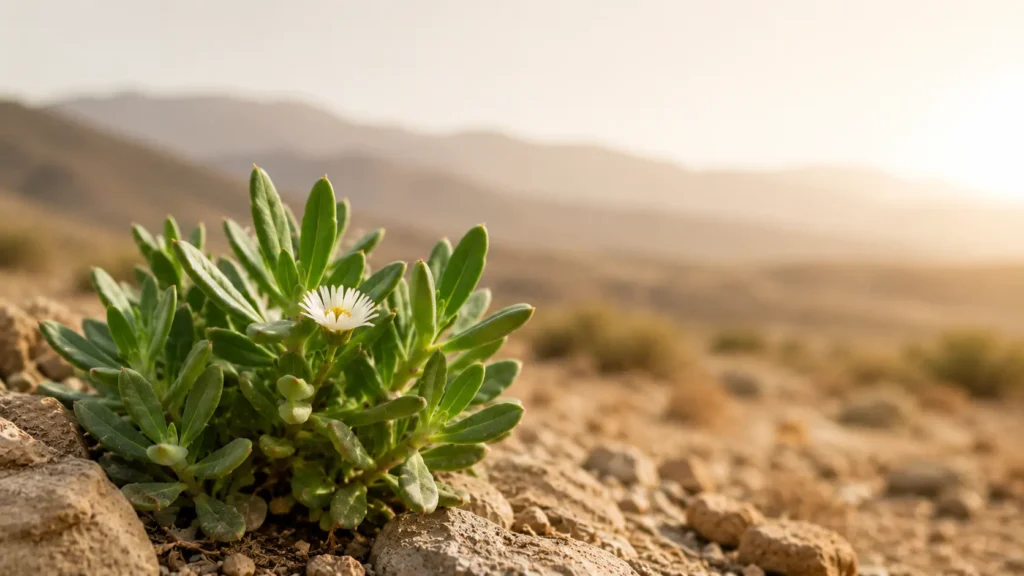
In appearance, Kanna is a low-growing succulent subshrub. The plant develops fleshy leaves that help it store water in dry environments. The leaves grow in pairs and can take on a slightly curved or twisted shape, which is also reflected in the species name tortuosum.
The plant belongs to the Aizoaceae family, which includes many succulent species from southern Africa. The flowers have a typical radiating appearance with many narrow petals. Colour and growth habit can vary depending on environment, cultivation and genetic material.
In commercial settings, Kanna raw materials do not usually consist of the root. Producers instead use the aerial parts, such as leaves and stems. Product documentation should therefore state which part of the plant the producer has actually processed.
Kanna in South African cultural history
Historically, Kanna has a long documented place in the ethnobotanical history of southern Africa. Historical and modern reviews describe links to Khoe and San communities. This background is important from a cultural-historical perspective, but it is not in itself evidence of modern safety, regulatory status or any particular product property.
Furthermore, a modern bibliometric review describes how research on plants in the genus Sceletium has developed, and how traditional knowledge often underlies later botanical, chemical and commercial studies. The review is freely available via PubMed Central.
It is also important that articles about Kanna distinguish between traditional plant material and modern standardised extracts. A vacuum-dried or spray-dried raw material with a defined total alkaloid content is technically different from crushed or fermented plant material.
What does Kanna contain?
Chemically, Kanna contains several naturally occurring alkaloids. Alkaloids are nitrogen-containing organic compounds that plants can produce as part of their chemistry. For Kanna, the focus is often on mesembrine-type alkaloids.
Mesembrine
Of these, mesembrine is one of the most studied alkaloids in Kanna and often serves as a central analytical marker. Aromexperten’s product descriptions list mesembrine as the dominant alkaloid in Serene, Solace and Embrace.
Mesembrenone and Δ7-mesembrenone
Standardised profiles may also report mesembrenone and Δ7-mesembrenone. These compounds belong to the same broader group of Kanna alkaloids but occur in different proportions from mesembrine.
Total alkaloid content
In short, total alkaloid content adds several alkaloids together into a single analytical parameter. A figure such as 3% total alkaloids is therefore not the same as 3% mesembrine. To understand the profile, the reader needs to see both the total content and the distribution between named alkaloids.
As an example, one published analytical method used HPLC to quantify several major alkaloids in Sceletium material. The method shows why high-resolution chromatography can provide more useful information than an unspecified alkaloid figure. Read the analytical study via PubMed Central.
Crushed leaves, powder, 50:1 and standardised extracts
At first glance, Kanna products can look alike in a photo yet differ clearly in processing, analysis and documentation. Buyers should therefore compare the raw material form rather than looking only at the product name or colour.
| Raw material form | How the producer makes it | What the figure shows | What the buyer should check |
|---|---|---|---|
| Crushed plant material | The producer dries and coarsely processes the aerial parts | Relatively low degree of processing | Species, plant part, origin, purity and storage |
| Kanna powder | The producer grinds the dried plant material | Finer particle size without a stated extraction | Identity, particle size and batch analysis |
| 50:1 extract | The producer extracts and concentrates the raw material | A nominal ratio between raw material and extract | Solvent, yield, carriers and alkaloid data |
| Standardised extract | The producer manufactures to defined analytical ranges | Controlled total alkaloid content and alkaloid profile | HPLC results, COA, carriers and batch number |
Kanna raw material and powder
Aromexperten’s Kanna raw material represents the less processed part of the range. This type of product should state the botanical name, plant part, origin and whether the material is powder or crushed parts.
Kanna 50:1 extract
A Kanna 50:1 extract uses a ratio to describe the relationship between the original material and the resulting extract. However, 50:1 does not in itself show the total alkaloid content, mesembrine content or full chemical profile.
Standardised extracts
Standardised Kanna extracts, by contrast, state a defined total alkaloid content. Aromexperten’s range includes Serene 0.4%, Solace 3% and Embrace 5%.
What do 0.4%, 3% and 5% Kanna extract mean?
First, the percentages refer to total alkaloid content. They are not a general strength rating, and they do not automatically mean pure mesembrine. The reader therefore needs to distinguish between total alkaloid content, mesembrine content and the full alkaloid profile.
Specifically, Kanna One describes its standardised range as extracts from South African aerial plant parts and states an HPLC-verified total alkaloid content. The company presents 0.4%, 3% and 5% as three different standardisation levels. These figures are manufacturer information. Read the company’s own presentation directly at Kanna One.
Kanna Serene 0.4%
For Serene, the product page states a minimum of 0.4% total alkaloids and a measured value of 0.52%. The page also lists approximately 0.46% mesembrine and approximately 0.06% mesembrenone. The producer spray-dries the extract and uses tapioca-based maltodextrin as the carrier.
Kanna Solace 3%
For Solace, the product page states a minimum of 3% total alkaloids and a measured value of 3.22%. The profile reports approximately 2.43% mesembrine, 0.29% mesembrenone, 0.18% Δ7-mesembrenone and 0.32% other alkaloids.
According to the product page, Solace is also vacuum-dried and HPLC-analysed. The product contains tapioca and amorphous silica as a flow agent.
Kanna Embrace 5%
For Embrace, the product page states a minimum of 5% total alkaloids and a measured value of 5.58%. The page also reports approximately 4.23% mesembrine, 0.16% mesembrenone, 0.16% Δ7-mesembrenone and 1.26% other alkaloids.
Embrace is also vacuum-dried and, according to the product page, contains tapioca and amorphous silica. Here too, the buyer needs to link the values to the correct batch and check the current certificate of analysis.
How to assess the quality of a Kanna raw material
To assess quality, start with botanical identity and then move on to plant part, process and analysis. A ratio or a percentage never gives the whole picture on its own.
- Check both Sceletium tortuosum and the accepted name Mesembryanthemum tortuosum.
- For standardised extracts, confirm that the documentation states aerial plant parts.
- Check the country of origin and batch number.
- Establish whether the product is crushed material, powder, a ratio extract or a standardised extract.
- For extracts: check the extraction process and drying method.
- Review total alkaloid content and named alkaloids separately.
- Check which HPLC method or other analytical method the laboratory uses.
- Review carriers, maltodextrin and flow agents.
- Check microbiology, heavy metals, mycotoxins and pesticide residues.
- Match the COA and batch number to the actual product.
- Read detection limits, footnotes and disclaimers.
- Distinguish manufacturer information from independent regulatory and research sources.
More detailed batch documentation is available for Solace 3% and Embrace 5%. However, equivalent COA documentation for Serene 0.4%, the 50:1 extract and the unprocessed raw material was not included in the material used for this article.
Finally, readers should therefore check the current product documentation for exact batch information before comparing different raw materials.
Kanna and the EU Novel Food rules
From a regulatory point of view, the EU defines Novel Food as food that was not consumed to a significant degree within the Union before 15 May 1997. A product with a long tradition in South Africa therefore does not automatically qualify as a permitted food in the EU.
In addition, the European Commission’s public list of pending applications includes an application for a hydroethanolic extract of Sceletium tortuosum and/or Sceletium crassicaule. An application does not mean that the product has been authorised. Always check the current summary of Novel Food applications.
Against this background, Aromexperten presents its Kanna products as ethnobotanical raw materials for technical and research purposes, not as food, food supplements or animal feed.
Summary: what is Kanna?
In summary, Kanna is a common name for the South African succulent Sceletium tortuosum. Kew currently accepts the name Mesembryanthemum tortuosum, while the older name still dominates in product descriptions and research.
The plant is available as crushed material, powder, ratio extracts and standardised extracts. These raw material forms differ in processing, chemical profile and documentation.
As for standardisation, the percentages 0.4%, 3% and 5% describe total alkaloid content. They should not be equated with pure mesembrine content or used as the only measure of quality. For a serious comparison, the buyer also needs to review the alkaloid profile, HPLC data, carriers, microbiology, heavy metals, batch number and COA.
Ultimately, a credible assessment starts with the right species, the right plant part and the right raw material form. Process, analysis and documented traceability follow from there.
Frequently asked questions about Kanna
What is Kanna?
Kanna is a common name for the South African succulent often referred to as Sceletium tortuosum.
Is Sceletium tortuosum the correct name?
The name is still widely used. Kew, however, treats it as a synonym of the accepted name Mesembryanthemum tortuosum.
Which part of the Kanna plant do producers use?
Standardised extracts usually use the aerial parts, such as leaves and stems.
What is the difference between Kanna powder and crushed leaves?
The difference lies mainly in particle size and processing. Powder is ground more finely, while crushed material retains larger plant pieces.
What does Kanna 50:1 mean?
The figure normally describes a ratio between the plant raw material used and the resulting extract. On its own, however, it does not show the total alkaloid content or mesembrine content.
What does 3% or 5% Kanna extract mean?
The percentage describes the total alkaloid content according to the product’s standardisation. It does not automatically mean the same percentage of mesembrine.
Is 5% always higher quality than 3%?
No. 5% indicates a higher total alkaloid content, but quality also depends on identity, purity, alkaloid profile, carriers, analytical method and batch documentation.
What is HPLC?
HPLC is a laboratory method that separates and measures substances in a sample. Producers can use the method to check the alkaloid profile.
Are Aromexperten’s Kanna products intended for consumption?
No. Aromexperten sells the products as ethnobotanical raw materials for technical and research purposes.
Sources and method
In terms of method, the article distinguishes between botanical databases, published research, EU information, product descriptions and manufacturer information. Exact product values come from Aromexperten’s current product pages and should be linked to the correct batch.
- Royal Botanic Gardens, Kew: Mesembryanthemum tortuosum.
- Royal Botanic Gardens, Kew: Sceletium tortuosum as a synonym.
- Bibliometric review of research on Sceletium.
- HPLC quantification of several Kanna alkaloids.
- Kanna One: technical manufacturer information.
- European Commission: Novel Food applications.
- Aromexperten: the Kanna category.

 Best Sellers
