


 Svenska

 News
 Botanical Blends
 Mitragyna
 Kanna (sceletium tortuosum)
 Akuamma (Picralima nitida)
 Tongkat Ali (Eurycoma longifolia)
 Blue Lotus (Nymphaea caerulea)
 Sakae Naa
 Wild Lettuce (Lactuca virosa)
 Damiana (turnera diffusa)
 Zornia latifolia (Maconha Brava)
 CBD products
 Mushroom Extracts
 Aromatherapy
Botanicals
What Is Akuamma? A Guide to Picralima nitida
Aug
Akuamma is the common name of Picralima nitida, a tropical tree from Africa. The species belongs to the family Apocynaceae, and the seeds are the most common botanical raw material. On the market, they are mainly found as whole dried seeds or as ground seed powder.
In this guide, we go through the plant’s botanical identity, natural distribution, appearance and chemical composition. In addition, we explain the difference between whole seeds, seed powder and extract. Finally, we go through which information matters when assessing a botanical raw material.
Akuamma quick facts
| Scientific name | Picralima nitida |
|---|---|
| Plant family | Apocynaceae |
| Plant type | Tropical tree or large shrub |
| Natural distribution | West and Central Africa and areas east to Uganda |
| Most common plant part | Seeds |
| Common product forms | Whole seeds and ground seed powder |
| Known compound group | Indole alkaloids |
Contents
What is Akuamma?
Akuamma is a common name and trade name for the tree Picralima nitida. The tree belongs to the family Apocynaceae, which includes many tropical and subtropical species.
Above all, the plant’s large fruits and hard seeds have made it known in botanical and ethnobotanical contexts.
When companies offer the raw material, it is usually whole seeds or ground seed material. However, the name Akuamma does not describe a single chemical compound. Instead, the name refers to the plant itself or a raw material from it.
The seeds contain several natural plant compounds, including various alkaloids. That is why you need to distinguish between the name of the plant, the plant part in question and the compounds a laboratory identifies in a specific sample.
Are Akuamma and Picralima nitida the same plant?
Yes. Akuamma is a common name, while Picralima nitida is the accepted scientific name.
Botanical databases, research articles and technical specifications therefore usually use the scientific name.
A scientific plant name consists of two parts. First comes the genus name Picralima. This is followed by the species name nitida. Together, they identify the specific species.
Older literature may also use names such as Tabernaemontana nitida and Picralima klaineana. Kew Science treats these as synonyms of Picralima nitida.
Read the current taxonomic record at
Plants of the World Online
.
For clear identification: a product description should state the full scientific name Picralima nitida, not just the common name Akuamma.
Where does Akuamma grow?
Picralima nitida is native to tropical parts of Africa. Kew gives a range from western tropical Africa to Uganda.
The documented areas include, for example, Benin, Cameroon, the Central African Republic, Ghana, Guinea, Côte d’Ivoire, Nigeria, Gabon and Uganda.
The species mainly occurs in humid tropical environments. That is why local climate, rainfall and growing site affect how the tree develops and forms fruit.
After harvest, drying, transport and storage can also affect the finished botanical raw material.
Many product texts use the broad wording “from West Africa”. A specific country of origin, however, gives better traceability. For that reason, it is an advantage when the supplier can state both the country and the production area.
What does the Akuamma tree look like?
Akuamma grows as a tropical tree or large shrub. Under favourable conditions, the plant develops a dense crown, a distinct trunk and dark green leaves.
Kew’s botanical description also mentions white to yellow flowers.
The leaves usually have an elliptical or oblong shape and sit in opposite pairs on the branches.
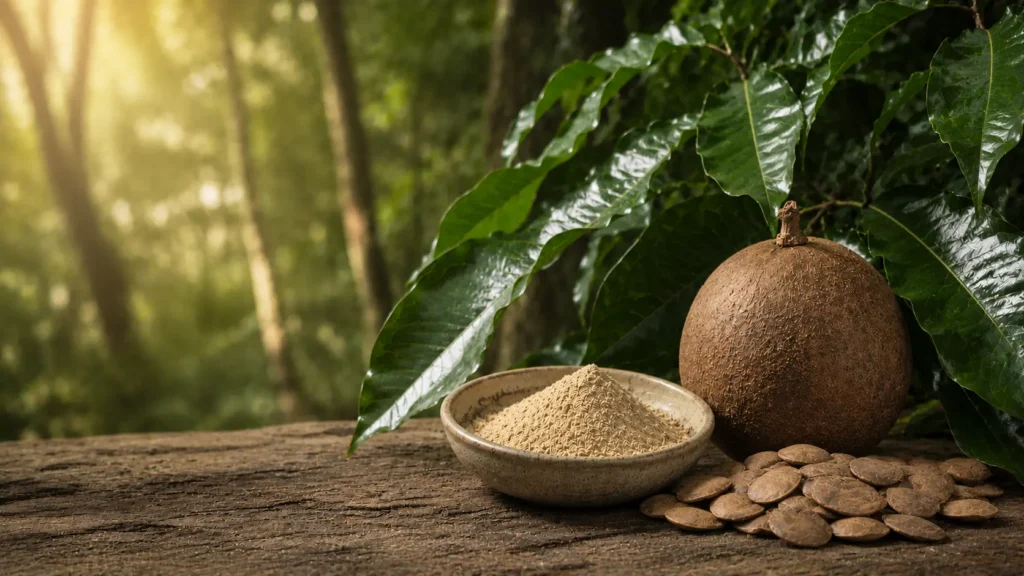
The fruit is one of the tree’s most distinctive features. It has a rounded or oval shape and contains several seeds. As the fruit ripens, both its colour and texture change.
Akuamma fruits and seeds
The fruits contain several hard seeds surrounded by fruit pulp.
After harvest, the producer separates the seeds from the pulp and cleans them. The producer then dries the material before further handling.
The producer can keep the seeds whole or grind them into powder. In other words, “Akuamma seed” describes the plant part, while “Akuamma seed powder” describes the physical form.
Seed powder is not automatically an extract. Grinding changes the physical form, whereas extraction means that the producer recovers certain components from the plant material.
Different harvests can give raw materials with varying colour, smell and degree of grinding. In addition, geographical origin, harvest time and storage can contribute to variation.
That is why you should not judge the quality of the whole raw material on appearance alone.
Which compounds are found in Akuamma seeds?
Akuamma seeds contain several natural compounds. Chemical research has paid particular attention to indole alkaloids, a group of nitrogen-containing organic compounds.
Researchers have identified several alkaloids in seeds from Picralima nitida. Examples in the scientific literature include akuammine, akuammigine, akuammidine, akuammiline and pseudo-akuammigine.
One scientific study describes the isolation and chemical characterisation of several of these compounds. The study is openly available via
PubMed Central
.
However, a general list of known compounds does not show exactly what a particular product batch contains. To obtain such information, the laboratory must analyse the batch in question.
Consequently, a product text should distinguish between general research information about the plant and actual analytical results for the product.
What is an alkaloid profile?
An alkaloid profile shows which alkaloids the laboratory has identified in a sample. In some analyses, the laboratory also reports the amount of each compound.
This way, the profile can give both qualitative and quantitative information about the sample.
Laboratories can, however, use different instruments, reference standards and calculation methods. A clear report should therefore also state the analytical method and unit of measurement.
Is alkaloid content the same as quality?
No. A content figure only tells you something about the compound or group of compounds the laboratory has measured.
At the same time, it does not automatically say anything about, for example, species identity, microbiological status, heavy metals, moisture content or traceability.
A more complete quality assessment therefore needs to weigh several pieces of information together.
- Check the botanical identity.
- Check which plant part the raw material consists of.
- Review the origin and supplier documentation.
- Check whether analytical results belong to the current batch.
- Assess which parameters the laboratory has actually analysed.
What is Akuamma seed powder?
Akuamma seed powder consists of dried seeds from Picralima nitida that the producer has ground.
The powder therefore contains the seed’s natural plant material in finely divided form.
Grinding mainly changes the structure and particle size of the raw material. However, the process does not automatically concentrate the natural compounds.
Product descriptions should therefore clearly distinguish between ordinary seed powder and extract.
| Product form | Production | What does the form describe? |
|---|---|---|
| Whole seeds | The producer cleans and dries the seeds | The seeds keep their original physical form |
| Seed powder | The producer grinds dried seeds | Finely divided seed material |
| Extract | The producer recovers selected components from the raw material | A processed raw material with a different composition from ordinary powder |
| Standardised extract | The producer controls defined analytical parameters | Selected analytical values must fall within set specifications |
Aromexperten’s current product consists of ground seed material and is sold as a botanical raw material for crafts and technical purposes.
How do you assess the quality of Akuamma seed powder?
Colour, smell and texture can give a first visual impression of a botanical powder. However, these properties alone cannot confirm identity, purity or chemical profile.
Documentation and relevant analyses therefore play an important role.
Above all, check:
- the full scientific name Picralima nitida
- which plant part the product contains
- country of origin or geographical origin
- whether the raw material is a powder or an extract
- batch number and date where such information is available
- storage instructions and packaging
- available analytical documents
- the product’s stated intended use
What is a COA?
COA stands for Certificate of Analysis. The document reports analytical results for a specific product or batch.
A COA may, for example, cover microbiological parameters, heavy metals, moisture content or chemical markers.
However, not every certificate needs to contain the same tests. The relevant analytical set-up depends on the raw material, the product form and which specifications have been set.
If no public COA is available, the customer cannot check any analytical information themselves. This does not automatically mean that the raw material is of low quality.
However, the product text should avoid detailed promises about purity or analysis that lack verifiable support.
Why does the batch number matter?
Botanical raw materials naturally vary between harvests and production runs. That is why an analytical result gives the most information when it can be linked to the same batch as the product in question.
A general laboratory document without a clear batch link gives less information. In the same way, an old certificate does not necessarily describe a new delivery.
How do you store Akuamma seed powder?
Store botanical powders in a dry, cool place, protected from direct sunlight.
In addition, the packaging should seal tightly to reduce contact with moisture, air and foreign material.
Powder has a larger exposed surface than whole seeds. That is why unsuitable storage conditions can affect powder more quickly.
Always follow the product’s specific storage instructions. Also keep the raw material out of the reach of children and separate from food, medicines and animal feed.
Akuamma and food rules in the EU
EU rules depend on how a company presents a botanical product and how it intends it to be used. A history of use outside Europe therefore does not automatically mean that companies may market the raw material as food or a food supplement in the EU.
A substance or raw material may fall under the rules on novel foods if it was not consumed to a significant degree within the EU before 15 May 1997.
At the same time, the assessment needs to take into account, among other things, the plant part in question, the product form and the intended use.
The European Commission describes the system on its page on
novel food in the EU
.
The Commission also offers a
Novel Food status catalogue
.
The catalogue is, however, for guidance only and is not in itself a binding legal decision for each individual product.
EFSA also describes the process for the safety assessment of novel foods:
EFSA – Novel Food
.
Product classification at Aromexperten: Akuamma seed powder is sold as a botanical raw material for crafts and technical purposes. The product is not sold as food, a food supplement, a medicine or animal feed and is not intended for consumption.
Short glossary
- Alkaloid
- A nitrogen-containing organic compound that occurs naturally in many plants.
- Botanical raw material
- Material from a plant, for example leaves, bark, root, fruit or seed.
- COA
- A certificate of analysis that reports results for a specific product or batch.
- Extract
- A product in which the producer has recovered selected components from the plant raw material.
- Seed powder
- Dried seeds that the producer has ground into smaller particles.
- Standardisation
- Checking that defined analytical parameters fall within set specifications.
- Taxonomy
- The scientific classification and naming of organisms.
Frequently asked questions about Akuamma
What is Akuamma?
Akuamma is a common name for Picralima nitida, a tropical African tree in the family Apocynaceae. The plant’s seeds are mainly found as a botanical raw material.
Are Akuamma and Picralima nitida the same thing?
Yes. Akuamma is the common name, while Picralima nitida is the accepted scientific name.
Which part of the plant is used as a botanical raw material?
The seeds are the most common commercial raw material. Producers offer them both whole and as ground seed powder.
Is Akuamma seed powder an extract?
No. Seed powder consists of ground seeds. An extract, by contrast, is produced when the producer recovers selected components from the plant material.
Which alkaloids are found in Akuamma?
The scientific literature describes, among others, akuammine, akuammigine, akuammidine, akuammiline and pseudo-akuammigine. Exact information about a particular product, however, requires analysis of the batch in question.
Does the colour show whether the seed powder is of high quality?
No. Colour and texture give some visual information, but they cannot alone confirm identity, purity or chemical profile.
What does 100% Akuamma seed mean?
The wording means that the product is stated to consist of Akuamma seed without any stated additives. It does not, however, automatically describe origin, purity or alkaloid profile.
Is Akuamma a food?
Aromexperten does not sell the Akuamma seed powder as food, a food supplement or animal feed. The product is a botanical raw material for technical and craft purposes and is not intended for consumption.
How do you store Akuamma seed powder?
Store the raw material in a dry, cool place, well sealed and protected from direct sunlight. It should also be kept out of the reach of children and separate from food.
Summary
Akuamma is the common name of Picralima nitida, a tropical tree in the family Apocynaceae. The species occurs naturally in tropical parts of Africa.
Above all, the seeds are used as a botanical raw material. Producers can offer them whole or grind them into seed powder. Ordinary seed powder, however, is not the same as an extract.
The seeds contain several indole alkaloids. A general list of known compounds, however, does not describe a specific product batch.
That is why exact product information requires relevant analysis and clear documentation.
Explore Akuamma as a botanical raw material
Read more about product form, storage, available sizes and the product’s stated intended use.
The product is a botanical raw material for crafts and technical purposes. It is not sold as food, a food supplement, a medicine or animal feed and is not intended for consumption.
Sources and further reading
-
Royal Botanic Gardens, Kew – Picralima nitida in Plants of the World Online
-
PubMed Central – scientific study on alkaloids from Picralima nitida
-
European Commission – Novel Food
-
European Commission – Novel Food status catalogue
-
EFSA – safety assessment of novel foods
Last fact-checked:

 Best Sellers
