


 Svenska

 News
 Botanical Blends
 Mitragyna
 Kanna (sceletium tortuosum)
 Akuamma (Picralima nitida)
 Tongkat Ali (Eurycoma longifolia)
 Blue Lotus (Nymphaea caerulea)
 Sakae Naa
 Wild Lettuce (Lactuca virosa)
 Damiana (turnera diffusa)
 Zornia latifolia (Maconha Brava)
 CBD products
 Mushroom Extracts
 Aromatherapy
Botanicals
What Is Erythrina mulungu? Mulungu Explained
Sep
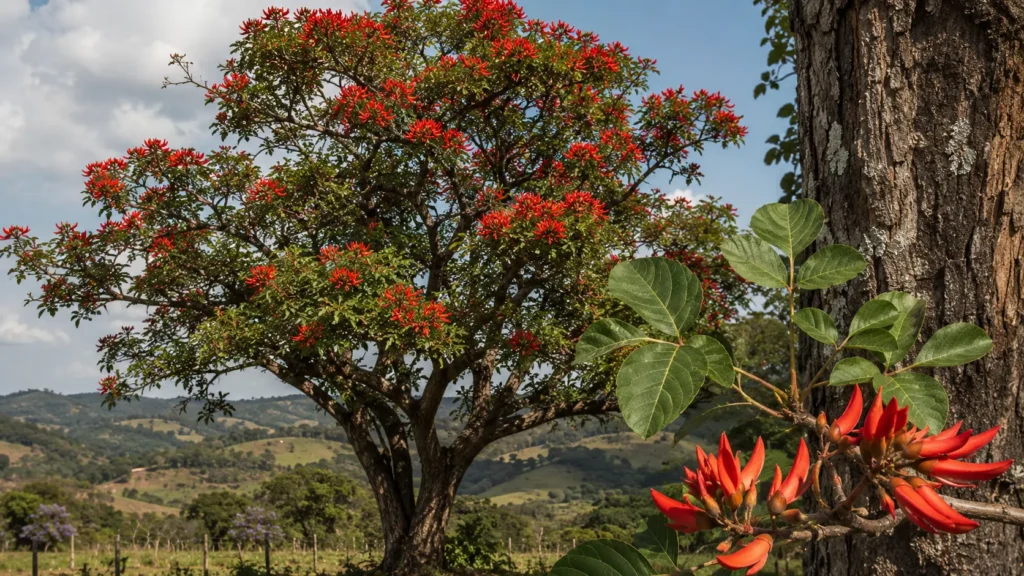
Erythrina mulungu, often called Mulungu, is a South American tree in the family Fabaceae. The species is characterised by, among other things, its striking red to red-orange flowers and belongs to the large genus Erythrina. Scientific analyses of the species have also identified several so-called erythrinian alkaloids.
In this guide, we go through the plant’s botanical identity, natural distribution, appearance and chemical profile. In addition, we explain why the trade name Mulungu can cause botanical confusion, what research shows about erythravine and closely related alkaloids, and why laboratory research does not automatically describe a commercial product batch.
Erythrina mulungu quick facts
| Scientific name | Erythrina mulungu Mart. ex Benth. |
|---|---|
| Common name | Mulungu |
| Plant family | Fabaceae |
| Order | Fabales |
| Genus | Erythrina |
| Plant type | Tree |
| Natural distribution | Bolivia, Brazil, Paraguay and northern Argentina |
| Known compound group | Erythrinian alkaloids |
| Examples from research | Erythravine, 11α-hydroxyerythravine and erysothrine |
Contents
- What is Erythrina mulungu?
- What does Mulungu mean?
- Botanical identity
- Where does Erythrina mulungu grow?
- What does the tree look like?
- What is the genus Erythrina?
- Which compounds are found in Erythrina mulungu?
- What is erythravine?
- Other alkaloids in research
- What does research actually show?
- Why does the plant part matter?
- How do you assess quality?
- Storage
- Product classification
- Frequently asked questions
What is Erythrina mulungu?
Erythrina mulungu is a tree in the legume family Fabaceae.
The Royal Botanic Gardens, Kew, accepts Erythrina mulungu Mart. ex Benth. as a distinct botanical species within the genus Erythrina.
The species occurs naturally in parts of South America. Above all, it is associated with Brazil and neighbouring areas.
The plant is particularly striking when it flowers, as many Erythrina species develop bright red or red-orange flowers.
In addition, the genus contains a characteristic group of natural alkaloids that researchers usually call erythrinian or Erythrina alkaloids.
What does the name Mulungu mean?
Mulungu is a Brazilian common name that appears in botanical and ethnobotanical literature.
However, the name is not as precise as a scientific species name. Different sources may use the word Mulungu for several species within the genus Erythrina.
For example, both Erythrina mulungu and Erythrina velutina appear under the name Mulungu in scientific and traditional literature.
That is why the scientific name is decisive. A raw material sold as Erythrina mulungu should not automatically be equated with research on another Mulungu species.
This guide is specifically about Erythrina mulungu Mart. ex Benth.
Botanical identity: Erythrina mulungu
Kew places the species in the genus Erythrina, the family Fabaceae and the order Fabales.
The accepted name is Erythrina mulungu Mart. ex Benth.
In addition, there are older botanical synonyms. Kew lists, for example, Corallodendron mulungu as a synonym of the accepted species.
For a correct raw material description: product information, supplier documentation and any analyses should state Erythrina mulungu and not just “Mulungu”.
Read the current taxonomic record at
Royal Botanic Gardens, Kew – Erythrina mulungu
.
Where does Erythrina mulungu grow naturally?
Kew states that the species’ natural range extends from Bolivia to central parts of Brazil and on to northern Argentina.
The database lists occurrence in, among other places, Bolivia, south-eastern and west-central Brazil, Paraguay, and north-eastern and north-western Argentina.
In addition, Kew describes the species as a tree that mainly grows in subtropical environments.
Geographical information matters when assessing the identity and traceability of a botanical raw material.
At the same time, you should distinguish the species’ natural range from the country of origin of a specific commercial batch.
What does Erythrina mulungu look like?
Erythrina mulungu grows as a woody tree with a branched crown.
Like many other species in the genus Erythrina, the plant develops striking, colourful flowers.
Above all, the red to red-orange flowers make the genus easy to recognise during the flowering period.
The name Erythrina is also linked to the Greek word for red, reflecting the characteristic flower colour of many species in the genus.
The leaves are compound in a way that is typical of several Fabaceae species. After flowering, the tree develops pod-like fruits with seeds.
However, dried botanical raw material should not be identified to species based on colour or visual appearance alone.
What is the genus Erythrina?
Erythrina is a relatively large plant genus within the Fabaceae, with species in tropical and subtropical regions.
Research on the genus covers botany, natural product chemistry and the analysis of natural alkaloids, among other areas.
A comprehensive scientific review describes more than a hundred alkaloids that researchers have isolated from different Erythrina species.
This does not mean, however, that all of these compounds are found in Erythrina mulungu.
Species data and genus data are not the same thing. A compound that researchers have found in another Erythrina species cannot automatically be stated as a constituent of Erythrina mulungu.
Read the review:
Alkaloids of genus Erythrina: An updated review
.
Which compounds are found in Erythrina mulungu?
Chemical research specifically on Erythrina mulungu has mainly focused on a group of so-called erythrinian alkaloids.
Research groups have, among other things, isolated erythravine, 11α-hydroxyerythravine, α-hydroxyerysotrine and erysothrine from plant material of E. mulungu.
In addition, other secondary plant metabolites occur within the genus, including flavonoids and pterocarpans.
It is, however, important to distinguish between compounds researchers have described across the whole genus and compounds that have actually been verified in E. mulungu itself.
Scientific literature is not a batch certificate. The fact that researchers isolated erythravine from a research sample does not mean that every commercial Mulungu batch contains the same amount.
What is erythravine?
Erythravine is a natural alkaloid that researchers have isolated from Erythrina mulungu.
The compound belongs to the structural group usually called erythrinian alkaloids.
For example, researchers isolated erythravine together with 11α-hydroxyerythravine and α-hydroxyerysotrine from flowers of E. mulungu.
Later laboratory studies have examined how these isolated compounds interact with, among other things, nicotinic acetylcholine receptors.
However, such experiments do not mean that the finished botanical raw material has a verified clinical effect.
Read the chemical study:
PubMed – erythrinian alkaloids from Erythrina mulungu
.
Other Erythrina mulungu alkaloids in research
In addition to erythravine, researchers have studied several closely related compounds from the species.
| Compound | What does the literature show? |
|---|---|
| Erythravine | Isolated from Erythrina mulungu and analysed in experimental studies |
| 11α-hydroxyerythravine | Closely related erythrinian alkaloid isolated from the plant |
| α-hydroxyerysotrine | Identified together with other alkaloids in research material |
| Erysothrine | Isolated from flowers of E. mulungu in a separate study |
Taken together, the studies show that the species contains several structurally closely related alkaloids.
An exact product profile, however, requires chemical analysis of the raw material in question.
What does research on Erythrina mulungu actually show?
There are several experimental studies on Erythrina mulungu and its isolated alkaloids.
The researchers have used animal models, cultured cells, nerve cells and electrophysiological receptor systems, among other methods.
For example, a study from 2013 showed that erythravine and 11α-hydroxyerythravine could inhibit certain neuronal nicotinic acetylcholine receptors in experimental cell models.
A later study also examined possible mechanisms of action of the same isolated alkaloids using neurochemical and electrophysiological methods.
This is preclinical research. Cell, receptor and animal studies show how an extract or an isolated compound behaves in an experiment. They do not automatically show how a commercial botanical raw material affects people.
Read the open-access receptor study:
Erythrina mulungu alkaloids and neuronal nicotinic receptors
.
See also the later mechanistic study:
New insights in the mode of action of erythravine alkaloids
.
Why does the plant part matter?
A botanical species consists of several different plant parts, and they do not necessarily have the same chemical profile.
Research on Erythrina mulungu has, for example, analysed flowers, while other literature on the Erythrina genus covers bark, leaves, seeds and other plant parts.
That is why you should not transfer an analysis of flowers directly to bark or other botanical material.
| Type of information | What needs to be checked? |
|---|---|
| Botanical species | Is the material really Erythrina mulungu? |
| Plant part | Flower, bark, leaf, seed or another part? |
| Chemical study | Which plant part did the researchers analyse? |
| Product analysis | Does the analysis refer to the same batch as the raw material in question? |
In other words, the species name gives only part of the information. The plant part and the batch link also matter.
How do you assess the quality of Erythrina mulungu?
A serious quality assessment starts with correct botanical identity.
This is particularly important for Mulungu, because the same common name can be used for several different Erythrina species.
That is why you should check more than the product’s trade name.
- the full scientific name Erythrina mulungu
- which plant part the product consists of
- country of origin or geographical origin
- the product’s physical form
- batch number where available
- the supplier’s traceability documentation
- available microbiological analyses
- any heavy metal analyses
- chemical analyses when specific alkaloid contents are stated
- storage information
Can an alkaloid profile be used for quality control?
Yes, a relevant chemical profile can give valuable information about a botanical material.
Alkaloids can, for example, serve as chemical markers when they are typical of a particular plant or raw material.
However, a validated or suitable analytical method and relevant reference standards are required if the laboratory is to state exact contents.
A study from the research literature or a general list of Erythrina alkaloids therefore does not replace a batch-specific certificate of analysis.
How do you store Erythrina mulungu?
Store dried botanical raw materials in a dry, cool place, protected from direct sunlight.
In addition, the packaging should be kept properly closed to limit exposure to moisture, air and foreign material.
Finely divided material has a larger exposed surface than whole, coarser plant parts. That is why the product’s physical form can affect how sensitive the raw material is during storage.
Always follow the storage information for the product in question and keep the raw material out of the reach of children.
Erythrina mulungu and product classification
Scientific studies or historical information about a botanical species do not automatically determine how a commercial product may be marketed.
Instead, the product form, content, plant part, intended use and current legislation need to be assessed together.
Aromexperten offers Erythrina mulungu as part of its range of botanical raw materials.
This article describes Erythrina mulungu as a botanical raw material. It gives no instructions on ingestion, preparation, dosage or medical use.
Frequently asked questions about Erythrina mulungu
What is Erythrina mulungu?
Erythrina mulungu is a South American tree in the family Fabaceae. The plant occurs naturally from Bolivia through parts of Brazil to Paraguay and northern Argentina.
Are Erythrina mulungu and Mulungu the same thing?
Mulungu is a common name used for the plant. However, the same name can also be used for other Erythrina species, which makes the scientific name more important.
Is Erythrina mulungu the same species as Erythrina velutina?
No. They belong to the same genus but are different botanical species.
Which compounds have researchers found in Erythrina mulungu?
Researchers have, among other things, isolated erythravine, 11α-hydroxyerythravine, α-hydroxyerysotrine and erysothrine from plant material of E. mulungu.
What is erythravine?
Erythravine is a natural erythrinian alkaloid that researchers have isolated from Erythrina mulungu.
Is erythravine found in all Mulungu products?
This cannot be assumed. A research study shows what the researchers found in their material. That is why exact information about a commercial batch requires a relevant product analysis.
Can research on flowers be used to describe bark?
Not without further evidence. Different plant parts can have different chemical profiles. Results from flowers should therefore not be presented as analytical data for bark or other plant parts.
Does the laboratory research show that the product has medical effects?
No. Most of the mechanistic research involves isolated compounds, cell models or animal experiments. Such studies are not the same as clinical evidence for a commercial raw material.
Is Aromexperten’s Erythrina mulungu intended for consumption?
This article presents the product as a botanical raw material and contains no consumption, dosage or medical instructions. Always follow the product’s current classification and labelling on the product page.
Summary
Erythrina mulungu is a South American tree in the family Fabaceae. Kew accepts the species as Erythrina mulungu Mart. ex Benth.
Above all, it is important to distinguish the species from other plants that may also be called Mulungu in the literature.
Chemical research has identified several erythrinian alkaloids from the species, including erythravine and 11α-hydroxyerythravine.
The researchers have also examined these isolated compounds in animal, cell and receptor studies. However, such experiments are not the same as clinical evidence for a finished botanical product.
A correct raw material description therefore needs to distinguish between botanical species, plant part, general scientific literature and actual batch results.
Explore Erythrina mulungu as a botanical raw material
Read the current product information for the botanical name, product form, available sizes, storage and stated intended use.
The product is presented as a botanical raw material. Always follow the product’s current labelling and stated intended use.
Sources and further reading
-
Royal Botanic Gardens, Kew – Erythrina mulungu Mart. ex Benth.
-
Flausino et al. – Erythrinian alkaloids isolated from Erythrina mulungu
-
Faggion et al. – erythravine and 11α-hydroxyerythravine isolated from Erythrina mulungu flowers
-
Rosa et al. – erysothrine isolated from Erythrina mulungu flowers
-
Setti-Perdigão et al. – Erythrina mulungu alkaloids and neuronal nicotinic receptors
-
New insights in the mode of action of erythravine and 11α-hydroxyerythravine
-
Fahmy et al. – Alkaloids of genus Erythrina: An updated review
-
Evidence-based review of pharmacology, toxicity and clinical research in the genus Erythrina
Last fact-checked:

 Best Sellers
