Svenska
 News
News Botanical Blends
 Mitragyna
 Kanna (sceletium tortuosum)
 Akuamma (Picralima nitida)
 Tongkat Ali (Eurycoma longifolia)
 Blue Lotus (Nymphaea caerulea)
 Sakae Naa
 Wild Lettuce (Lactuca virosa)
 Damiana (turnera diffusa)
 Zornia latifolia (Maconha Brava)
 CBD products
 Aromatherapy
Botanicals
What is a COA? How to read a Certificate of Analysis
Aug
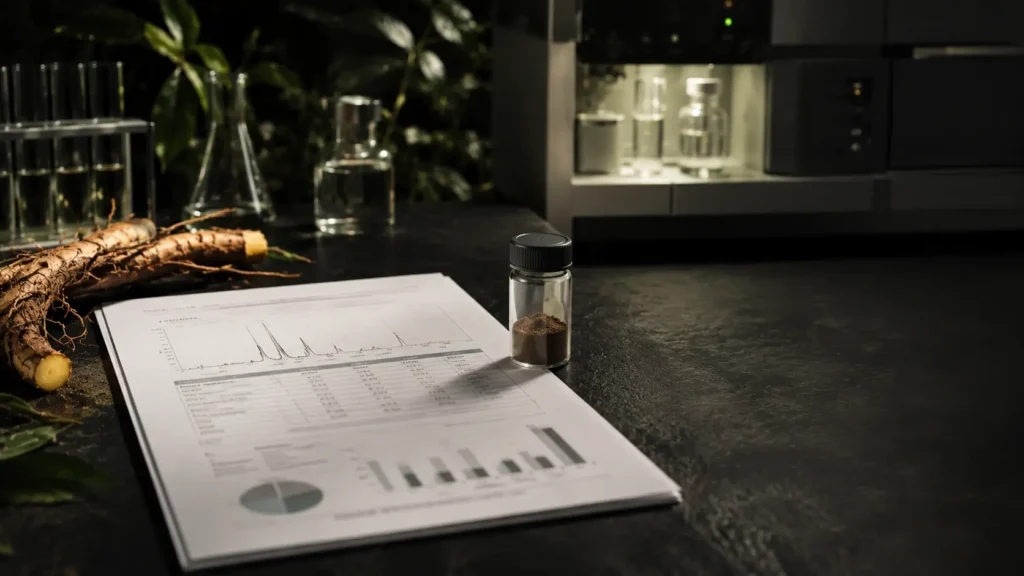
What is a COA? COA stands for Certificate of Analysis and is an analysis certificate that summarises the results for a specific production batch. The document may, among other things, show the batch number, test parameters, specifications and measured results. For botanical raw materials, a COA therefore provides important information about the documented properties of the current batch.
Contents
What is a COA?
COA is an abbreviation of Certificate of Analysis. In Swedish, terms such as analysis certificate or analysis statement are often used. The document links test results to a specific product or production batch.
A laboratory or manufacturer analyses a sample and then compiles the results in the document. For example, you can see which parameters were checked, which specifications apply, and what result the analysis produced.
In this way, the document functions as a technical summary of the current batch’s analytical data. However, it is important to remember that the content varies between different raw materials, manufacturers and laboratories.
In short:
COA = Certificate of Analysis = analysis certificate for a specific product or batch.
Why is the batch number important?
The batch number is one of the first details you should check. It identifies the production run to which the test results apply.
Botanical raw materials can naturally vary between different production runs. Therefore, you should not automatically use test results from an older batch for a newer batch.
A current analysis certificate should therefore be traceable to the product via the same batch number. In this way, you can ensure that the documentation actually applies to the raw material you are reviewing.
Specifications and test results
Two of the most important concepts in an analysis certificate are specification and result. They do not describe the same thing.
| Term | What does it mean? |
|---|---|
| Specification | The requirement, range or limit value established by the manufacturer |
| Result | The value the analysis shows for the current batch |
| Analytical method | The method the laboratory uses to measure the parameter |
| Batch number | Identifies the production run to which the analysis applies |
If the specification, for example, states a range, the test result must fall within that range in order to meet the established specification.
In other words, the specification shows what the raw material is required to meet, while the result shows what the laboratory actually measured in the current batch.
What can a COA include?
The content depends on the product type and which quality parameters the manufacturer has defined. A document for a botanical raw material may therefore differ from a certificate for, for example, a chemical raw material.
Common details may include:
- Product name or raw material name
- Botanical name
- Batch or lot number
- Manufacturing date or analysis date
- Expiry date or retest date where relevant
- Physical properties such as colour or appearance
- Identification of the raw material
- Chemical test parameters
- Microbiological analyses
- Metals or other checks where these are included in the specification
- Analytical methods
- Established specifications
- Measured test results
Not all of these details need to be included in every document. Therefore, a COA should always be assessed based on the specific raw material and the documentation that is relevant to it.
COA for botanical raw materials
Botanical raw materials come from biological material and can therefore exhibit natural variation. Origin, plant part, growing conditions, harvest and processing can affect the raw material’s profile.
For this reason, batch-specific analysis can be particularly valuable for botanical extracts. The analysis certificate makes it possible to compare the current production run with the manufacturer’s established specifications.
For a standardised extract, the manufacturer may also define several chemical test parameters. Such a document therefore provides more information than just a product name or an extraction ratio.
If you would like to understand the difference between different raw material forms, you can read our guide on Tongkat Ali powder or extract.
Example: COA for Tongkat Ali Physta®
Physta® is a standardised water extract from the root of Eurycoma longifolia. For the extract, the manufacturer analyses several defined quality parameters.
The current Aromexperten batch has batch number TA 2506105. The documentation reports, among other things, eurycomanone, glycosaponins, polysaccharides and total protein fraction.
| Test parameter | Result | Specification |
|---|---|---|
| Eurycomanone | 0.87% | 0.8–1.5% |
| Glycosaponins | 51.1% | At least 40% |
| Polysaccharides | 37.5% | At least 30% |
| Total protein fraction | 35.4% | At least 22% |
Overall, the table shows the difference between the established specification and the laboratory’s results for this specific production batch.
You can view the Certificate of Analysis for batch TA 2506105.
For more information about the extract, you can also read What is Physta®?.
How to review a COA
It is easy to get stuck on individual test values. Instead, it is better to review the document in a clear order.
-
Check the product name.
The document should clearly identify which raw material the analysis applies to. -
Check the batch number.
The batch number on the document should match the current product. -
Identify the specifications.
See which requirements or ranges the manufacturer has defined. -
Compare the test results.
Check how the results for the current batch relate to the specifications. -
Review the analytical method.
Where the method is stated, it may provide additional information about how the laboratory carried out the check. -
Check the date and document version.
This reduces the risk of reviewing an old document for a previous production run.
Most important: a COA should be traceable to the current product through product identity and batch number.
COA and chemical marker compounds
For some botanical extracts, the manufacturer uses chemical markers as part of quality control. The markers help the laboratory describe parts of the raw material’s chemical profile.
In Tongkat Ali, for example, eurycomanone is used as a test parameter in some standardised extracts. However, you should not assess the overall quality of the raw material based on only one marker.
If you would like to read more about that specific test parameter, see our guide What is eurycomanone?.
Frequently asked questions about COA
What does COA stand for?
COA stands for Certificate of Analysis. In Swedish, it can be described as an analysis certificate or analysis statement.
Is a COA the same as a safety data sheet?
No. An analysis certificate primarily reports product- or batch-specific analytical data. A safety data sheet (SDS) has a different purpose and describes, among other things, information on handling, classification and safety where such requirements apply.
Are all COAs the same?
No. The content varies depending on the product, manufacturer, laboratory and the applicable specifications. Therefore, two documents for different botanical raw materials may look very different.
Why should the batch number match the product?
Because the test results apply to the specific production run that the laboratory analysed. A document for another batch therefore does not automatically describe the current product.
Is a COA proof that all batches are identical?
No. Botanical raw materials can exhibit natural variation. Standardisation instead means that the manufacturer checks selected parameters against established specifications.
Can a high test value automatically mean better quality?
No. An isolated value does not provide a complete quality assessment. You should also review raw material identity, specifications, analytical method, other parameters and batch documentation.
Sources and Further Reading
Read more about analysis and Physta®
Explore eurycomanone as an analytical marker, read about how Physta® is standardised, or view the current Physta® batch and analytical documentation.

 Best Sellers