


 Svenska

 News
 Botanical Blends
 Mitragyna
 Kanna (sceletium tortuosum)
 Akuamma (Picralima nitida)
 Tongkat Ali (Eurycoma longifolia)
 Blue Lotus (Nymphaea caerulea)
 Sakae Naa
 Wild Lettuce (Lactuca virosa)
 Damiana (turnera diffusa)
 Zornia latifolia (Maconha Brava)
 CBD products
 Mushroom Extracts
 Aromatherapy
Botanicals
What Is Blue Lotus? Nymphaea caerulea Explained
Aug
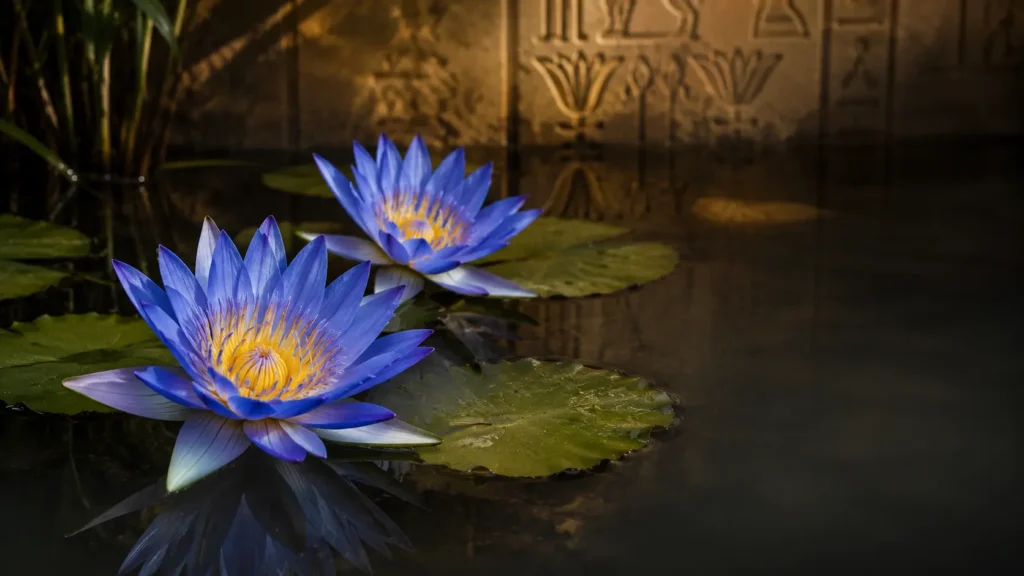
Blue Lotus is the established trade name for the blue water lily often referred to as Nymphaea caerulea. The plant belongs to the family Nymphaeaceae and is above all characterised by its blue to blue-violet flowers. The plant also has a long and well-documented connection to the art and symbolism of ancient Egypt.
In this guide, we go through the plant’s botanical identity, natural distribution, history and chemical composition. In addition, we explain the difference between dried Blue Lotus and a 50:1 ratio extract. We also take a closer look at what research actually shows about nuciferine and apomorphine, and which information matters when assessing botanical raw materials.
Blue Lotus quick facts
| Common name | Blue Lotus / Egyptian blue lotus / blue water lily |
|---|---|
| Common trade name | Nymphaea caerulea |
| Accepted taxonomy according to Kew | Nymphaea nouchali var. caerulea |
| Plant family | Nymphaeaceae |
| Plant type | Rhizome-forming aquatic plant |
| Natural distribution | Egypt, large parts of Africa and neighbouring areas |
| Product forms at Aromexperten | Dried flowers/flower parts and 50:1 ratio extract |
| Origin of Aromexperten’s raw material | Thailand |
Contents
- What is Blue Lotus?
- Is Blue Lotus actually a lotus?
- Nymphaea caerulea and modern taxonomy
- Where does Blue Lotus grow naturally?
- Blue Lotus in ancient Egypt
- What does the plant look like?
- Which compounds has research examined?
- Nuciferine and apomorphine
- Dried flower or 50:1 extract?
- What does 50:1 mean?
- Is 50:1 the same as standardisation?
- How do you assess quality?
- Storage
- Product classification and regulations
- Frequently asked questions
What is Blue Lotus?
Blue Lotus is a common trade name for an aquatic plant in the genus Nymphaea. Above all, the plant develops blue to blue-violet flowers that rise above or close to the water surface.
Despite the name, the plant does not botanically belong to the true lotus plants of the genus Nelumbo. Instead, botanists place it in the family Nymphaeaceae, the water lily family.
The name Nymphaea caerulea is still often used in trade, older literature and historical contexts. However, modern botanical taxonomy at Kew uses a different accepted name for the same taxon.
That is why it is useful to know both names when comparing product descriptions, botanical databases and scientific articles.
Is Blue Lotus actually a lotus?
Botanically, the answer is no. Blue Lotus belongs to the genus Nymphaea, while the well-known Indian or sacred lotus belongs to the genus Nelumbo.
The two plant groups can look similar because both grow in water and develop large, striking flowers. However, their botanical relationship is clearly different.
| Property | Blue Lotus | True lotus |
|---|---|---|
| Common example | Egyptian blue lotus | Sacred lotus |
| Genus | Nymphaea | Nelumbo |
| Family | Nymphaeaceae | Nelumbonaceae |
| Botanical group | Water lily | Lotus |
In other words, “Blue Lotus” works well as an established trade name. From a strictly botanical point of view, however, “blue water lily” describes the plant’s relationships more accurately.
Nymphaea caerulea and modern taxonomy
Older botanical literature and many commercial products use the name Nymphaea caerulea Savigny.
The Royal Botanic Gardens, Kew, however, gives Nymphaea nouchali var. caerulea (Savigny) Verdc. as the accepted name. At the same time, Kew lists Nymphaea caerulea as a synonym.
This does not mean that it is an entirely different plant. Instead, botanists have placed the taxon differently in the modern classification.
In practice, Nymphaea caerulea is still very often used in trade and scientific literature. It is therefore wise to state both the established trade name and the modern taxonomic placement in a more detailed guide.
See Kew’s taxonomic record:
Nymphaea caerulea – Plants of the World Online
.
Where does Blue Lotus grow naturally?
Kew gives a natural range that includes Egypt and large parts of Africa, as well as certain neighbouring areas.
The plant lives in aquatic environments and develops leaves that lie on or near the water surface. Above all, it occurs in freshwater environments where the rhizome anchors the plant in the bottom sediment.
Aromexperten’s commercial raw material, however, has Thailand as its country of origin.
It is important to distinguish between these two types of information. In other words, botanical distribution describes where the plant occurs naturally, while commercial origin describes where the raw material in question comes from.
That is why a product can have Thailand as its commercial origin even though the taxon’s natural range lies in Africa and neighbouring regions.
Read more at
Kew – Nymphaea nouchali var. caerulea
.
Blue Lotus in ancient Egypt
Blue Lotus has a clear connection to the art and symbolism of ancient Egypt.
Egyptian images and archaeological objects show blue water lilies in decorative, religious and ceremonial contexts. In addition, the flower appears on objects from several periods of Egyptian history.
The Metropolitan Museum of Art describes the symbolic connection of the blue water lily to the sun, regeneration and rebirth.
The flower’s daily rhythm probably contributed to this symbolism. It opens during the day and then changes its appearance as light conditions shift.
For example, surviving bowls and other works of art show clear depictions of blue water lilies. Museum collections also contain botanical material from Egyptian burial contexts.
Historical caution: art and archaeological material show that the plant had cultural significance. However, such finds do not automatically prove every modern claim about how people used the plant or which effects they expected.
See an example from The Metropolitan Museum of Art:
Marsh Bowl with blue water lilies
.
What does Blue Lotus look like?
Blue Lotus is an aquatic plant that develops rhizomes, long leaf stalks and broad leaves at the water surface.
The flowers are the plant’s most distinctive feature. They range from blue to blue-violet and consist of many petals around a lighter central part.
In addition, the colour and shape of the flower can vary depending on growing site, developmental stage and growing conditions.
When the producer dries the flower material, both colour and structure change. That is why dried botanical raw material does not always look exactly like the fresh flowers in botanical photographs.
Which compounds has research examined in Blue Lotus?
Blue Lotus contains many different natural plant compounds, and research shows a more complex chemical profile than simpler product descriptions often suggest.
A study from 2023 analysed six authentic Nymphaea caerulea extracts and eleven commercial products. Among other methods, the researchers used gas chromatography coupled with mass spectrometry to compare the composition of the samples.
The authentic flower extracts showed several different groups of compounds. For example, the researchers reported aliphatic hydrocarbons, aromatic alcohols, fatty acids, phenyl compounds, diterpenoids, phytosterols and other plant components.
Earlier research has also described flavonoids and anthocyanins in flower material.
Taken together, these results show that you should not reduce the chemical profile of Blue Lotus to just one or two alkaloids.
Read the openly available study:
Chemical Composition, Market Survey, and Safety Assessment of Blue Lotus Extracts
.
Nuciferine and apomorphine – what does research show?
Nuciferine and apomorphine often appear in texts about Blue Lotus. However, research gives a more nuanced picture than many commercial descriptions.
In the 2023 study, the researchers examined authentic Blue Lotus extracts specifically for these compounds.
The researchers could not detect apomorphine in the authentic extracts. At the same time, nuciferine occurred only in very small trace amounts in the samples analysed.
However, an older study reported nuciferine in several commercial products marketed as Blue Lotus. The researchers also found apomorphine in some of these samples.
The difference does not necessarily mean that the studies contradict each other. Instead, it shows how botanical identity, extraction method, product form and commercial composition can affect the analytical result.
Important: general scientific literature on nuciferine or apomorphine does not show the content in a specific product batch. For such a claim, the laboratory needs to analyse the specific raw material or batch in question.
See the 2023 study via
PubMed
.
See also the older analysis of commercial products:
analysis of commercial Blue Lotus products
.
Dried Blue Lotus or 50:1 extract?
Aromexperten offers Blue Lotus in two clearly different product forms: dried flower material and a 50:1 ratio extract.
That is why it is important not to describe them as if they were the same raw material in different packaging.
| Product form | Description | What should you keep in mind? |
|---|---|---|
| Dried flower | Dried botanical flower material from Nymphaea caerulea | The raw material keeps the structure of the flower material in dried form |
| Petals / flower parts | Sorted dried parts of the flower | Sorting does not automatically change the chemical concentration |
| 50:1 extract | Processed ratio extract from flower material | The ratio describes the relationship between the starting raw material and the finished extract |
| Standardised extract | Extract with defined analytical markers and a specification | Requires a stated marker and relevant analytical support |
In other words, the product form describes both how the raw material has been processed and what type of information is needed to characterise it.
What does Blue Lotus Extract 50:1 mean?
A ratio extract uses a ratio to describe the relationship between the original plant material and the finished extract.
For Aromexperten’s Blue Lotus Extract 50:1, the relationship is stated as 50 parts plant material to 1 part extract.
However, 50:1 does not automatically mean that the extract contains a 50 times higher content of nuciferine, apomorphine or any other specific compound.
50:1 describes an extraction ratio – not a chemical content figure.
To state the content of a specific compound, the laboratory needs to carry out a relevant quantitative analysis.
Read the product information for
Blue Lotus Extract 50:1
.
Is a 50:1 extract the same as a standardised extract?
No. Ratio and standardisation describe two different properties of an extract.
A ratio extract describes the relationship between the amount of starting raw material and the amount of finished extract.
A standardised extract, on the other hand, is based on defined analytical markers and set specifications.
The producer therefore needs to control one or more selected chemical parameters if the product is to be described as standardised for those markers.
Consequently, a 50:1 extract can be a ratio extract without being standardised for nuciferine or any other compound.
That is why the term 50:1 ratio extract describes the product form more precisely when no separate standardisation is stated.
How do you assess the quality of Blue Lotus?
Appearance, colour and smell can give some information about a botanical material. However, these properties do not on their own confirm botanical identity, chemical profile or purity.
The 2023 study is particularly interesting from a quality perspective, because the researchers compared authentic plant extracts with commercial products.
The researchers saw clear differences between several of the commercial products and the authentic samples. In addition, they found various components in commercial products that did not match the profile of the authentic extracts.
That is why botanical identity, supply chain and relevant documentation matter greatly when comparing Blue Lotus raw materials.
It helps to check the following:
- botanical name
- which plant part the raw material consists of
- country of origin
- whether the product is a dried raw material or an extract
- which type of extract the producer states
- batch number where available
- available laboratory analyses
- relevant microbiological and chemical parameters
- storage and packaging
- the product’s clearly stated intended use
What can laboratory tests show?
Different laboratory tests answer different questions.
For example, a microbiological analysis can examine selected microorganisms, while a heavy metal analysis measures specific metals.
A chemical analysis of nuciferine or other plant compounds, on the other hand, requires a different analytical set-up.
Consequently, you cannot use a laboratory test for one parameter as evidence for another parameter that the laboratory never examined.
How do you store Blue Lotus?
Store dried botanical raw materials in a dry, cool place, protected from direct sunlight.
In addition, the packaging should seal properly to limit contact with moisture, air and foreign material.
Dried flowers and finely divided extracts have different physical structures. That is why their sensitivity to storage conditions can differ.
Always follow the product’s specific storage information. Finally, the raw material should be kept out of the reach of children and separate from food, medicines and animal feed.
Blue Lotus, product classification and regulations
Historical use of a plant does not automatically mean that companies may market it as food, a food supplement or a medicine in the EU.
Instead, the regulations depend on, among other things, which plant part and product form are concerned and how the company presents the product and intends it to be used.
The European Commission’s Novel Food system helps authorities and companies assess raw materials where food use within the EU may fall under the rules on novel foods.
The Novel Food status catalogue works as a guidance tool. However, the catalogue does not replace a product-specific legal assessment.
Read more in the
European Commission’s Novel Food status catalogue
.
Aromexperten’s product classification: The Blue Lotus products are sold as botanical raw materials for technical, aromatic and craft purposes. They are not sold as food or food supplements and are not intended for human consumption.
Frequently asked questions about Blue Lotus
What is Blue Lotus?
Blue Lotus is a common name for the blue water lily often referred to as Nymphaea caerulea. In modern taxonomy, Kew gives Nymphaea nouchali var. caerulea as the accepted name.
Is Blue Lotus a real lotus?
No. Botanically, the plant belongs to the genus Nymphaea and the family Nymphaeaceae. True lotus, by contrast, belongs to the genus Nelumbo.
Is Nymphaea caerulea still a useful name?
Yes. Trade and scientific literature still use the name often. However, Kew lists it as a synonym of Nymphaea nouchali var. caerulea.
Does Blue Lotus come from Egypt?
The plant’s natural range includes Egypt but extends much further across Africa and neighbouring areas. Aromexperten’s commercial raw material, however, has Thailand as its country of origin.
Does Blue Lotus appear in ancient Egyptian culture?
Yes. Blue water lilies are clearly visible in Egyptian art and archaeological material. In addition, museum sources link the flower to symbolism around the sun, regeneration and rebirth.
Does Blue Lotus contain nuciferine?
Researchers have reported nuciferine in some samples and commercial products. However, the 2023 study found only very small trace amounts in the authentic Blue Lotus extracts the researchers analysed.
Does Blue Lotus contain apomorphine?
Older analyses of some commercial products have reported apomorphine. The researchers behind the 2023 study, however, could not detect the compound in their authentic extracts.
What does Blue Lotus 50:1 mean?
50:1 describes the relationship between the amount of original plant material and the amount of finished extract. That is why the figure does not automatically mean a 50 times higher content of any specific alkaloid.
Is a 50:1 extract standardised?
Not automatically. Standardisation requires defined analytical markers and a set specification.
Is dried Blue Lotus the same as an extract?
No. Dried Blue Lotus consists of botanical flower material. An extract, by contrast, has gone through an extraction process that results in a different product form.
Summary
Blue Lotus is the established name of the blue water lily often referred to as Nymphaea caerulea. Kew today uses Nymphaea nouchali var. caerulea as the accepted name.
The plant’s natural range includes Egypt and large parts of Africa. In addition, historical objects and images show that the blue water lily had clear cultural significance in ancient Egypt.
At the same time, modern chemical research gives a more nuanced picture of nuciferine and apomorphine than many older product descriptions.
A study from 2023 could not detect apomorphine and found only very small amounts of nuciferine in the authentic extracts the researchers analysed. That is why exact claims about a specific product require relevant analytical support.
Aromexperten offers both dried flower material and a 50:1 ratio extract. Finally, it is important to remember that 50:1 describes an extraction ratio and not a guaranteed content of a particular chemical compound.
Explore Blue Lotus as a botanical raw material
Compare dried flower material with the 50:1 ratio extract and read the specification for each product.
See the full Blue Lotus category →
The products are sold as botanical raw materials for technical, aromatic and craft purposes. They are not food, food supplements or medicines and are not intended for consumption.
Sources and further reading
-
Royal Botanic Gardens, Kew – Nymphaea caerulea Savigny
-
Royal Botanic Gardens, Kew – Nymphaea nouchali var. caerulea
-
Dosoky et al. – Chemical Composition, Market Survey, and Safety Assessment of Blue Lotus Extracts
-
PubMed Central – full text of the study on Blue Lotus extracts
-
Poklis et al. – analysis of commercial Blue Lotus products
-
The Metropolitan Museum of Art – Egyptian object with blue water lilies
-
The Metropolitan Museum of Art – botanical material from ancient Egypt
-
European Commission – Novel Food Status Catalogue
Last fact-checked:

 Best Sellers
