


 Svenska

 News
 Botanical Blends
 Mitragyna
 Kanna (sceletium tortuosum)
 Akuamma (Picralima nitida)
 Tongkat Ali (Eurycoma longifolia)
 Blue Lotus (Nymphaea caerulea)
 Sakae Naa
 Wild Lettuce (Lactuca virosa)
 Damiana (turnera diffusa)
 Zornia latifolia (Maconha Brava)
 CBD products
 Mushroom Extracts
 Aromatherapy
Botanicals
What Is Wild Lettuce? A Guide to Lactuca virosa
Sep
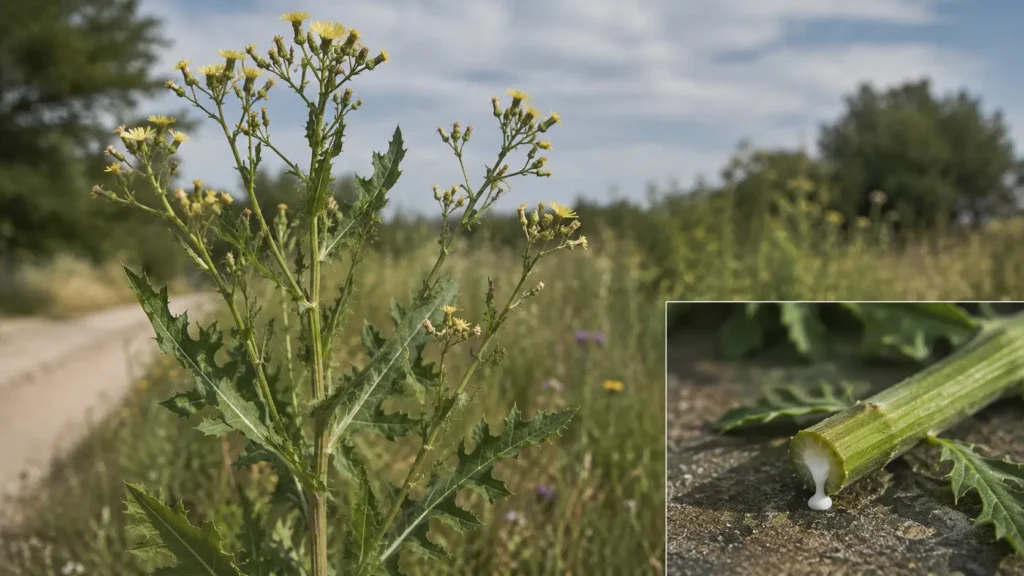
Wild Lettuce is the common trade name for Lactuca virosa, a herbaceous plant in the family Asteraceae. The species is closely related to other plants in the genus Lactuca and is characterised by, among other things, yellow flower heads, a sturdy stem and a white milky sap that the plant releases when its tissue is damaged.
In this guide, we go through the plant’s botanical identity, natural distribution, appearance and chemical composition. In addition, we explain terms such as lactucarium, lactucin and lactucopicrin, as well as the difference between crushed plant material and powder. Finally, we look at documentation, quality and safe product classification.
Wild Lettuce quick facts
| Scientific name | Lactuca virosa L. |
|---|---|
| Common name | Wild Lettuce / bitter lettuce |
| Plant family | Asteraceae |
| Order | Asterales |
| Plant type | Biennial herb |
| Natural distribution | Europe, Madeira and north-western Africa |
| Known compound groups | Sesquiterpene lactones and other plant metabolites |
| Product forms at Aromexperten | Crushed plant material and powder |
| Origin of Aromexperten’s raw material | Europe |
Contents
- What is Wild Lettuce?
- Wild Lettuce and Lactuca virosa
- Where does Lactuca virosa grow?
- What does the plant look like?
- What is the plant’s white latex?
- What does lactucarium mean?
- Which compounds does Lactuca virosa contain?
- Lactucin and lactucopicrin
- Why can the chemical profile vary?
- Powder or crushed raw material?
- How do you assess quality?
- Storage
- Research and safety
- Product classification
- Frequently asked questions
What is Wild Lettuce?
Wild Lettuce is a common English name for Lactuca virosa. The species belongs to the family Asteraceae, the same large plant family that includes dandelions, chicory and several other Lactuca species.
Despite the name, Wild Lettuce should not automatically be equated with ordinary cultivated lettuce. Instead, Lactuca virosa is a separate botanical species with its own morphological and chemical characteristics.
The plant develops a sturdy above-ground structure and produces a white milky sap when leaves or stems are damaged. This latex has received a great deal of attention in historical and chemical literature.
That is why it is important to distinguish between the plant itself, dried plant material, plant latex and historical preparations of the latex.
Are Wild Lettuce and Lactuca virosa the same plant?
Yes, when the trade name Wild Lettuce is used specifically for Lactuca virosa.
The Royal Botanic Gardens, Kew, accepts Lactuca virosa L. as a distinct species name within the genus Lactuca.
At the same time, everyday names such as “wild lettuce” can be used less precisely in trade and popular literature. The scientific name therefore gives much better botanical precision.
Botanical identification: a clear raw material description should always state Lactuca virosa and not just the name Wild Lettuce.
Read the taxonomic record at
Royal Botanic Gardens, Kew – Lactuca virosa
.
Where does Lactuca virosa grow?
Kew states that the natural range of Lactuca virosa covers Madeira, large parts of Europe and north-western Africa.
The species occurs naturally in, for example, France, the United Kingdom, Spain, Portugal, Italy, Germany, Greece, Morocco and Algeria.
In addition, people have introduced the species to certain other areas outside its natural range.
Kew describes it as a plant that mainly belongs in temperate environments.
Aromexperten’s raw material has Europe as its stated commercial origin. This lies within the species’ main geographical range.
What does Wild Lettuce look like?
Lactuca virosa develops an upright and relatively sturdy stem. The leaves are oblong and can have clearly toothed or lobed edges.
In addition, the stem can develop reddish or violet tones. During flowering, the plant forms several small yellowish flower heads.
The fruits develop a pappus, a collection of fine hairs that helps the seed spread with the wind.
Another characteristic feature is the white plant latex that appears when the tissue is damaged.
Overall, however, more characteristics than colour and leaf shape are needed for reliable species identification. When botanical identity matters, supplier documentation should complement the visual assessment.
What is the white latex in Wild Lettuce?
Plants in the genus Lactuca can produce a white milky sap, often called latex, in specialised plant structures.
When a leaf or stem is damaged, the plant releases the latex. In this way, it functions as part of the plant’s natural chemical and physical defence system.
Researchers have analysed latex from various Lactuca species and identified several sesquiterpene lactones and their chemical derivatives.
For example, a study in the Journal of Biological Chemistry describes lactucin, deoxylactucin and lactucopicrin, as well as conjugated forms of these compounds, in latex from Lactuca.
Read the study via
PubMed – Metabolite profiling of sesquiterpene lactones from Lactuca species
.
What does lactucarium mean?
The term lactucarium often appears in older literature about Wild Lettuce.
The word refers to a material that was historically obtained by collecting and drying latex from certain Lactuca species.
That is why lactucarium is not the same as whole dried leaves, crushed plant material or ordinary plant powder.
| Term | What does it describe? |
|---|---|
| Whole plant | The botanical organism Lactuca virosa |
| Crushed raw material | Dried plant material that the producer has broken into smaller pieces |
| Powder | Dried plant material that the producer has ground more finely |
| Latex | The natural white milky sap that the plant produces |
| Lactucarium | Historical name for collected and dried Lactuca latex |
In other words, a product made from ground Lactuca virosa should not be described as lactucarium if it actually consists of ordinary dried plant material.
Which compounds does Lactuca virosa contain?
Chemical research on Lactuca virosa and other species in the genus Lactuca describes several natural secondary plant compounds.
Particular interest has been directed at sesquiterpene lactones. This group includes lactucin, lactucopicrin, 8-deoxylactucin and various closely related derivatives.
In addition, researchers have described other groups of compounds within Lactuca, for example phenolic compounds and flavonoids.
This does not mean, however, that every sample contains exactly the same compounds or the same levels.
Important: scientific literature describes the plant species or analysed research samples. It does not automatically show the chemical profile of a specific commercial batch.
What are lactucin and lactucopicrin?
Lactucin and lactucopicrin are natural sesquiterpene lactones that researchers have studied within the genus Lactuca and in closely related plants.
Chemically, the compounds belong to the group of guaianolide lactones. In addition, this type of compound contributes to the characteristic bitterness of several lettuce and chicory plants.
At the same time, studies of Lactuca show that the plant can contain both free compounds and chemically bound derivatives.
That is why a simple statement such as “contains lactucopicrin” is not the same as a quantitative analysis of a commercial product.
For an actual content figure, the laboratory needs to analyse the raw material in question using a suitable method and relevant reference standards.
Why can the chemical profile vary?
Botanical raw materials are naturally variable materials.
Research within Lactuca shows, for example, that the profile of sesquiterpene lactones can vary between species and varieties. In addition, the proportions can change depending on the plant’s developmental stage.
Which plant part the laboratory analyses also matters. Latex, leaves, stem and root do not necessarily show the same chemical profile.
Consequently, you should be careful about transferring a result from a particular plant part or research study to an entirely different raw material.
Geographical origin, harvest time, drying and storage conditions can also contribute to differences between botanical batches.
Wild Lettuce as powder or crushed raw material
Aromexperten offers Lactuca virosa as both powder and crushed botanical material.
Both forms come from the same botanical raw material. However, they differ in particle size and physical structure.
| Product form | Processing | Practical difference |
|---|---|---|
| Crushed | Dried plant material is broken into smaller pieces | The plant structure is more clearly visible |
| Powder | Dried plant material is ground into smaller particles | The material gets a finer and more uniform physical form |
| Extract | Selected components are transferred from the raw material through an extraction process | A different product form from ordinary plant powder |
Grinding is not extraction. A powder does not become more concentrated just because the producer grinds the material more finely.
Read the product information for
Wild Lettuce – Lactuca virosa
.
How do you assess the quality of Wild Lettuce?
Colour, smell and structure can give a first impression of a botanical raw material. However, visual properties are not enough to verify botanical identity or chemical composition.
A more thorough quality assessment therefore combines raw material information with traceability and relevant analytical data.
It helps to check the following:
- the full botanical name Lactuca virosa
- which plant part or parts the raw material consists of
- country of origin
- whether the material is crushed or powdered
- batch number where available
- date and traceability information
- available microbiological analyses
- any heavy metal analyses
- storage information
- the product’s clearly stated technical intended use
What can a laboratory analysis show?
Different analyses answer different questions.
For example, microbiological tests can examine specified microorganisms. A separate analysis can instead measure selected heavy metals.
If you want to determine the amount of lactucin or lactucopicrin, however, a relevant chemical analysis is required.
That is why a product description should never use a microbiological quality test as evidence of a specific alkaloid or lactone content.
How do you store Wild Lettuce?
Store dried botanical raw materials in a dry, cool place, protected from direct sunlight.
In addition, the packaging should be kept properly closed to reduce contact with moisture, air and foreign material.
Powder has a larger exposed surface than coarser crushed material. That is why unsuitable storage conditions can affect finely divided material more quickly.
Always follow the information on the product packaging. Also keep the raw material out of the reach of children and separate from food, medicines and animal feed.
What does research say about Wild Lettuce and safety?
The scientific literature on Lactuca virosa includes both chemical studies and medical case reports.
One published case report describes eight people who needed hospital care after ingesting Wild Lettuce. All of them recovered, but one person needed intensive care for part of the hospital stay.
This matters from a raw material perspective. Historical information or laboratory research about a plant should not be interpreted as evidence that a botanical product is suitable for ingestion.
Aromexperten’s Wild Lettuce is not intended for consumption. This article therefore gives no instructions on dosage, preparation, ingestion, inhalation or any other medical use.
The published case report is available at
PubMed – Wild lettuce (Lactuca virosa) toxicity
.
Product classification and Wild Lettuce
A plant’s botanical history or its appearance in older literature does not automatically determine how a commercial product may be classified in the EU.
Instead, the product form, actual composition, intended use and marketing need to be assessed in context.
The European Commission provides, among other things, a Novel Food status catalogue with information on raw materials that may fall under the rules on novel foods.
The catalogue is for guidance only. That is why it does not replace a complete product-specific legal assessment.
Read more at
European Commission – Novel Food Status Catalogue
.
Aromexperten’s product classification: Wild Lettuce is sold as a botanical raw material for technical and botanical use. The product is not sold as food, a food supplement, a medicine or animal feed and is not intended for consumption.
Frequently asked questions about Wild Lettuce
What is Wild Lettuce?
Wild Lettuce is a common name for Lactuca virosa, a biennial herb in the family Asteraceae.
Is Wild Lettuce ordinary lettuce?
No. Lactuca virosa and cultivated lettuce, Lactuca sativa, belong to the same genus but are different botanical species.
Where does Lactuca virosa grow naturally?
Kew gives Madeira, Europe and north-western Africa as the species’ natural range.
What is the white liquid in the plant?
It is the plant’s natural latex or milky sap. When the tissue is damaged, the plant releases the latex from specialised structures.
What is lactucarium?
Lactucarium is a historical name for material made from collected and dried Lactuca latex. It is therefore not the same as ordinary crushed plant material or powder.
What is lactucin?
Lactucin is a natural sesquiterpene lactone that researchers have identified within the Lactuca genus.
What is lactucopicrin?
Lactucopicrin is a closely related sesquiterpene lactone that also appears in chemical research on Lactuca.
Do all batches have the same levels of lactucin and lactucopicrin?
This cannot be assumed. Research shows variation between plant materials and developmental stages. That is why an exact content figure requires analysis of the batch in question.
Is Wild Lettuce powder an extract?
No. Powder is ground plant material. An extract, by contrast, requires a separate extraction process.
Is Aromexperten’s Wild Lettuce intended for consumption?
No. The product is sold as a botanical raw material for technical use and is not intended as food, a food supplement, a medicine, animal feed or for human consumption.
Summary
Wild Lettuce is the common trade name for Lactuca virosa, a plant in the family Asteraceae that is native to Europe, Madeira and north-western Africa.
The plant develops white latex and contains several natural sesquiterpene lactones. Among others, researchers have studied lactucin, lactucopicrin and closely related compounds within the Lactuca genus.
The chemical profile can, however, vary between plant materials, plant parts and developmental stages. That is why general scientific literature cannot replace a batch-specific product analysis.
Aromexperten offers the raw material as crushed plant material and powder of European origin. Both forms are botanical raw materials, while an extract or lactucarium describes other types of material.
Explore Wild Lettuce as a botanical raw material
Read more about the botanical name, available forms, origin, storage and the product’s stated technical intended use.
The product is sold as a botanical raw material for technical use. It is not food, a food supplement, a medicine or animal feed and is not intended for consumption.
Sources and further reading
-
Royal Botanic Gardens, Kew – Lactuca virosa L.
-
Sessa et al. – Metabolite profiling of sesquiterpene lactones from Lactuca species
-
Journal of Biological Chemistry – metabolite profiling of Lactuca latex
-
Besharat et al. – Wild lettuce (Lactuca virosa) toxicity
-
PubMed Central – full text of the case report on Lactuca virosa
-
European Commission – Novel Food Status Catalogue
Last fact-checked:

 Best Sellers
