Svenska
 News
News Botanical Blends
 Mitragyna
 Kanna (sceletium tortuosum)
 Akuamma (Picralima nitida)
 Tongkat Ali (Eurycoma longifolia)
 Blue Lotus (Nymphaea caerulea)
 Sakae Naa
 Wild Lettuce (Lactuca virosa)
 Damiana (turnera diffusa)
 Zornia latifolia (Maconha Brava)
 CBD products
 Aromatherapy
Botanicals
Tongkat Ali Sweden – Raw Material, Quality, and Physta®
Aug
Are you looking for Tongkat Ali in Sweden? Tongkat Ali is the common name for Eurycoma longifolia, a botanical raw material from Southeast Asia. On the Swedish market, the raw material is available as root powder, ratio extract, and standardized extracts. The differences between products lie primarily in origin, processing, standardization, and documentation.
Contents
Tongkat Ali in Sweden
Interest in botanical raw materials from Southeast Asia has made Eurycoma longifolia available on the Swedish market as well. However, products can differ considerably from one another.
One product may consist of relatively simply processed root material, while another may be a concentrated extract. Additionally, there are standardized raw materials where the producer analyzes defined quality parameters from batch to batch.
Therefore, the product name Tongkat Ali alone is not sufficient to describe what type of raw material is being compared. Origin, plant part, extraction method, and analytical documentation provide a much clearer picture.
In short: two products both sold as Tongkat Ali can have very different raw material forms, manufacturing processes, and documentation.
What is Tongkat Ali?
Tongkat Ali is the most common international name for Eurycoma longifolia. The species grows naturally in Southeast Asia and is particularly associated with Malaysia and Indonesia, among other countries.
The root is primarily used as botanical starting material. Producers can dry and grind the root into powder or further process the material through various extraction processes.
For a scientific overview of the plant’s botany, chemical components, and processing, you can read this review via PubMed Central.
If you want to read more about the plant’s botany, origin, and history, our own in-depth article What is Tongkat Ali? is available.
Different Forms of Tongkat Ali in Sweden
When comparing Tongkat Ali products, the raw material form is a good starting point. In practice, several different types occur.
| Raw Material Form | What Does It Describe? | Documentation |
|---|---|---|
| Root Powder | Dried and ground root | Varies between producer and batch |
| Ratio Extract | Extract with stated ratio, for example 100:1 | Scope varies |
| Standardized Extract | Extract with defined analytical parameters | Specifications and batch data can be provided |
| Physta® | Standardized water extract of Tongkat Ali root | Multiple defined parameters and batch-specific COA |
For a more detailed comparison, you can read Tongkat Ali Powder or Extract?.
What Should You Check When Comparing Tongkat Ali?
It is easy to focus on a high ratio number or a single analytical marker. However, several pieces of information together provide a more useful picture of the raw material.
- Botanical name: verify that the product states Eurycoma longifolia.
- Plant part: check whether the raw material comes from the root.
- Origin: examine where the raw material comes from.
- Raw material form: distinguish between powder, ratio extract, and standardized extract.
- Extraction method: check how the producer has manufactured the extract where this information is available.
- Standardization: see which analytical parameters the producer actually controls.
- Batch number: documentation should be traceable to the current production batch.
- COA: check whether a current Certificate of Analysis is available.
Overall, transparency regarding raw material and documentation is more informative than a single marketing claim.
Standardized Extract or Ratio Extract?
Ratio and standardization describe two different things.
A ratio such as 100:1 describes information about the relationship between starting material and extract according to the producer’s process. However, it does not automatically indicate the content of a specific chemical analytical marker.
In standardization, the producer instead defines one or more measurable parameters. The producer then analyzes the batches and compares the results with the established specifications.
EFSA has published a scientific opinion that describes, among other things, composition and specifications for a standardized water extract of Eurycoma longifolia. You can read EFSA’s opinion here.
100:1 and standardized are therefore not two ways of expressing the same thing. Ratio describes an extraction ratio, while standardization describes control of defined properties.
Read more in our guide What Does Standardized Extract Mean?.
Tongkat Ali Physta® in Sweden
Physta® is a trademarked standardized water extract from the root of Eurycoma longifolia. The raw material comes from Malaysia and the producer controls several defined quality parameters.
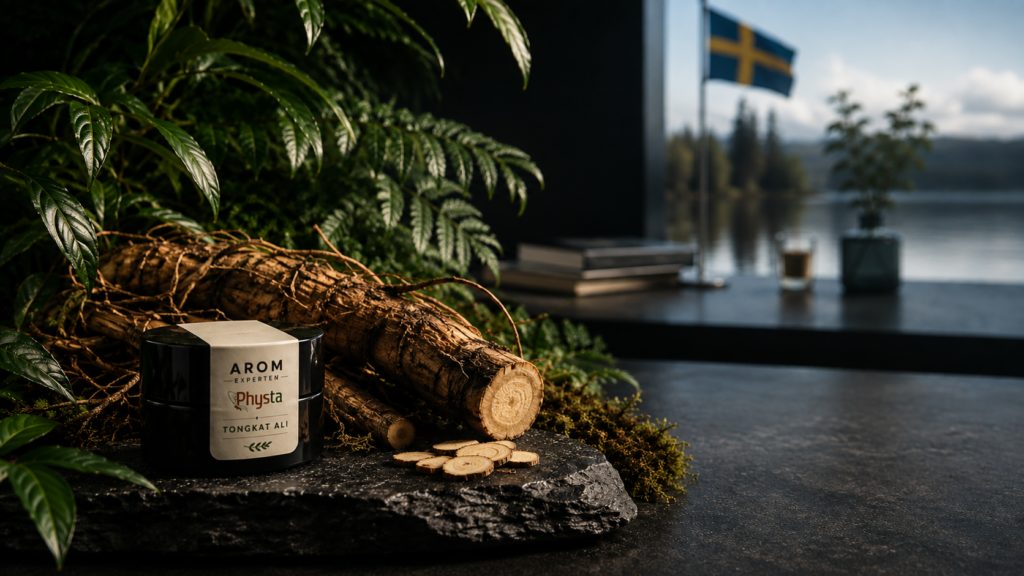
Aromexperten is the exclusive distributor of Tongkat Ali Physta® in Scandinavia. Physta® therefore has a clear role in Aromexperten’s Swedish Tongkat Ali range as the standardized and batch-documented raw material.
Standardization includes eurycomanone, glycosaponins, polysaccharides, and total protein fraction, among other parameters.
If you want to understand the extract in more detail, you can read What is Physta®?.
See current product:
Tongkat Ali Physta® – current batch and analytical documentation →
Batch Analysis and COA
A Certificate of Analysis, COA, is an analytical certificate that provides information for a specific production batch.
The document can show, among other things, which parameters the laboratory has analyzed, which specifications apply, and what result the current batch achieved.
Therefore, you should verify that the batch number in the analytical document corresponds to the batch number of the product.
Example from Current Physta® Batch
| Parameter | Result | Specification |
|---|---|---|
| Eurycomanone | 0.87% | 0.8–1.5% |
| Glycosaponins | 51.1% | Minimum 40% |
| Polysaccharides | 37.5% | Minimum 30% |
| Total Protein Fraction | 35.4% | Minimum 22% |
The values above apply to Physta® batch TA 2506105. Future batches may show different analytical values within the established specifications.
You can read our guide on how to read a COA or open the analytical certificate for the current Physta® batch.
Eurycomanone as Analytical Marker
Eurycomanone is a quassinoid that occurs in Eurycoma longifolia and is used as a chemical analytical marker for certain Tongkat Ali extracts.
However, a higher value does not automatically mean higher overall quality. For a standardized raw material, it is more important to check how the analytical result relates to the established specification and what other documentation is available.
Scientific literature describes eurycomanone as one of several compounds used in chemical characterization of Eurycoma longifolia. For more background, you can read the review via PubMed Central.
Also read our in-depth article What is Eurycomanone?.
Frequently Asked Questions About Tongkat Ali in Sweden
Is Tongkat Ali Available in Sweden?
Yes, Tongkat Ali is available on the Swedish market in various raw material forms. However, range and documentation may vary between different suppliers.
Are All Tongkat Ali Extracts the Same?
No. Extraction method, ratio, origin, standardization, and analytical documentation can differ considerably between products.
What Is the Difference Between Physta® and Regular Tongkat Ali?
Tongkat Ali is the name of the plant Eurycoma longifolia. Physta®, however, is a specific standardized water extract manufactured from Tongkat Ali root.
What Does 100:1 Tongkat Ali Mean?
100:1 is a stated extraction ratio. However, the number does not automatically indicate the content of eurycomanone or any other specific analytical marker.
What Is a Standardized Tongkat Ali Extract?
It means that the producer has defined one or more analytical parameters and controls production batches against established specifications.
What Should I Check in a COA?
Check primarily product identity, batch number, specifications, and measured analytical results. Where analytical method and date are stated, this information is also relevant.
Sources and Further Reading
Tongkat Ali Physta® at Aromexperten
If you want to see the standardized raw material, you can go directly to Tongkat Ali Physta® with current batch and analytical documentation.
You can also read more about what Tongkat Ali is, what Physta® is, or the difference between powder and extract.

 Best Sellers