


 Svenska

 News
 Botanical Blends
 Mitragyna
 Kanna (sceletium tortuosum)
 Akuamma (Picralima nitida)
 Tongkat Ali (Eurycoma longifolia)
 Blue Lotus (Nymphaea caerulea)
 Sakae Naa
 Wild Lettuce (Lactuca virosa)
 Damiana (turnera diffusa)
 Zornia latifolia (Maconha Brava)
 CBD products
 Mushroom Extracts
 Aromatherapy
Botanicals
What Is Damiana? A Guide to Turnera diffusa
Sep
Damiana is the common name of Turnera diffusa, an aromatic shrub in the family Passifloraceae. The plant occurs naturally from southern Texas through parts of Central America and the Caribbean to parts of South America. Above all, the small aromatic leaves are the plant part most often found as a botanical raw material.
In this guide, we go through Damiana’s botanical identity, natural distribution, appearance and chemical composition. In addition, we look at why the plant’s chemical profile can vary between growing sites and how to distinguish dried leaves from powder and extract. Finally, we go through quality, documentation, storage and product classification.
Damiana quick facts
| Scientific name | Turnera diffusa Willd. ex Schult. |
|---|---|
| Common name | Damiana |
| Plant family | Passifloraceae |
| Order | Malpighiales |
| Plant type | Small shrub or subshrub |
| Natural distribution | Southern Texas, Central America, the Caribbean and parts of eastern Brazil |
| Common botanical raw material | Dried leaves |
| Known compound groups | Flavonoids, terpenoids, phenolic compounds and other plant metabolites |
| Aromexperten’s raw material | 100% Turnera diffusa leaves |
| Origin | Mexico |
Contents
- What is Damiana?
- Damiana and Turnera diffusa
- Where does Damiana grow?
- What does the plant look like?
- Why are the leaves used as a botanical raw material?
- Which compounds are found in Damiana?
- Flavonoids and phenolic compounds
- Terpenoids and aromatic components
- Why does the chemical profile vary?
- Leaves, powder or extract?
- How do you assess quality?
- Storage
- Product classification
- Frequently asked questions
What is Damiana?
Damiana is the established common name of Turnera diffusa, a small shrub or subshrub in the family Passifloraceae.
The plant develops small aromatic leaves and yellow flowers. Above all, the leaves have become the most common commercial botanical raw material.
The name Damiana, however, describes the plant itself or a raw material from the plant. It does not refer to a single chemical compound.
That is why it is important to distinguish between the botanical name, the plant part and the chemical profile that researchers or laboratories find in a specific sample.
Are Damiana and Turnera diffusa the same plant?
Yes. Damiana is the common name, while Turnera diffusa is the accepted scientific species name.
The Royal Botanic Gardens, Kew, places the species in the genus Turnera and the family Passifloraceae.
In addition, Kew’s taxonomic register shows that older literature may use other names. One example is Turnera aphrodisiaca, which Kew today treats as a synonym of Turnera diffusa.
For clear botanical identification: a product description should state the full scientific name Turnera diffusa and not just the trade name Damiana.
Read the taxonomic record at
Royal Botanic Gardens, Kew – Turnera diffusa
.
Where does Damiana grow naturally?
Kew states that Turnera diffusa has a natural range from southern Texas through Mexico and Central America to the Caribbean and parts of eastern Brazil.
The species mainly occurs in seasonally dry tropical environments.
That is why Damiana is often associated with drier scrubland and other environments where the plant copes with distinct periods of lower rainfall.
Aromexperten’s raw material has Mexico as its stated country of origin. Mexico lies in the middle of the species’ natural range.
At the same time, it is important to distinguish between the species’ natural geographical range and the exact place where a commercial batch was grown or harvested.
What does Damiana look like?
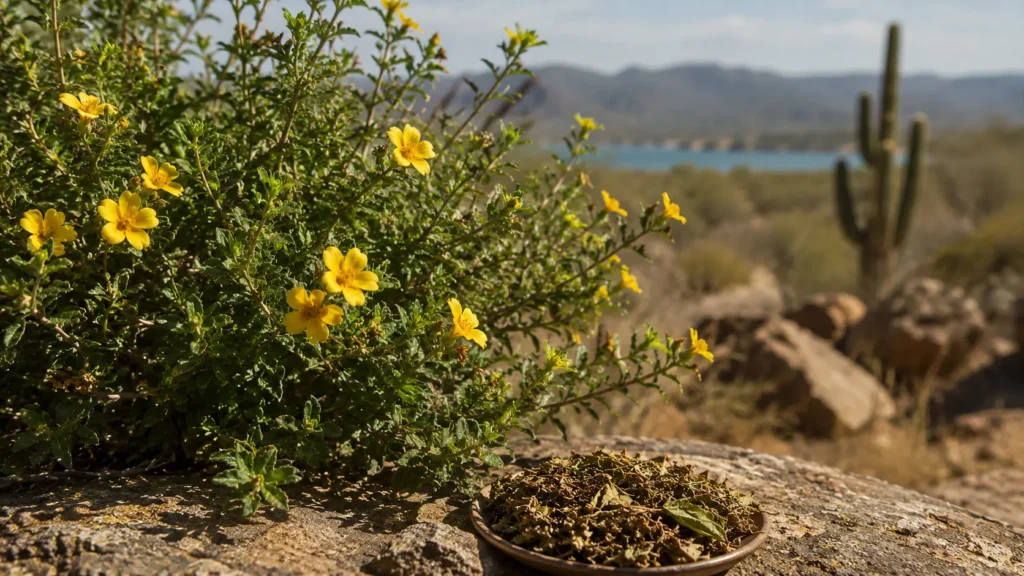
Turnera diffusa grows as a small, often densely branched shrub.
The leaves are relatively small and can be obovate or oval. The edges have distinct small teeth, while the leaf surface contains fine glandular structures.
In addition, the plant develops small yellow flowers that make the species relatively easy to recognise during the flowering period.
At the same time, Kew’s botanical descriptions show that the plant’s exact size and shape can vary between populations and growing sites.
That is why botanical identity should not be determined solely by colour or a quick visual comparison of dried leaves.
Why is Damiana found as dried leaves?
The aromatic leaves are the plant part often used as a commercial botanical raw material.
When the producer harvests the raw material, the leaf material is separated and dried. The producer can then keep the leaves coarsely cut or process them further into a finer material.
Drying reduces the water content and makes the raw material more stable during storage and transport.
However, drying does not mean that the material automatically becomes an extract or a standardised product.
Dried Damiana leaves are still botanical leaf material. Extraction and standardisation are separate processing steps that require other processes and other documentation.
Which compounds are found in Damiana?
Turnera diffusa contains many different natural plant compounds.
A comprehensive phytochemical study isolated and characterised 35 different compounds from the plant. The researchers identified, among others, flavonoids, terpenoids, phenolic compounds, sugar-related compounds and cyanogenic derivatives.
In addition, the study identified several compounds that the researchers had not previously described from the plant.
This shows that Damiana’s chemical profile is much more complex than a simple list of one or two so-called active ingredients.
Important: a scientific study of Turnera diffusa shows which compounds the researchers found in their analysed samples. It does not automatically show the exact composition of every commercial Damiana batch.
Read the study via
PubMed – Phytochemical investigation of Turnera diffusa
.
Flavonoids and phenolic compounds in Damiana
Flavonoids are a well-documented part of Damiana’s phytochemistry.
The published phytochemical study identified several flavonoid structures, including derivatives of luteolin, apigenin, syringetin and laricitrin.
In addition, broader research reviews of the genus Turnera have described many different flavonoids and other phenolic compounds.
Flavonoids act as secondary plant metabolites and can fulfil several roles in the plant, for example related to colour, environmental stress and the plant’s chemical defence.
However, a product text should not state an exact flavonoid content unless the laboratory has analysed the product in question.
Terpenoids and Damiana’s aromatic profile
Damiana leaves have a characteristic aroma that is linked to the plant’s volatile chemical components.
Research on Turnera diffusa has identified several terpenoids and other volatile compounds.
For example, one study analysed plants from different areas of Tamaulipas in Mexico and identified 21 compounds in the essential oil fractions.
At the same time, the researchers observed clear differences between plants from different geographical locations.
Consequently, the origin of the raw material can affect its aromatic and chemical profile.
Read the study:
Natural variability of essential oil and antioxidants in Turnera diffusa
.
Why can Damiana’s chemical profile vary?
Botanical raw materials are naturally variable materials.
Studies of Turnera diffusa show that geographical origin can affect both the composition of the volatile oil and the amount of phenolic compounds in the plant material.
In addition, climate, rainfall, soil, the plant’s developmental stage and harvest time can contribute to variation.
After harvest, the drying method and storage conditions can also affect the properties of the raw material.
That is why you should not use an analytical result from a research population in Mexico as if it were a batch certificate for all Damiana products.
Damiana as leaves, powder or extract
Damiana can be found in several different botanical product forms.
Aromexperten’s current product consists of dried Turnera diffusa leaves.
| Product form | Processing | What does the form describe? |
|---|---|---|
| Dried leaves | The producer harvests and dries the leaf material | Botanical leaf material in dried form |
| Crushed leaves | The producer breaks dried leaves into smaller pieces | Coarser divided leaf material |
| Powder | The producer grinds dried leaf material | Finer physical particle size |
| Extract | The producer uses an extraction process to transfer selected components | A different product form from ordinary dried leaves |
| Standardised extract | The producer checks defined analytical markers against a specification | Requires stated markers and relevant analytical support |
In other words, dried or crushed leaves are not the same as an extract.
Read the product information for
Damiana – Turnera diffusa leaves
.
How do you assess the quality of Damiana?
Colour, aroma and leaf structure can give a first impression of a dried botanical raw material.
However, such visual properties cannot alone verify species identity, purity or chemical profile.
A better quality assessment combines botanical information with traceability and relevant documentation.
Above all, check:
- the scientific name Turnera diffusa
- which plant part the raw material consists of
- country of origin
- whether the raw material consists of leaves, powder or extract
- batch number where available
- harvest or production information when the supplier states it
- available laboratory documents
- storage information
- the condition and sealing of the packaging
- the product’s clearly stated technical intended use
What can a COA show?
COA stands for Certificate of Analysis.
Such a document can, for example, report microbiological parameters, heavy metals, moisture content or selected chemical markers.
However, a COA only shows the parameters the laboratory has actually analysed.
If the laboratory has tested microbiology, for example, the result says nothing about the exact flavonoid or terpenoid profile.
That is why every product claim needs to be linked to the right type of documentation.
How do you store Damiana leaves?
Store dried botanical leaves in a dry, cool place, protected from direct sunlight.
In addition, the packaging should be kept well sealed to limit contact with moisture, air and foreign material.
Aromatic plant materials contain volatile components. That is why unsuitable storage can affect both the scent and the general properties of the raw material over time.
Always follow the product’s specific storage information and keep the raw material out of the reach of children.
Damiana and product classification
The botanical or historical use of a plant does not automatically determine how a commercial product may be classified or marketed.
Instead, companies need to take into account the product form, content, intended use and current legislation.
A botanical raw material should therefore be described based on the product classification that actually applies to the product in question.
Aromexperten’s product classification: The Damiana product consists of 100% Turnera diffusa leaves from Mexico and is sold as a botanical raw material for crafts and technical purposes.
This article therefore describes the plant from a botanical, chemical and raw material perspective. It contains no instructions on consumption, dosage or medical use.
Frequently asked questions about Damiana
What is Damiana?
Damiana is the common name of Turnera diffusa, a small shrub in the family Passifloraceae.
Are Damiana and Turnera diffusa the same thing?
Yes. Damiana is the common trade name, while Turnera diffusa is the scientific species name.
Where does Damiana grow naturally?
The species occurs naturally from southern Texas through Mexico and Central America to the Caribbean and parts of eastern Brazil.
Which part of Damiana is used as a botanical raw material?
The leaves are the most common commercial raw material. Aromexperten’s product consists of dried Turnera diffusa leaves from Mexico.
Which compounds are found in Damiana?
Researchers have identified several groups of compounds, including flavonoids, terpenoids, phenolic compounds, saccharides and cyanogenic derivatives.
Do all Damiana products have the same chemical profile?
No. Studies show variation between plants from different geographical areas. That is why exact product information requires analysis of the raw material or batch in question.
Are dried Damiana leaves the same as an extract?
No. Dried leaves consist of botanical leaf material. An extract, by contrast, requires a separate extraction process.
Is Damiana powder more concentrated than leaves?
Not automatically. Grinding mainly changes the particle size and the physical form. It does not in itself mean chemical concentration.
How do you store Damiana?
Store dried leaves in a dry, cool place, well sealed and protected from direct sunlight.
Is Aromexperten’s Damiana intended for consumption?
No. The product is sold as a botanical raw material for crafts and technical purposes, and this article gives no consumption or dosage instructions.
Summary
Damiana is the common name of Turnera diffusa, an aromatic shrub in the family Passifloraceae.
The species’ natural range extends from southern Texas through Central America and the Caribbean to parts of South America. Aromexperten’s raw material comes from Mexico.
In addition, scientific analyses show that the plant has a complex chemical profile including flavonoids, terpenoids and phenolic compounds.
At the same time, studies show that the composition can vary between geographical populations. That is why you should distinguish general scientific information about the species from actual analytical results for a specific product batch.
Aromexperten’s current Damiana consists of dried Turnera diffusa leaves and is sold as a botanical raw material for crafts and technical purposes.
Explore Damiana as a botanical raw material
Read more about the botanical name, origin, available sizes, storage and the product’s stated technical intended use.
The product consists of botanical leaf material and is sold for crafts and technical purposes. This article contains no instructions on consumption or medical use.
Sources and further reading
-
Royal Botanic Gardens, Kew – Turnera diffusa Willd. ex Schult.
-
Zhao et al. – Phytochemical investigation of Turnera diffusa
-
Urbizu-González et al. – Natural variability of essential oil and antioxidants in Turnera diffusa
-
Szewczyk & Zidorn – Ethnobotany, phytochemistry and bioactivity of the genus Turnera with a focus on Turnera diffusa
Last fact-checked:

 Best Sellers
