


 Svenska

 News
 Botanical Blends
 Mitragyna
 Kanna (sceletium tortuosum)
 Akuamma (Picralima nitida)
 Tongkat Ali (Eurycoma longifolia)
 Blue Lotus (Nymphaea caerulea)
 Sakae Naa
 Wild Lettuce (Lactuca virosa)
 Damiana (turnera diffusa)
 Zornia latifolia (Maconha Brava)
 CBD products
 Mushroom Extracts
 Aromatherapy
Botanicals
Lion’s Mane: Fruiting Body or Mycelium – What Is the Difference?
Sep
Lion’s Mane fruiting body and Lion’s Mane mycelium are not the same raw material.
Both come from the fungus Hericium erinaceus, but they represent different stages of the fungal life cycle and can also have different chemical profiles. That is why the information about which part of the fungus a product contains matters when comparing Lion’s Mane powders and extracts.
In short: The fruiting body is the visible structure the fungus forms, whereas the mycelium is a network of microscopic hyphae. Research on Hericium erinaceus also shows that certain secondary metabolites are more clearly associated with the fruiting body and others with the mycelium.
In this guide
What is Lion’s Mane?
Lion’s Mane is the English name of the fungus Hericium erinaceus. The scientific name Hericium erinaceus (Bull.) Pers. is the accepted name in Index Fungorum, and the species belongs to the family Hericiaceae.
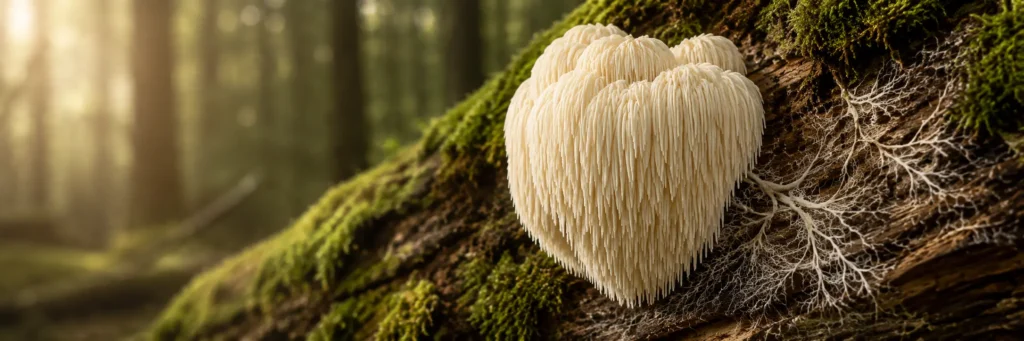
The fungus is recognised by its characteristic white structure with hanging spines. It therefore looks clearly different from many classic cap-and-stem mushrooms.
But when Lion’s Mane is used as a raw material, knowing the species name is not enough. You also need to know which part of the fungus the producer has actually used.
What is the Lion’s Mane fruiting body?
The fruiting body is the macroscopic structure the fungus forms for reproduction. In Lion’s Mane, it is the characteristic white, spiny structure that most people associate with the mushroom itself.
The fruiting body consists of organised fungal tissue and contains, among other things, polysaccharides, sterols and a large number of secondary metabolites.
Researchers have also identified several so-called hericenones in fruiting bodies of Hericium erinaceus. Modern analytical research continues to map this group of compounds.
What is Lion’s Mane mycelium?
The mycelium is the vegetative network of the fungus. It consists of thin threads called hyphae, which together grow through the material in which the fungus establishes itself.
The mycelium can therefore exist long before a visible fruiting body develops. It represents a different biological structure from the mature Lion’s Mane fruiting body.
In commercial cultivation, the producer may grow mycelium in, for example, liquid culture or on a solid substrate. The term “Lion’s Mane mycelium” therefore sometimes needs to be supplemented with more information about how the raw material was grown and separated from its substrate.
Lion’s Mane fruiting body vs mycelium – what is the difference?
The most fundamental difference is biological: the fruiting body and the mycelium are two different structures of the same fungal organism.
| Property | Fruiting body | Mycelium |
|---|---|---|
| Structure | Macroscopic fungal tissue | Network of microscopic hyphae |
| Role | Reproductive structure | Vegetative growth |
| Cultivation | Develops from established mycelium | Grows through or in a growth medium |
| Studied compound groups | Including hericenones | Including erinacines |
| Raw material information | Should be stated as fruiting body | Should be stated as mycelium and describe the growth substrate where relevant |
This does not mean, however, that one part of the fungus is automatically “better” than the other. They should instead be regarded as different raw materials.
What is relevant therefore depends on the identity of the product, how the producer has grown and processed the material, and which compounds and quality parameters have been analysed.
Hericenones – mainly associated with the fruiting body
Hericenones are a group of secondary metabolites that researchers have isolated and studied from Hericium erinaceus.
Several studies link hericenones primarily to the fruiting body of the fungus. One study comparing mycelium, primordium and sporophore/fruiting body, for example, identified erinacine A in the mycelium, while the researchers quantified hericenones C and D in the fruiting body material.
In addition, researchers published a detailed chemical analysis of hericenones from the fruiting body of Hericium erinaceus in 2025. A larger scoping review from 2026 also describes an extensive range of identified hericenones.
Important: The fact that a compound appears in the research literature does not automatically mean that every Lion’s Mane product contains a certain amount of it. A specific raw material requires relevant analysis or a supplier specification.
Erinacines – mainly studied in mycelium
Erinacines are another group of secondary metabolites from Hericium erinaceus. Unlike hericenones, several erinacines have mainly been identified and studied in mycelium.
This is an important detail, because the terms are sometimes mixed up in product descriptions. A product containing Lion’s Mane fruiting body does not automatically have the same erinacine profile as a specific mycelium extract that researchers have examined.
In the same way, you cannot assume that a generic mycelium powder has the same chemical profile as the specific mycelium material used in a published study.
Where do beta-glucans fit in?
Lion’s Mane also contains polysaccharides, including beta-glucans. These compounds belong to the structural chemistry of the fungus and are a different type of compound from both hericenones and erinacines.
The research literature describes polysaccharides from the fruiting body, mycelium and culture medium of Hericium erinaceus. You therefore need to know which raw material an analysis refers to when interpreting a result.
In addition, total polysaccharides and beta-glucans are not the same analytical parameter. A high figure for total polysaccharides does not automatically tell you how much beta-glucan the material contains.
In practice when comparing raw materials: Look for a specified analytical method and a clear beta-glucan value instead of relying only on a general “polysaccharide value”.
Mycelium and growth substrate – why does it matter?
Mycelium needs a growth medium in order to grow. In solid-state cultivation, the producer may, for example, let the mycelium colonise grain or another organic substrate.
This means that a finished raw material may in some cases consist of both fungal mycelium and residues of the growth material. That is why the raw material declaration matters.
This does not mean that mycelium as a type of raw material is automatically of low quality. On the contrary, a great deal of research uses specifically cultivated mycelium cultures. But the product should clearly describe what the raw material actually consists of.
A good comparison should therefore ask questions such as:
- Is the product made from fruiting body or mycelium?
- If it contains mycelium – which growth medium was used?
- Has the producer separated the mycelium from the growth medium?
- Which compounds or quality parameters are analysed?
- Which analytical method is used?
- Is the product a powder or an actual extract?
Fruiting body does not automatically mean high quality
It is easy to simplify the discussion to “fruiting body is good and mycelium is bad”. Scientifically, that picture is too simple.
The fruiting body and the mycelium are biologically different raw materials, and research uses both. Quality should therefore be assessed using more criteria than just which part of the fungus is stated on the label.
For a documented Lion’s Mane extract, the following information is valuable, for example:
- correct species identity – Hericium erinaceus
- clearly stated part of the fungus
- origin of the raw material
- extraction method
- extraction solvent
- specified analytical parameters
- laboratory methods
- microbiological specification
- heavy metal specification
- manufacturing and traceability information
In other words: “100% fruiting body” is valuable information about the identity of the raw material, but it does not replace analysis and quality documentation.
What does this mean for Lion’s Mane extract?
When you compare Lion’s Mane products, it is first important to distinguish between the raw material and the processing form.
“Fruiting body” and “mycelium” tell you which part of the fungus the producer uses. “Powder” and “extract”, on the other hand, describe how the producer has processed the material.
A product can therefore be, for example:
- ground Lion’s Mane fruiting body
- extracted Lion’s Mane fruiting body
- dried Lion’s Mane mycelium
- an extract from specifically cultivated mycelium
That is why the words “Lion’s Mane” on the front of a product are not enough. The technical documentation should give a clearer picture of what the material actually is.
Aromexperten’s NordRelease® Lion’s Mane is based on 100% fruiting body of Hericium erinaceus. You can read more about the raw material, the water extraction and its specified analytical parameters on our page for
Lion’s Mane extract.
Would you like to compare different documented mushroom raw materials? Explore the full category of
mushroom extracts.
Summary: fruiting body or mycelium?
Lion’s Mane fruiting body and Lion’s Mane mycelium come from the same species, Hericium erinaceus, but they are not the same raw material.
The fruiting body is the visible reproductive structure of the fungus, while the mycelium is the network of hyphae responsible for vegetative growth. Chemical research also shows that compound profiles can differ between these structures.
Hericenones have mainly been associated with fruiting body material, while several erinacines have mainly been studied in mycelium. At the same time, polysaccharides and other compound groups occur in different parts of the fungus.
The best question is therefore not just “fruiting body or mycelium?” A better assessment looks at species identity, part of the fungus, cultivation method, extraction, analyses and documentation together.
About this content: This article describes fungal biology, raw material identity and published research on chemical compounds in Hericium erinaceus. It should not be interpreted as information about any medical effect or as a recommendation for consumption. Aromexperten’s products are sold as botanical mushroom raw materials for technical and raw material purposes.
Sources and further reading
-
Index Fungorum – Hericium erinaceus (Bull.) Pers.
-
Gonçalves et al. – Array of Metabolites in Italian Hericium erinaceus Mycelium, Primordium, and Sporophore
-
Wang et al. – Uncovering Hericenones from the Fruiting Bodies of Hericium erinaceus
-
Othman et al. – Hericenones From Hericium erinaceus: A Scoping Review of Structural Diversity
-
Friedman – Chemistry of Hericium erinaceus Fruiting Bodies and Mycelia
-
Recent developments in Hericium erinaceus polysaccharides from fruiting body, mycelium and culture broth

 Best Sellers
