


 Svenska

 News
 Botanical Blends
 Mitragyna
 Kanna (sceletium tortuosum)
 Akuamma (Picralima nitida)
 Tongkat Ali (Eurycoma longifolia)
 Blue Lotus (Nymphaea caerulea)
 Sakae Naa
 Wild Lettuce (Lactuca virosa)
 Damiana (turnera diffusa)
 Zornia latifolia (Maconha Brava)
 CBD products
 Mushroom Extracts
 Aromatherapy
Botanicals
What Is Zornia latifolia? A Guide to Maconha Brava
Sep
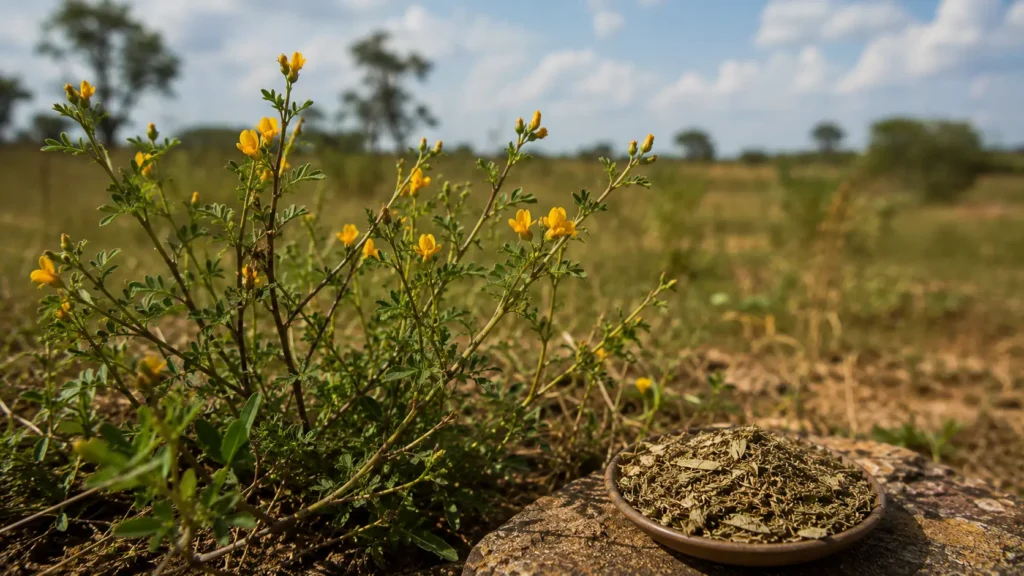
Zornia latifolia, also known as Maconha Brava, is a perennial herb or subshrub in the family Fabaceae. The species occurs naturally in tropical and subtropical parts of the Americas and grows mainly in open, sunny environments. As a botanical raw material, the plant is found as dried and crushed plant material, among other forms.
In this guide, we go through the species’ botanical identity, natural distribution, appearance and chemical profile. In addition, we look at why correct species identification is particularly important for Zornia latifolia, which flavonoids research has described and how to assess the quality and documentation of a botanical raw material.
Zornia latifolia quick facts
| Scientific name | Zornia latifolia Sm. |
|---|---|
| Common name | Maconha Brava |
| Plant family | Fabaceae |
| Order | Fabales |
| Plant type | Perennial herb or subshrub |
| Natural distribution | Tropical and subtropical parts of the Americas |
| Flowers | Small yellow to yellow-orange flowers |
| Known compound groups | Mainly flavonoids and other phenolic plant compounds |
| Aromexperten’s product form | Crushed botanical plant material |
| Stated origin | South or Central America |
Contents
- What is Zornia latifolia?
- What does Maconha Brava mean?
- Botanical identity
- Where does Zornia latifolia grow?
- What does the plant look like?
- Which compounds are found in Zornia latifolia?
- Flavonoids in Zornia latifolia
- What is syzalterin?
- Why is species verification especially important?
- Zornia latifolia and Stylosanthes guianensis
- Crushed raw material, powder or extract?
- How do you assess quality?
- Storage
- Product classification
- Frequently asked questions
What is Zornia latifolia?
Zornia latifolia is a plant species in the family Fabaceae, the legume family. Kew accepts the species as Zornia latifolia Sm.
The plant grows as a perennial herb or subshrub. Above all, it occurs in tropical and subtropical areas where it thrives in open, sunny and often seasonally dry environments.
As a botanical trade raw material, it is found under the name Maconha Brava, among others.
However, the trade name does not describe a particular chemical compound or a standardised extract. The name refers to the plant itself or a raw material from it.
What does Maconha Brava mean?
Maconha Brava is a Portuguese trade and common name used for Zornia latifolia, mainly in Brazilian and South American contexts.
The name can roughly be translated as “wild marijuana”, but the botanical relationship it implies is misleading.
Zornia latifolia is not cannabis. The species belongs to the family Fabaceae, while cannabis belongs to the family Cannabaceae.
That is why product descriptions should always prioritise the scientific name Zornia latifolia over common names that can create incorrect botanical associations.
Botanical identity: Zornia latifolia
The accepted scientific name is Zornia latifolia Sm.
The Royal Botanic Gardens, Kew, places the species in the genus Zornia within the family Fabaceae.
At the same time, there are several older synonyms in the botanical literature. Historical plant collections and older publications may therefore sometimes use other names.
For raw material control: the scientific name should appear in supplier documentation, specifications and relevant laboratory reports.
Read more at
Royal Botanic Gardens, Kew – Zornia latifolia
.
Where does Zornia latifolia grow?
Kew gives tropical and subtropical parts of the Americas as the species’ natural range.
This includes large parts of Brazil, Colombia, Venezuela, Peru, Bolivia, Paraguay, Uruguay, parts of Central America and the Caribbean, as well as certain areas in the southern United States.
In addition, the species has been introduced to several areas in Africa and other tropical regions.
The plant mainly occurs in open environments such as savannah, grassland, scrubland and other sunlit habitats.
Aromexperten’s raw material states South or Central America as its commercial origin.
What does Zornia latifolia look like?
Zornia latifolia grows as a relatively slender and branched perennial herb.
The leaves are small and characteristically sit on thin stems. In addition, the plant develops small yellow to yellow-orange flowers.
As a member of the Fabaceae, the species forms pod-like fruits.
The exact form of the plant can vary depending on growing site, climate and developmental stage.
That is why colour or leaf shape alone is not enough for reliable identification of dried and crushed plant material.
Which compounds are found in Zornia latifolia?
The scientific evidence on Zornia latifolia is much more limited than for many better-studied botanical species.
The most relevant authenticated studies mainly point to a flavonoid-rich chemical profile.
Among other things, researchers have described derivatives of luteolin, apigenin and genistein.
In addition, later studies have identified several flavonoid aglycones and glycosides in fractions from the plant material.
Important: research results from authenticated plant samples do not automatically show the chemical composition of a commercial product batch.
To state the actual profile of a specific product, the laboratory needs to analyse that particular batch.
Flavonoids in Zornia latifolia
Flavonoids are secondary plant metabolites that occur in many botanical species.
A study published in 2018 analysed authentic Zornia latifolia material from Brazil. The researchers found large amounts of flavonoid diglycosides derived from luteolin, apigenin and genistein, among others.
In this respect, the authentic raw material differed clearly from another plant material found in commercial products sold under the same name.
This makes the flavonoid profile interesting both chemically and as a possible part of species verification.
Read the study via
PubMed – Zornia latifolia: a smart drug being adulterated by Stylosanthes guianensis
.
What is syzalterin?
Syzalterin is a flavonoid compound that researchers have identified in Zornia latifolia.
A study from 2020 analysed different fractions from the aerial parts of authenticated plant material. Above all, the more lipophilic fraction contained several flavonoid aglycones, among which syzalterin played a clear role in the laboratory experiments.
The study used cultured cortical nerve cells from rats and analysed electrical activity using a so-called multielectrode array.
This is laboratory research – not clinical evidence. The results show how an isolated plant fraction behaved in an experimental system. They do not show how a commercial product affects people.
Read the study:
PubMed – Cannabis-like activity of Zornia latifolia detected in vitro
.
Why is species verification especially important for Zornia latifolia?
For Zornia latifolia in particular, there is an unusually clear scientific example of why botanical authentication matters.
The researchers behind a study from 2018 examined commercial products sold as Zornia latifolia.
However, microscopy, DNA barcoding and phytochemical analyses showed that the commercial products examined contained a different species: Stylosanthes guianensis.
At the same time, the researchers had access to authentic Zornia latifolia material from Brazil and could therefore compare the species directly.
Consequently, correct species identification is a much stronger quality parameter than the trade name alone.
Zornia latifolia and Stylosanthes guianensis
Both Zornia latifolia and Stylosanthes guianensis belong to the family Fabaceae, but they are different species.
The published comparative study found clear differences in both morphology and chemical profile.
| Property | Zornia latifolia | Stylosanthes guianensis |
|---|---|---|
| Botanical species | Zornia latifolia | Stylosanthes guianensis |
| Family | Fabaceae | Fabaceae |
| Flavonoid profile in the study | Rich in derivatives of luteolin, apigenin and genistein | Lower amounts, mainly quercetin derivatives |
| Species verification | Confirmed by morphology and DNA barcoding | Identified in commercial samples sold under a different name |
In other words, two dried botanical raw materials can look relatively similar and still represent different species.
Crushed Zornia latifolia, powder or extract?
Aromexperten’s current product consists of crushed Zornia latifolia plant material.
Crushing mainly changes the physical size and structure of the raw material.
| Product form | Processing | What does the form describe? |
|---|---|---|
| Crushed plant material | The producer breaks dried material into smaller pieces | Botanical raw material with visible plant structure |
| Powder | The producer grinds the material more finely | Smaller particle size |
| Extract | The producer uses an extraction process | A different chemical and physical product form |
| Standardised extract | The producer checks stated analytical markers against a specification | Requires defined markers and analytical data |
Crushing is not extraction. Crushed plant material does not automatically become more concentrated because the producer breaks the material into smaller pieces.
Read the product information for
Zornia latifolia – Maconha Brava
.
How do you assess the quality of Zornia latifolia?
For Zornia latifolia, botanical authentication is particularly important because research has documented misidentified commercial products.
That is why the quality assessment should cover more than colour, smell and visual appearance.
It helps to check the following:
- the full botanical name Zornia latifolia
- country of origin or geographical area
- which part of the plant the raw material contains
- whether the material is crushed, powdered or extracted
- batch number and traceability information
- the supplier’s botanical identity check
- microbiological analyses
- heavy metal analyses
- any chemical fingerprint analyses
- storage and packaging
What does Aromexperten test?
Aromexperten’s product page states that every batch undergoes microbiological analysis, heavy metal testing and quality control of the raw material.
According to the product information, the microbiological analyses cover, among other things, E. coli, salmonella, yeast, mould and enterobacteria.
In addition, the page states that the raw material undergoes checks of purity and plant material quality.
These tests provide important quality information. However, microbiological analysis or heavy metal testing is not the same as DNA barcoding or chemical species identification.
How do you store Zornia latifolia?
Store dried botanical material in a dry, cool place, protected from direct sunlight.
In addition, the packaging should be kept well sealed to reduce contact with moisture, air and foreign material.
Crushed material has a larger exposed surface than whole plant material. That is why unsuitable storage conditions can affect the raw material more quickly.
Always follow the product’s specific storage information and keep the raw material out of the reach of children.
Zornia latifolia and product classification
Historical information or research on a botanical species does not automatically determine how a commercial product may be marketed.
Instead, the product form, composition, intended use and current legislation need to be assessed together.
Aromexperten sells its Zornia latifolia as a botanical raw material for technical use.
Product classification: the product consists of crushed Zornia latifolia plant material and is not intended for consumption, animal feed or medical use.
This article therefore describes the species from a botanical, chemical and raw material perspective. It contains no consumption advice, dosage instructions or medical recommendations.
Frequently asked questions about Zornia latifolia
What is Zornia latifolia?
Zornia latifolia is a perennial herb or subshrub in the family Fabaceae, native to tropical and subtropical parts of the Americas.
What does Maconha Brava mean?
Maconha Brava is a Portuguese common name used for the plant. However, Zornia latifolia is botanically not cannabis.
Is Zornia latifolia the same as cannabis?
No. Zornia belongs to the family Fabaceae, while cannabis belongs to Cannabaceae.
Which compounds are found in Zornia latifolia?
Authenticated research samples have mainly shown a flavonoid-rich profile with derivatives of luteolin, apigenin and genistein, among others.
What is syzalterin?
Syzalterin is a flavonoid compound that researchers have identified in Zornia latifolia. A laboratory study from 2020 examined the compound in connection with the plant’s flavonoid-rich fractions.
Can Zornia latifolia be confused with other plants?
Yes. A published study showed that commercial products sold as Zornia latifolia could in fact contain Stylosanthes guianensis.
How can species identity be checked?
The researchers in the comparative study used micromorphology, DNA barcoding and phytochemical profiling, among other methods.
Is crushed Zornia latifolia an extract?
No. Crushing mainly changes the particle size. An extract requires a separate extraction process.
Do all batches have the same flavonoid profile?
This cannot be assumed. That is why exact information about a product batch requires relevant laboratory analysis.
Is Aromexperten’s Zornia latifolia intended for consumption?
No. The product is sold as a botanical raw material for technical use and is not intended for consumption, animal feed or medical use.
Summary
Zornia latifolia, also known as Maconha Brava, is a perennial herb or subshrub in the family Fabaceae.
The species occurs naturally in tropical and subtropical parts of the Americas. Aromexperten’s product consists of crushed plant material originating from South or Central America.
Above all, research shows a flavonoid-rich chemical profile including derivatives of luteolin, apigenin and genistein.
At the same time, scientific studies have shown that commercial material can be misidentified. That is why botanical authentication, traceability and relevant documentation are particularly important for this raw material.
Published research on the plant’s chemical fractions is still limited and consists mainly of laboratory and phytochemical studies. The results should therefore not be interpreted as clinical evidence or as product claims.
Explore Zornia latifolia as a botanical raw material
Read more about product form, origin, quality control, available sizes and the product’s stated technical intended use.
The product is sold as a botanical raw material for technical use. It is not intended for consumption, animal feed or medical use.
Sources and further reading
-
Royal Botanic Gardens, Kew – Zornia latifolia Sm.
-
Furnari et al. – Zornia latifolia: a smart drug being adulterated by Stylosanthes guianensis
-
Furnari et al. – Cannabis-like activity of Zornia latifolia detected in vitro on rat cortical neurons
Last fact-checked:

 Best Sellers
