


 Svenska

 News
 Botanical Blends
 Mitragyna
 Kanna (sceletium tortuosum)
 Akuamma (Picralima nitida)
 Tongkat Ali (Eurycoma longifolia)
 Blue Lotus (Nymphaea caerulea)
 Sakae Naa
 Wild Lettuce (Lactuca virosa)
 Damiana (turnera diffusa)
 Zornia latifolia (Maconha Brava)
 CBD products
 Mushroom Extracts
 Aromatherapy
Botanicals
Mushroom Powder vs Mushroom Extract – What Is the Difference?
Sep
Mushroom powder vs mushroom extract – what is actually the difference?
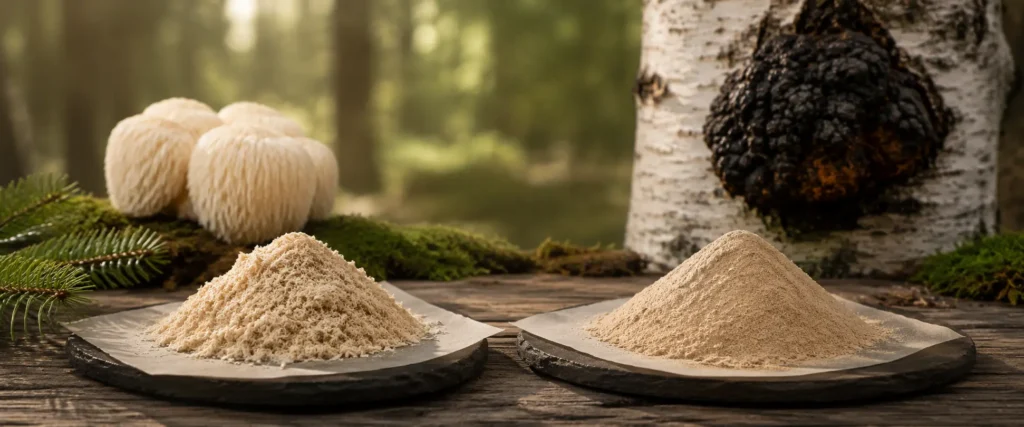
A standard mushroom powder basically consists of dried and finely milled mushroom material. A mushroom extract, on the other hand, undergoes additional processing in which the producer uses an extraction process to separate or concentrate parts of the raw material’s chemical profile. That is why it is important to understand the difference between mushroom powder and mushroom extract when comparing different raw materials.
In short: Powder mainly describes the physical form of the mushroom material. Extract, by contrast, tells you that the raw material has gone through a separate extraction step. The two words should therefore not be used as synonyms.
In this guide
- What is mushroom powder?
- What is mushroom extract?
- Mushroom powder vs mushroom extract
- How does water extraction work?
- Why is freeze-drying used?
- What do 10:1 and 20:1 mean?
- Beta-glucans and analytical values
- Polysaccharides vs beta-glucans
- Fruiting body, mycelium and other mushroom raw materials
- How is quality assessed?
- Summary
What is mushroom powder?
A mushroom powder is usually made by first drying the mushroom material and then milling it into a fine powder.
The raw material may consist of, for example, a fruiting body, mycelium or another defined mushroom structure. The word mushroom powder therefore does not automatically tell you which part of the mushroom has been used.
Nor does the powder form in itself mean that the producer has carried out an extraction. A finely milled mushroom powder can therefore still be a relatively unprocessed raw material.
Important: A very fine powder is not automatically an extract. Milling changes the particle size of the material, whereas extraction is a separate processing step.
What is a mushroom extract?
A mushroom extract also starts with a defined mushroom raw material. The difference is that the producer then uses a liquid or another process to extract parts of the material’s chemical content.
Water is a common extraction medium for mushroom polysaccharides. At the same time, other processes may use, for example, alcohol, alkaline solutions, enzymatic treatment or combinations of different methods.
Exactly what the extract contains therefore depends on several factors, including the mushroom species, the part of the mushroom, the composition of the raw material and the extraction conditions themselves.
Mushroom powder vs mushroom extract – the key difference
When comparing mushroom powder vs mushroom extract, the clearest difference is processing.
| Property | Mushroom powder | Mushroom extract |
|---|---|---|
| Basic process | Drying and milling | Extraction in addition to basic processing |
| Form | Finely milled mushroom material | Can also be a powder after drying |
| Extraction step | Not required | Yes |
| Extraction medium | Not relevant if no extraction takes place | For example water or other defined media |
| Analysis | Can be analysed | Can be analysed and specified after extraction |
| Raw material identity | Must be stated separately | Must also be stated separately |
This does not mean, however, that all extracts are automatically of higher quality than all powders. The extraction process is only one part of the quality assessment.
Mushroom powder vs mushroom extract – what happens during water extraction?
In water extraction, the producer uses water to transfer water-soluble or water-extractable components from the mushroom material into a liquid phase.
First, the producer usually breaks the raw material down into smaller particles. The material is then brought into contact with water under defined process conditions. Temperature, time and the ratio of water to raw material can affect the extraction result.
After extraction, the producer needs to separate and stabilise the extracted material. Further process steps therefore often follow before a finished extract powder is obtained.
Defined raw material
Drying
Size reduction
Water extraction
Drying of the extract
Analysis
In other words, water extraction is more than simply adding water to a powder. It is a process in which several parameters together determine the properties of the final raw material.
Why is freeze-drying used after extraction?
After a liquid extraction, the producer needs to remove the water to create a stable and manageable raw material. One method is freeze-drying, also known as lyophilisation.
In freeze-drying, the producer first freezes the material. The water is then removed mainly through sublimation under reduced pressure.
The result can be a dry extract that is then milled into a powder. That is why both a standard mushroom powder and a mushroom extract can look like powder, even though they have gone through completely different processes.
What do 10:1, 20:1 and other extraction ratios mean?
Mushroom extracts are sometimes labelled 10:1, 20:1 or similar. These figures can describe the ratio between the amount of original raw material and the amount of extract the producer obtains after processing.
The problem is that the figure alone says relatively little about the actual composition of the extract.
Two products that are both called 10:1 can, for example, differ in terms of:
- mushroom species
- which part of the mushroom the producer uses
- the moisture content of the raw material
- extraction medium
- temperature and extraction time
- number of extraction steps
- filtration and concentration
- which substances the producer actually analyses
A higher extraction ratio therefore does not automatically mean a better or “stronger” extract. For a technical comparison of raw materials, analysed parameters and clear process documentation are considerably more informative.
What does the beta-glucan value of a mushroom extract tell you?
Beta-glucans are a group of polysaccharides found in the cell walls of mushrooms. That is why beta-glucan content is often used as an analytical parameter when characterising different mushroom raw materials.
Laboratories can measure beta-glucan using methods that first determine the total glucan content and then separate out alpha-glucans, starch or related carbohydrates. The beta-glucan value is then calculated from the measured fractions.
This means that a specified beta-glucan value provides more concrete information than a general statement such as “contains mushroom polysaccharides”.
At the same time, the beta-glucan percentage should not be used as a universal measure of strength between different mushrooms. Different species and raw materials have different chemical profiles.
Polysaccharides and beta-glucans are not the same thing
The term polysaccharides covers many different types of complex carbohydrates. Beta-glucans make up only part of this larger group.
Two products with the same stated total polysaccharide content can therefore still have different beta-glucan profiles.
In addition, raw materials may contain other carbohydrate fractions that affect a general polysaccharide value. This is particularly relevant when comparing pure mushroom material with products in which growth substrate may remain.
When comparing: Look for which parameter the laboratory has actually measured. “30% polysaccharides” and “30% beta-glucans” do not describe the same thing.
The quality of an extract starts with the raw material
An advanced extraction process cannot replace clear information about which raw material the producer uses in the first place.
A well-documented mushroom product should therefore state both the species and the part of the mushroom.
For Lion’s Mane, the relevant raw material may be, for example, the fruiting body or mycelium. For Chaga, on the other hand, the characteristic Chaga conk is used, which should not be described as an ordinary fruiting body.
Research on several mushrooms also shows that polysaccharides can differ depending on whether the material comes from the fruiting body, mycelium or growth medium. The source of the raw material is therefore central when interpreting analytical data.
How do you assess the quality of mushroom powder and mushroom extract?
When comparing mushroom powder and mushroom extract, you should not just look at the product name or a large figure on the front of the packaging.
In a technical raw material assessment, the following information is considerably more useful:
- correct scientific species name
- clearly defined part of the mushroom
- geographical origin of the raw material
- extraction method
- extraction medium
- specified analytical values
- relevant laboratory method
- microbiological limits
- heavy metal specification
- manufacturing information and traceability
That is why a clear raw material specification is often more valuable than marketing terms such as “premium”, “super-concentrated” or an extraction ratio without further explanation.
Two examples of mushroom extracts: Lion’s Mane and Chaga
Aromexperten’s current mushroom extracts also illustrate why different species need to be assessed separately.
NordRelease® Lion’s Mane is based on 100% fruiting body of Hericium erinaceus. The raw material specification states, among other things, a minimum of 18% 1,3:1,6-beta-glucans and a specified level of hericenones/hericenes.
NordRelease® Chaga instead uses Chaga conk from Inonotus obliquus. Here, beta-glucans are included together with other specified raw material markers such as inotodiol and betulinic acid.
Both are mushroom extracts, but their raw material identity and analytical profile differ. A comparison based solely on, for example, beta-glucan percentage would therefore give an incomplete picture.
Read more about each raw material on the product pages for
Lion’s Mane extract
and
Chaga extract.
Want to see the whole range in one place? Explore the
mushroom extracts category.
Summary: mushroom powder vs mushroom extract
When comparing mushroom powder vs mushroom extract, the most important difference is the processing itself.
A mushroom powder normally consists of dried and milled mushroom material. A mushroom extract, on the other hand, undergoes an additional extraction step.
The difference can therefore be significant even if both end products look like a fine powder.
Water extraction is a common method for processing mushroom polysaccharides, but the end result is affected by process parameters such as temperature, time and the raw material-to-liquid ratio.
At the same time, neither the word “extract” nor a high extraction ratio tells you everything about quality.
The most informative assessment therefore combines raw material identity, part of the mushroom, extraction process, analytical method and documented quality parameters.
About this content: This article describes mushroom raw materials, extraction processes and analytical quality parameters. It should not be interpreted as information about medical effects or as a recommendation for consumption. Aromexperten’s mushroom products are sold as botanical raw materials for technical and raw material purposes.
Sources and further reading
-
McCleary & Draga – Measurement of β-Glucan in Mushrooms and Mycelial Products
-
Recent Advances in the Preparation, Structure, and Biological Activities of β-Glucan from Ganoderma Species
-
Recent developments in Hericium erinaceus polysaccharides: extraction, purification and structural characteristics
-
Mushroom β-glucans: application and innovation for food industry and immunotherapy

 Best Sellers
