


 Svenska

 News
 Botanical Blends
 Mitragyna
 Kanna (sceletium tortuosum)
 Akuamma (Picralima nitida)
 Tongkat Ali (Eurycoma longifolia)
 Blue Lotus (Nymphaea caerulea)
 Sakae Naa
 Wild Lettuce (Lactuca virosa)
 Damiana (turnera diffusa)
 Zornia latifolia (Maconha Brava)
 CBD products
 Mushroom Extracts
 Aromatherapy
Botanicals
What Is Mucuna pruriens? A Guide to Velvet Bean
Sep
Mucuna pruriens, often called Velvet Bean, is a tropical climbing plant in the family Fabaceae. The species is particularly well known in botanical and chemical research because its seeds can naturally contain significant amounts of the amino acid derivative L-DOPA. At the same time, the plant consists of many more groups of compounds than this single substance.
In this guide, we go through the plant’s botanical identity, appearance, plant parts and chemical composition. In addition, we explain what L-DOPA is from a botanical perspective, why its content can vary between samples and why research on Mucuna does not automatically describe a specific commercial product batch.
Mucuna pruriens quick facts
| Scientific name | Mucuna pruriens (L.) DC. |
|---|---|
| Common name | Velvet Bean / Cow-itch |
| Plant family | Fabaceae |
| Order | Fabales |
| Plant type | Tropical climbing plant / legume |
| Most studied plant part | Seeds |
| Known natural compound | L-DOPA |
| Other compound groups | Phenolic compounds, flavonoids, tannins, saponins and other plant metabolites |
Contents
- What is Mucuna pruriens?
- What does Velvet Bean mean?
- What does the plant look like?
- Why are the seeds studied?
- What is L-DOPA?
- How does the plant form L-DOPA?
- Why does the L-DOPA content vary?
- Which other compounds are found in Mucuna?
- Why does the plant part matter?
- Powder, seed or extract?
- How do you assess quality?
- How is L-DOPA analysed?
- Storage
- Why is caution needed?
- Product classification
- Frequently asked questions
What is Mucuna pruriens?
Mucuna pruriens is a tropical legume in the family Fabaceae.
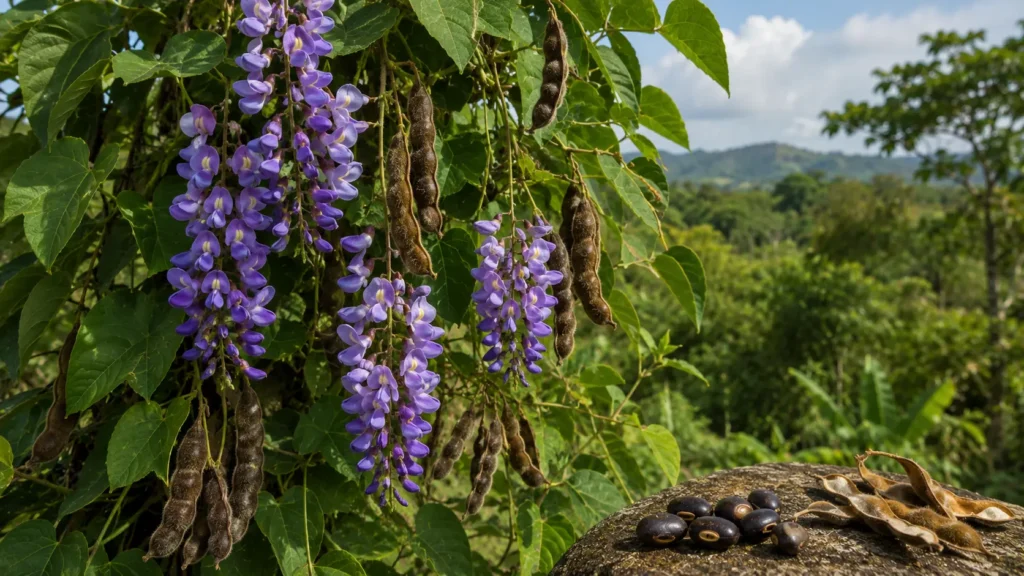
The plant develops long vines, compound leaves, flower clusters and pods with relatively large seeds. Above all, the seeds have received a great deal of attention in botanical chemistry.
The name Mucuna describes the plant species itself and not a single chemical compound.
That is why you need to distinguish between botanical raw material, seed material, extract and specific chemical compounds that the laboratory identifies in a sample.
What does Velvet Bean mean?
Velvet Bean is a common English name for Mucuna pruriens.
The name refers to the characteristic pods, which in some forms are covered in fine hairs.
However, the scientific name is much better for precise botanical identification.
For a clear raw material description: use the full name Mucuna pruriens in product information and documentation, not just Velvet Bean.
What does Mucuna pruriens look like?
Mucuna grows as a vigorous climbing plant with long stems.
The leaves are compound and usually consist of three leaflets.
In addition, the plant develops flower clusters that later form pods.
The pods can bear densely packed hairs. These hairs are botanically characteristic of the species and are behind some of the plant’s common names.
Inside the pod are the seeds, the plant part that most chemical studies have analysed.
Why are Mucuna seeds studied so much?
The seeds of Mucuna pruriens have been studied more than the leaves, roots and other plant parts.
An important reason is their content of L-DOPA, also known as levodopa or L-3,4-dihydroxyphenylalanine.
A recent scientific review shows that research on Mucuna largely focuses on the seeds and their chemical composition.
At the same time, the seeds are chemically complex and contain many more compounds than L-DOPA.
What is L-DOPA in Mucuna pruriens?
L-DOPA is a naturally occurring compound that the plant forms itself.
Chemically, the substance is a hydroxylated amino acid derivative and an intermediate in several biological processes.
In Mucuna pruriens, L-DOPA can occur in both the seeds and other plant parts, although the seeds have usually attracted the most research interest.
Important: L-DOPA is also a pharmacologically active substance used in medicinal treatment. Botanical information about Mucuna should therefore not be interpreted as advice on consumption, dosage or treatment.
How does Mucuna pruriens form L-DOPA?
Researchers have investigated how the plant itself produces L-DOPA.
A study from 2020 showed that the enzyme polyphenol oxidase plays a central role in the synthesis of L-DOPA in Mucuna pruriens.
The researchers compared several possible biosynthetic pathways and found that polyphenol oxidase was more important than alternative mechanisms via cytochrome P450 or tyrosine hydroxylase.
In other words, L-DOPA is not just a compound that happens to be present in the seed. It is part of the plant’s own metabolism.
Why does the L-DOPA content in Mucuna vary?
Botanical raw materials have natural biological variation.
The L-DOPA content can therefore differ between varieties, plant parts, developmental stages and geographical origins.
In addition, storage and processing can affect the measured amount.
A study in Scientific Reports examined L-DOPA in several Mucuna samples and showed both natural variation and degradation of the compound under certain conditions.
That is why a specific percentage should never be stated solely with reference to general literature.
An exact L-DOPA content requires analysis of the raw material or batch in question.
Which other compounds are found in Mucuna pruriens?
Mucuna is chemically much more complex than a raw material that contains only L-DOPA.
Modern literature describes several groups of secondary plant metabolites.
For example, researchers have reported phenolic compounds, flavonoids, tannins, saponins, alkaloids and other natural compounds in different plant parts.
The leaves can also contain volatile components such as linalool and various fatty acid and terpenoid derivatives.
Taken together, research shows that the chemical profile varies clearly between seeds, leaves and roots.
Why does the plant part matter?
Different parts of the same plant do not necessarily have the same chemical composition.
The seeds, for example, have received the most attention for L-DOPA, while leaves, roots and pods show other profiles of secondary metabolites.
That is why you should always check which plant part a study actually analysed.
| Plant part | What research often focuses on |
|---|---|
| Seeds | L-DOPA as well as primary and secondary metabolites |
| Leaves | Phenolic compounds, flavonoids and volatile components |
| Roots | Other phenolic and terpenoid plant compounds |
| Pods | Much less studied than seeds |
In other words, analytical data from seeds cannot be used as if it described the leaves or the whole plant.
Mucuna as seed, powder or extract
Mucuna can be found in several different product forms.
| Product form | Processing | What does the form describe? |
|---|---|---|
| Whole seeds | Cleaned and dried seed material | The seed’s original physical form |
| Seed powder | Dried seeds are ground | Finely divided botanical raw material |
| Extract | The producer uses an extraction process | Processed raw material with a changed chemical profile |
| Standardised extract | The producer checks a defined marker against a specification | Can, for example, be standardised for L-DOPA if relevant analysis is available |
Grinding is not standardisation. A Mucuna powder therefore does not automatically have a defined L-DOPA content just because the raw material has been ground.
How do you assess the quality of Mucuna pruriens?
For Mucuna, correct botanical identity and clear plant part information are particularly important.
In addition, any L-DOPA information should be linked to an actual analysis and not just to general research on the species.
It helps to check the following:
- the full botanical name Mucuna pruriens
- which plant part the product consists of
- country of origin
- whether the material is whole, powdered or extracted
- batch number where available
- the supplier’s traceability information
- available microbiological analyses
- heavy metal analyses where relevant
- L-DOPA analysis if a specific content is stated
- storage and packaging
How is L-DOPA in Mucuna analysed?
Laboratories can use chromatographic methods to identify and quantify L-DOPA.
For example, scientific studies have used HPLC and other analytical techniques to measure the compound in Mucuna material.
A modern product study from 2025 used LC-MS and NMR, among other methods, to verify and quantify L-DOPA in commercial products. At the same time, the researchers found variation between labelling and actual composition.
That is why a batch-specific analytical result gives much more information than a general statement about what Mucuna “usually contains”.
How do you store Mucuna raw material?
Store dried botanical raw materials in a dry, cool place, protected from direct sunlight.
In addition, the packaging should be kept well sealed to limit contact with moisture, oxygen and foreign material.
L-DOPA can be affected by chemical degradation and oxidation. Stable storage is therefore particularly relevant when the chemical profile of the raw material matters.
Always follow the product’s specific storage information and keep the raw material out of the reach of children.
Why does Mucuna require especially clear product information?
Mucuna differs from many other botanical raw materials because the plant can naturally contain a compound that is also used as a medicine.
That is why it is particularly important to keep botanical research separate from product use.
The scientific literature includes both preclinical and clinical studies on Mucuna preparations. At the same time, more recent research also describes a need for better safety data and clearer standardisation.
This article gives no instructions on consumption or treatment. It describes Mucuna pruriens from a botanical, chemical and raw material perspective.
Mucuna pruriens and product classification
The fact that a plant appears in medical research does not automatically mean that a commercial botanical raw material may be marketed as a medicine, food supplement or food.
Instead, the product form, plant part, composition, intended use and current legislation need to be assessed together.
Aromexperten generally states that the botanical raw materials in its range are intended for technical and botanical use and not for consumption.
Aromexperten’s product line: botanical raw materials are sold for technical and botanical use. They are not intended as food, food supplements or for any other consumption.
Frequently asked questions about Mucuna pruriens
What is Mucuna pruriens?
Mucuna pruriens is a tropical climbing plant in the family Fabaceae, often called Velvet Bean.
What is L-DOPA?
L-DOPA is a natural compound that Mucuna produces as part of its own metabolism. The same substance is also used pharmacologically as levodopa.
Is L-DOPA only found in the seeds?
No. Research has identified L-DOPA in several parts of the plant, but the seeds are the most studied raw material.
Do all Mucuna seeds have the same L-DOPA content?
No. The content can vary between varieties, samples, developmental stages and processing conditions.
Can the L-DOPA content be stated without laboratory analysis?
You can describe what research reports in general, but an exact product or batch content requires relevant analysis.
Is Mucuna powder the same as an extract?
No. Powder is ground plant material. An extract, by contrast, requires a separate extraction process.
Is a Mucuna extract automatically standardised?
No. Standardisation requires a defined chemical marker and a set specification.
Can research on seeds be used to describe leaves?
Not without further evidence. Different plant parts have different chemical profiles. That is why analytical results should be linked to the right plant part.
Why is L-DOPA mentioned so often in research on Mucuna?
The seeds can contain relatively high levels of L-DOPA, which has made the compound central to both botanical and pharmacological research.
Is Aromexperten’s Mucuna intended for consumption?
Aromexperten’s botanical raw materials are sold for technical and botanical use and are not intended for consumption.
Summary
Mucuna pruriens, or Velvet Bean, is a tropical legume in the family Fabaceae.
Above all, the seeds are well known in research because they can contain significant amounts of L-DOPA.
At the same time, the plant contains many other groups of compounds, and the chemical profile varies between seeds, leaves, roots and other plant parts.
The L-DOPA content can also vary between varieties, origins, developmental stages and processing conditions. That is why an exact content figure requires analysis of the raw material or batch in question.
Mucuna is also a clear example of why botanical information and pharmacological use must be kept apart. This article therefore describes only the plant’s botany, chemistry and raw material quality.
Explore Mucuna pruriens as a botanical raw material
Read the current product information for plant part, product form, origin, available sizes, storage and stated intended use.
Aromexperten’s botanical raw materials are sold for technical and botanical use and are not intended for consumption.
Sources and further reading
-
Saranya et al. – L-DOPA synthesis in Mucuna pruriens
-
Pulikkalpura et al. – Levodopa in Mucuna pruriens and its degradation
-
Singh et al. – Biochemical characterization and spatio-temporal analysis of the L-DOPA pathway
-
Soares et al. – The role of L-DOPA in plants
-
Comprehensive review of Mucuna pruriens phytochemistry
-
Quality assessment of commercial high-percentage L-DOPA products
Last fact-checked:

 Best Sellers
