


 Svenska

 News
 Botanical Blends
 Mitragyna
 Kanna (sceletium tortuosum)
 Akuamma (Picralima nitida)
 Tongkat Ali (Eurycoma longifolia)
 Blue Lotus (Nymphaea caerulea)
 Sakae Naa
 Wild Lettuce (Lactuca virosa)
 Damiana (turnera diffusa)
 Zornia latifolia (Maconha Brava)
 CBD products
 Mushroom Extracts
 Aromatherapy
Botanicals
Inotodiol and Betulinic Acid in Chaga – What Do the Analytical Values Mean?
Oct
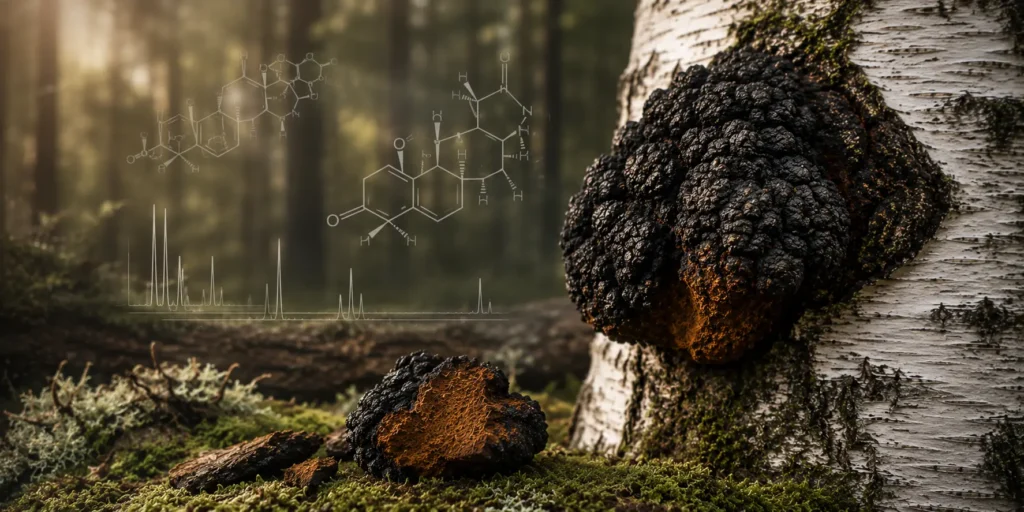
Inotodiol and betulinic acid in Chaga are two chemical markers that can give information about the raw material’s triterpenoid profile.
Both appear in research on Inonotus obliquus, but a high analytical value does not automatically mean that a Chaga raw material is “stronger” or better. To interpret the values, you also need to understand the type of raw material, host tree, geographical origin and analytical method.
In short: Inotodiol is a characteristic lanostane-type triterpenoid from Chaga. Betulinic acid belongs to a different triterpenoid group and occurs together with betulin, among others. When a laboratory analyses these compounds, the results describe the chemical profile of the raw material – not its physiological effect.
In this guide
- What are triterpenoids?
- What is inotodiol?
- What is betulin?
- What is betulinic acid?
- Inotodiol, betulin and betulinic acid – the difference
- What role does birch play?
- Why do the levels vary?
- Outer and inner parts of the Chaga conk
- How do laboratories analyse these compounds?
- Can triterpenoids help authenticate Chaga?
- How should you interpret analytical values?
- What does this mean for Chaga extract?
- Summary
What are triterpenoids in Chaga?
Triterpenoids are a large group of organic compounds built up from terpene structures. Researchers have identified many different triterpenoids in Inonotus obliquus.
Chaga contains, among others, lanostane-type triterpenoids. This group includes, for example, inotodiol and trametenolic acid.
At the same time, birch-related compounds such as betulin and betulinic acid also appear in analyses of Chaga conk.
That is why a broad triterpenoid profile gives more information about the chemistry of the raw material than a single isolated analytical value.
What is inotodiol in Chaga?
Inotodiol is a lanostane-type triterpenoid that researchers often identify in Inonotus obliquus.
The compound recurs in many chemical studies of Chaga conk and therefore works as a relevant analytical marker when laboratories characterise the raw material.
Studies have also shown that inotodiol can occur in relatively high concentrations compared with several other triterpenoids in Chaga material.
In a comparison between the outer and inner parts of Chaga conk, for example, researchers found inotodiol to be one of the dominant triterpenoids in both parts.
Important: Inotodiol works as a chemical raw material marker. A higher inotodiol value should not automatically be interpreted as greater physiological effect or better quality in every respect.
What is betulin?
Betulin is a pentacyclic triterpenoid that occurs naturally in high levels in the bark of several birch species.
Betulin-rich components are, among other things, what contributes to the characteristic white colour of birch bark.
Because Chaga often develops on birch, researchers have also analysed betulin in Chaga conks.
Studies show that betulin occurs in Chaga from different geographical origins and from different host trees. The levels, however, can vary between samples.
That is why betulin is a good example of how the relationship between the fungus and the host tree can contribute to the chemical profile of a Chaga raw material.
What is betulinic acid in Chaga?
Betulinic acid is chemically related to betulin but is a separate compound.
Researchers have identified and quantified betulinic acid in Chaga conks from several geographical areas and from different host trees.
The levels can, however, vary considerably between samples. You should therefore not assume that all Chaga contains the same amount of betulinic acid.
A study comparing Chaga conks from birch and alder, for example, found clear differences in betulinic acid between the host trees, while inotodiol was at more similar levels.
This shows why the origin of the raw material needs to be considered alongside the analytical value.
Inotodiol, betulin and betulinic acid – what is the difference?
The three compounds often appear together in discussions about Chaga, but they do not describe the same chemical compound.
| Compound | Chemical group | Raw material relevance |
|---|---|---|
| Inotodiol | Lanostane-type triterpenoid | Characteristic Chaga marker |
| Betulin | Pentacyclic triterpenoid | Strongly associated with birch bark and also occurs in Chaga |
| Betulinic acid | Oxidised pentacyclic triterpenoid | Can be analysed as an additional part of Chaga’s triterpenoid profile |
In other words, the compounds give different information about the chemical composition of the raw material.
What role does birch play in Chaga’s triterpenoids?
Inonotus obliquus grows mainly on birch trees of the genus Betula.
Birch bark naturally contains betulin and related triterpenoids. Researchers have therefore investigated how the host tree can affect the chemical profile of the Chaga conk.
A comparative study analysed Chaga conks from Betula pendula and Alnus incana. The researchers found betulin in all the conks analysed but saw clear differences in betulinic acid between the host trees.
At the same time, inotodiol levels were relatively similar between Chaga from the two trees.
This does not mean that the host tree alone determines the raw material’s profile. However, the results show that information about the host tree can provide relevant context when comparing chemical analytical values.
Why do inotodiol and betulinic acid vary between different Chaga samples?
Chaga is a biological raw material, so its composition can vary.
Research findings point to several possible factors:
- geographical origin
- host tree
- developmental stage of the conk
- which part of the conk the laboratory analyses
- drying and storage
- extraction method
- extraction medium
- analytical method
One study, for example, compared Chaga from France, Canada and Ukraine and analysed betulin, betulinic acid and inotodiol using HPLC-MS/MS.
The researchers observed clear differences in concentration between material from the different geographical areas.
That is why you cannot take an analytical value from a published study and automatically apply it to another commercial Chaga raw material.
Outer and inner Chaga conk can have different triterpenoid profiles
The Chaga conk does not consist of completely homogeneous tissue.
The outer part is dark, hard and heavily pigmented. The inner tissue, on the other hand, has a browner to rust-coloured structure.
Researchers have compared triterpenoids in these different parts of Inonotus obliquus.
One such study found, among other things, inotodiol and trametenolic acid to be the dominant triterpenoids in both outer and inner material. At the same time, the researchers measured higher levels of several triterpenoids in the outer part.
This means that sampling can affect the analytical result.
If you would like to read more about the structure of the raw material itself, see our guide on
what a Chaga conk is.
How do laboratories analyse inotodiol and betulinic acid?
Triterpenoids occur in relatively small amounts compared with the total mass of the raw material. Laboratories therefore need to use sensitive chromatographic methods.
Researchers use, for example, HPLC and LC-MS to separate, identify and quantify triterpenoids in Chaga.
In a geographical comparison study, the researchers developed an HPLC-MS/MS method for the simultaneous determination of betulin, betulinic acid and inotodiol.
More recent research has gone even further. In 2026, a validated multi-analytical method was published that combined LC-PDA-ELSD and LC-DAD-QToF for the characterisation and quantitative analysis of a larger number of compounds in Chaga material.
The researchers applied the method to:
- Chaga sclerotia/conk
- Inonotus obliquus mycelium
- grain-based Chaga samples
- commercial Chaga products
This is important, because a declared analytical value becomes much more informative when you also know which method the laboratory used.
Can inotodiol help authenticate Chaga?
Yes, as part of a broader analytical profile.
An extensive authentication study from 2025 compared authentic Chaga conk with mycelium and fermented grain products.
The researchers used several complementary analytical methods and observed clear differences in triterpenoids, polysaccharides, starch and melanin profile, among other things.
Authentic Chaga conk contained characteristic triterpenoids, including inotodiol and trametenolic acid.
Grain-based products, by contrast, showed a much more starch-dominated profile.
Even so, a single marker is not always enough for full authentication. The strongest quality assessment combines several chemical and raw-material-related parameters.
How should you interpret inotodiol and betulinic acid on a specification?
If a Chaga specification states, for example, a minimum level of inotodiol or betulinic acid, you should first check what the value actually describes.
It helps to ask the following questions:
- Does the value refer to Chaga conk, mycelium or another raw material?
- Is the percentage a specified minimum or a batch result?
- Which analytical method does the laboratory use?
- What is the geographical origin of the raw material?
- Which host tree does the Chaga come from?
- Which extraction process is used?
It is also important not to compare percentages in isolation.
A Chaga extract with more betulinic acid is not automatically a better Chaga extract. The same principle applies to inotodiol.
The analytical values describe specific parts of the raw material’s chemistry. They do not replace a broader quality assessment.
You may also like our guide on
how to assess the quality of mushroom extracts.
Inotodiol and beta-glucans describe different parts of Chaga
A Chaga raw material can have both a beta-glucan value and specified triterpenoids at the same time.
This is because the compounds belong to entirely different chemical groups.
| Parameter | Chemical type | What does it describe? |
|---|---|---|
| Beta-glucans | Polysaccharides | Part of the fungus’s structural glucan profile |
| Inotodiol | Lanostane triterpenoid | Part of Chaga’s triterpenoid profile |
| Betulinic acid | Pentacyclic triterpenoid | An additional chemical marker that can occur in Chaga |
That is why one parameter cannot replace another. Together, however, they give a broader picture of the raw material’s composition.
For more about glucan analysis, you can read our guide on
beta-glucans in mushroom extracts.
What does this mean for Aromexperten’s Chaga extract?
Aromexperten’s NordRelease® Chaga is based on 100% Chaga conk from Inonotus obliquus from certified organic Finnish forests.
The raw material is water-extracted and freeze-dried in Finland.
The raw material specification states, among other things:
- ≥5% 1,3:1,6-beta-glucans
- ≥0.6% inotodiol
- ≥0.05% betulinic acid
This means that the specification combines a structural polysaccharide parameter with two triterpenoid-related raw material markers.
At the same time, the values should be read as chemical specifications. They should not be translated into a measure of physiological strength or effect.
Read more about the origin, the NordRelease® process and the full raw material specification on the page for
Chaga extract.
Would you like to compare with other documented mushroom raw materials? Explore the category of
mushroom extracts.
Summary: inotodiol and betulinic acid in Chaga
Inotodiol and betulinic acid in Chaga describe two parts of the raw material’s triterpenoid profile.
Inotodiol is a lanostane-type triterpenoid that researchers repeatedly identify in Inonotus obliquus. The compound therefore works as a useful chemical marker for Chaga raw material.
Betulinic acid is a separate triterpenoid that is chemically related to betulin. Its levels can vary considerably depending on, among other things, the origin of the raw material and the host tree.
Research also shows that geographical origin, host tree and which part of the Chaga conk the laboratory analyses can affect the triterpenoid profile.
Modern chromatographic methods make it possible to analyse several Chaga triterpenoids at the same time and can also help distinguish authentic Chaga conk from other types of raw material.
That is why you should never assess Chaga on the basis of a single large percentage. The most informative assessment combines raw material identity, origin, extraction, analytical method and several relevant quality parameters.
About this content: This article describes chemical analysis, triterpenoids and raw material identity of Inonotus obliquus. Research findings on inotodiol, betulin and betulinic acid should not be interpreted as medical or physiological claims. Aromexperten’s Chaga is sold as a botanical mushroom raw material for technical and raw material purposes and is not intended for consumption.
Sources and further reading
-
Chemical study and quantitative analysis of betulin, betulinic acid and inotodiol in Chaga from different geographic origins
-
Comparative Analyses of Bioactive Compounds in Inonotus obliquus Conks Growing on Alnus and Betula
-
Composition of Triterpenoids in Inonotus obliquus – comparison between inner and outer parts
-
Comparative Study of Chaga Dietary Supplements Using Complementary Analytical Techniques
-
Quantitative Analysis and Simultaneous Characterization of Triterpenoids and Phenolics in Inonotus obliquus Using LC-PDA-ELSD and LC-DAD-QToF

 Best Sellers
