


 Svenska

 News
 Botanical Blends
 Mitragyna
 Kanna (sceletium tortuosum)
 Akuamma (Picralima nitida)
 Tongkat Ali (Eurycoma longifolia)
 Blue Lotus (Nymphaea caerulea)
 Sakae Naa
 Wild Lettuce (Lactuca virosa)
 Damiana (turnera diffusa)
 Zornia latifolia (Maconha Brava)
 CBD products
 Mushroom Extracts
 Aromatherapy
Botanicals
What Is Entada rheedii? A Guide to Entada rheedei
Oct
Entada rheedii is a common trade and literature name for the tropical climbing plant that Kew today accepts as Entada rheedei Spreng. The species belongs to the family Fabaceae and is particularly known for its very large pods and hard seeds. Scientific analyses of the seed kernel have also identified several characteristic saponins and other natural plant compounds.
In this guide, we go through the plant’s botanical identity, natural distribution, appearance and chemical profile. In addition, we explain the difference between the spellings rheedii and rheedei, why the seed kernel plays a central role in research and why laboratory findings from research samples do not automatically describe a commercial product batch.
Entada rheedei quick facts
| Accepted scientific name | Entada rheedei Spreng. |
|---|---|
| Common alternative spelling | Entada rheedii |
| Plant family | Fabaceae |
| Order | Fabales |
| Genus | Entada |
| Plant type | Large woody liana |
| Natural distribution | Tropical and subtropical parts of Africa, Asia and Oceania |
| Characteristic feature | Very large pods and large hard seeds |
| Most studied plant part | Seed kernel |
| Known compound groups | Triterpene saponins, entadamide derivatives and other natural plant metabolites |
Contents
- What is Entada rheedii?
- Entada rheedii or Entada rheedei?
- Where does Entada rheedei grow?
- What does the plant look like?
- Why are the seeds so special?
- The seed kernel in research
- Which compounds are found in Entada rheedei?
- Rheediinosides and rheedeiosides
- What are entadamides?
- Tryptorheedei A and B
- Why does the plant’s chemical profile vary?
- Seed, powder and extract
- How do you assess quality?
- How are the plant compounds analysed?
- Storage
- Product classification
- Frequently asked questions
What is Entada rheedii?
Entada rheedei is a large climbing plant in the family Fabaceae, the same large plant family as many other legumes.
The plant develops sturdy woody vines and can climb high up into other vegetation. Above all, the species is known for its unusually large fruits and seeds.
In trade and older scientific literature, the spelling Entada rheedii is often used.
However, the Royal Botanic Gardens, Kew, today uses Entada rheedei Spreng. as the accepted species name.
Entada rheedii or Entada rheedei – which name is correct?
Both spellings appear in modern literature and trade.
Kew’s Plants of the World Online accepts Entada rheedei Spreng. as the scientific species name.
At the same time, several published research articles use the spelling Entada rheedii, especially older studies.
In practice, this means: anyone searching for scientific information should use both “Entada rheedei” and “Entada rheedii”, as databases and articles may use different spellings.
NCBI also lists Entada rheedii as an alternative name for the current taxonomic record of Entada rheedei.
Read the current taxonomy at
Royal Botanic Gardens, Kew – Entada rheedei
.
Where does Entada rheedei grow naturally?
Entada rheedei has a very large natural range.
Kew lists the species as native to tropical and subtropical parts of the Old World. This includes large areas of Africa, South Asia, Southeast Asia and parts of Oceania.
The areas Kew lists include, for example, Cameroon, Ghana, Kenya, Tanzania, India, Sri Lanka, Thailand, Malaysia, Indonesia, the Philippines and northern Australia.
In addition, the species occurs on several island groups in the Indian Ocean and the Pacific.
Kew describes the plant as a liana that mainly grows in tropical, seasonally dry biomes.
What does Entada rheedei look like?
The species grows as a large woody liana that uses surrounding trees and vegetation for support.
The leaves are compound and typical of many members of the Fabaceae.
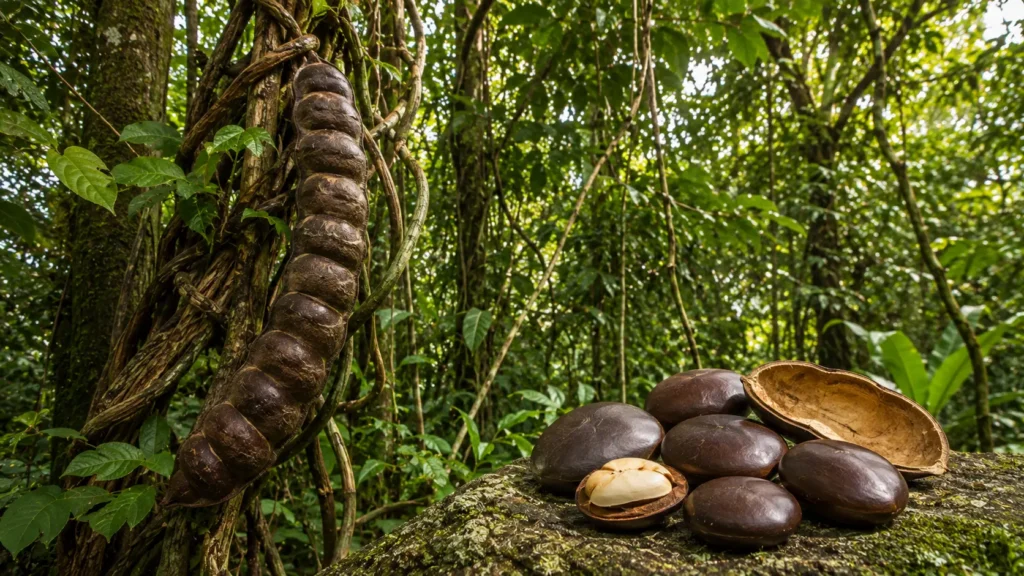
Above all, the fruits are striking. The plant can develop very large, elongated pods containing large, hard seeds.
As the pod ripens, it separates into segments around the seeds.
The hard seeds can also withstand long transport in water. That is why seeds from large tropical lianas in the genus Entada have become well known as so-called drift seeds or sea beans.
Visual identification of a single processed seed or powder, however, is not sufficient for reliable species identification.
Why are Entada seeds so special?
The seeds are large, hard and clearly adapted to protect the embryo.
The sturdy outer shell differs clearly from the softer seed kernel inside.
This difference matters when reading the research. Many chemical studies of Entada rheedei have not analysed the whole seed but specifically the seed kernel.
Seed shell and seed kernel are different materials. A research result from the seed kernel cannot therefore automatically be used as analytical data for whole seeds or other plant parts.
The Entada rheedei seed kernel in research
The seed kernel is the best-characterised plant part in the published phytochemical research on the species.
Research groups from Cameroon, Thailand and Japan, among others, have isolated various natural compounds from seed kernels.
For example, the researchers have identified triterpene saponins, thioamide-related glycosides, entadamide derivatives and tryptophan derivatives.
This does not mean, however, that all seed kernels have an identical chemical profile.
That is why you need to distinguish between what research has found in specific samples and what a laboratory has actually verified in a commercial batch.
Which compounds are found in Entada rheedei?
The chemical profile of Entada rheedei includes several groups of natural plant compounds.
Above all, researchers have studied triterpenoid saponins from the seed kernel.
The most characteristic compounds include rheediinosides and rheedeiosides.
In addition, researchers have identified entadamides, tryptophan derivatives, sterol-related compounds and other metabolites in the same type of material.
Important: a published list of compounds for Entada rheedei is not the same as a certificate of analysis for a commercial product. Exact product claims require analysis of the raw material or batch in question.
What are rheediinosides and rheedeiosides?
Rheediinosides and rheedeiosides are names that researchers have given to certain saponin-like compounds isolated from Entada rheedei.
A study published in Phytochemistry in 2010 isolated two triterpenoid saponins from seed kernels and named them rheediinoside A and rheediinoside B.
The researchers used NMR and mass spectrometry, among other methods, to determine the structures of the molecules.
In addition, a study from 2011 identified four other oleanane-based triterpene glycosides, rheedeiosides A, B, C and D, from seed kernels of material from Thailand.
The names are easy to confuse: rheediinosides and rheedeiosides refer to different compounds that research groups have isolated and named.
Read the studies via
PubMed – Rheediinosides A and B
and
PubMed – Rheedeiosides A–D
.
What are entadamides?
Entadamides are a group of nitrogen- and sulphur-containing natural compounds that researchers have described from species in the genus Entada.
In Entada rheedei, researchers have identified, among others, entadamide A and a glycosylated derivative of cis-entadamide A.
In addition, entadamides appear in the broader research on closely related Entada species.
It is therefore important to check which species the researchers actually analysed before transferring a finding to E. rheedei.
Species data must be kept apart. A compound that occurs in Entada phaseoloides is not automatically present in the same amount or form in Entada rheedei.
What are tryptorheedei A and B?
A study published in 2013 isolated two previously undescribed tryptophan derivatives from seed kernels of Entada rheedei.
The researchers named the compounds tryptorheedei A and tryptorheedei B.
In addition, the same study identified several already known compounds, including entadamide A, homogentisic acid and a β-sitosterol glycoside derivative.
The researchers also examined certain biological properties in laboratory models. However, such cell-based experiments should not be interpreted as clinical evidence for a commercial botanical raw material.
Read the study:
PubMed – Tryptorheedei A and B from Entada rheedei
.
Why can the chemical profile of Entada rheedei vary?
Botanical raw materials have natural biological variation.
A species with such a large geographical range as Entada rheedei can also grow under very different climatic and environmental conditions.
That is why geographical origin, the plant’s developmental stage, plant part and harvest time can affect the chemical profile.
After harvest, drying, storage and other processing can also contribute to differences.
The research studies illustrate this clearly, as different groups have worked with material from, for example, Cameroon and Thailand and have also used different extraction methods.
Consequently, literature data should be used to describe the species’ known phytochemistry, not to state an exact batch content.
Entada rheedei as seed, powder or extract
Botanical raw materials from Entada can be found in several different physical forms.
| Product form | Processing | What does the form mean? |
|---|---|---|
| Whole seed | The seed keeps its shell and kernel | Minimal physical processing |
| Seed kernel | The outer seed shell is removed | The inner seed material is isolated |
| Powder | Dried material is ground | Smaller particle size |
| Extract | An extraction process transfers parts of the chemical profile | A different product form from ordinary ground plant material |
| Standardised extract | Defined analytical markers are checked against a specification | Requires relevant analytical support |
Grinding is not extraction. A botanical powder does not become an extract or a standardised product just because the material is finely divided.
Read the current product information for
Entada rheedii at Aromexperten
.
How do you assess the quality of Entada rheedei?
The quality assessment should start with botanical identity and clear information about which plant part the product contains.
This is particularly important because much of the scientific research concerns seed kernels and cannot automatically be transferred to whole seeds or other plant parts.
It helps to check the following:
- the full botanical name Entada rheedei
- any alternative labelling such as Entada rheedii
- which plant part the raw material consists of
- geographical origin
- whether the material is whole, crushed, powdered or extracted
- batch number where available
- the supplier’s traceability information
- microbiological analyses where available
- heavy metal analysis where relevant
- chemical analysis if specific saponins or other markers are stated
Can saponins be used as chemical markers?
Saponin profiling can give important information about botanical materials.
For example, researchers have characterised rheediinosides and rheedeiosides using advanced spectroscopy and chromatographic methods.
A quality analysis that is to state a specific compound, however, needs to use a method suited to that particular marker.
That is why an ordinary microbiological test cannot be used as evidence of the presence or amount of rheediinosides.
How do researchers analyse the plant compounds of Entada rheedei?
Natural product chemists use several analytical methods to identify compounds in Entada.
The research studies on rheediinosides and rheedeiosides used, among other things, 1D and 2D NMR and mass spectrometry.
In addition, chromatographic methods are used to separate complex mixtures before researchers determine the structure of individual compounds.
This is a much more extensive process than a simple screening analysis.
In other words, the analytical method must match the question the laboratory is trying to answer.
How do you store Entada rheedei as a botanical raw material?
Store dried botanical raw materials in a dry, cool place, protected from direct sunlight.
In addition, the packaging should be kept well sealed to limit exposure to moisture, air and foreign material.
Powder and other finely divided material have a larger exposed surface than whole seeds. That is why the physical product form can affect storage stability.
Always follow the product’s current storage information and keep the raw material out of the reach of children.
Entada rheedei and product classification
The fact that a plant appears in ethnobotanical or pharmacognostic research does not automatically mean that a commercial raw material may be marketed as food, a food supplement or a medicine.
Instead, the product form, plant part, composition, intended use and current legislation need to be assessed together.
Aromexperten places the product among its botanical raw materials.
This guide describes Entada rheedei from a botanical, chemical and raw material perspective. It contains no instructions on consumption, dosage, preparation or medical use.
Frequently asked questions about Entada rheedii
What is Entada rheedii?
Entada rheedii is a common alternative spelling for the large tropical liana that Kew accepts as Entada rheedei Spreng.
Are Entada rheedii and Entada rheedei the same plant?
Yes, the names are used for the same taxon in modern literature. However, Kew today uses the spelling Entada rheedei as the accepted name.
Which plant family does Entada belong to?
The species belongs to the Fabaceae, the legume family.
Where does Entada rheedei grow?
The species has a large natural range in tropical and subtropical parts of Africa, Asia and Oceania.
Why are Entada seeds so large?
The species develops very large pods with large, hard seeds. The sturdy seed shell protects the inner seed material.
What are rheediinosides?
Rheediinosides A and B are triterpenoid saponins that researchers isolated from seed kernels of Entada rheedei.
What are rheedeiosides?
Rheedeiosides A–D are other triterpene glycosides that researchers have isolated from seed kernels of Entada rheedei.
Are rheediinosides and rheedeiosides the same thing?
No. The names refer to different structurally characterised compounds, even though both groups come from research on the seed kernel.
What is entadamide A?
Entadamide A is a natural compound that researchers have identified within the genus Entada and also in analyses of Entada rheedei seed kernels.
What are tryptorheedei A and B?
They are two tryptophan derivatives that researchers isolated from seed kernels of Entada rheedei and whose structures they determined.
Do all Entada products contain the same amount of saponins?
This cannot be assumed. Botanical raw materials vary naturally. That is why an exact content figure requires analysis of the product or batch in question.
Is Entada powder the same as an extract?
No. Powder is finely divided botanical material. An extract requires a separate extraction process.
Is Aromexperten’s Entada intended for consumption?
Aromexperten’s botanical raw materials are intended for botanical and technical use. This article contains no consumption, dosage or medical instructions.
Summary
Entada rheedei is a large tropical liana in the family Fabaceae, with a natural range across large parts of tropical and subtropical Africa, Asia and Oceania.
The spelling Entada rheedii is still often used in both trade and scientific literature. However, Kew today uses Entada rheedei Spreng. as the accepted name.
Above all, researchers have analysed the plant’s seed kernels. There they have identified several triterpene saponins, including rheediinosides and rheedeiosides, as well as entadamide and tryptophan derivatives.
At the same time, these studies describe specific research samples and plant parts. They do not automatically show the exact chemical composition of a commercial product batch.
Product quality should therefore be assessed through botanical identity, the correct plant part, traceability and relevant analytical documentation.
Explore Entada rheedii as a botanical raw material
Read the current product information for product form, plant part, origin, available sizes, storage and stated intended use.
The product is presented as a botanical raw material. Always follow the product’s current labelling and stated technical intended use.
Sources and further reading
-
Royal Botanic Gardens, Kew – Entada rheedei Spreng.
-
NCBI Taxonomy – Entada rheedei and the alternative name Entada rheedii
-
Nzowa et al. – Rheediinosides A and B from Entada rheedii seed kernels
-
Sugimoto et al. – Rheedeiosides A–D and cis-entadamide A glucoside from Entada rheedei
-
Nzowa et al. – Tryptorheedei A and B from Entada rheedei seed kernels
-
Sugimoto et al. – Biological activity and chemistry of Entada phaseoloides and Entada rheedei
Last fact-checked:

 Best Sellers
