


 Svenska

 News
 Botanical Blends
 Mitragyna
 Kanna (sceletium tortuosum)
 Akuamma (Picralima nitida)
 Tongkat Ali (Eurycoma longifolia)
 Blue Lotus (Nymphaea caerulea)
 Sakae Naa
 Wild Lettuce (Lactuca virosa)
 Damiana (turnera diffusa)
 Zornia latifolia (Maconha Brava)
 CBD products
 Mushroom Extracts
 Aromatherapy
Botanicals
What Is Calea zacatechichi? A Guide to Calea ternifolia
Oct
Calea zacatechichi, often called Mexican Dream Herb, is a well-known trade name and synonym for the Central American shrub that modern botanical taxonomy also knows as Calea ternifolia Kunth. The species belongs to the family Asteraceae and occurs naturally from Mexico through parts of Central America to Colombia.
In this guide, we go through the plant’s botanical identity, natural distribution, appearance and chemical profile. In addition, we explain why the names Calea zacatechichi and Calea ternifolia are used in parallel. We also take a closer look at sesquiterpene lactones, calealactones, quality control and modern laboratory research.
Calea zacatechichi quick facts
| Accepted scientific name according to Kew | Calea ternifolia Kunth |
|---|---|
| Common synonym | Calea zacatechichi Schltdl. |
| Common trade name | Mexican Dream Herb |
| Plant family | Asteraceae |
| Order | Asterales |
| Plant type | Shrub |
| Natural distribution | Mexico through Central America to Colombia |
| Characteristic compound group | Sesquiterpene lactones |
| Examples from research | Calealactones and other germacranolides |
Contents
- What is Calea zacatechichi?
- Calea zacatechichi and Calea ternifolia
- Why is Calea called Mexican Dream Herb?
- Where does Calea zacatechichi grow?
- What does Calea zacatechichi look like?
- The chemical profile of Calea zacatechichi
- Sesquiterpene lactones in Calea
- Calealactones in Calea zacatechichi
- Why does the chemical profile vary?
- What does research show about Calea?
- Calea zacatechichi and safety research
- Calea as a botanical raw material
- Quality of Calea zacatechichi
- Storage
- Product classification
- Frequently asked questions about Calea zacatechichi
What is Calea zacatechichi?
Calea zacatechichi is a botanical name that is still often used in trade, ethnobotanical literature and scientific publications.
The species belongs to the family Asteraceae. In other words, it belongs to the same large plant family as sunflowers, daisies and many other flowering herbs and shrubs.
The Royal Botanic Gardens, Kew, however, uses Calea ternifolia Kunth as the accepted name for the taxon.
That is why it is practical to know both names when comparing botanical databases, scientific articles and commercial raw material information.
At the same time, the name describes the plant itself and not a single chemical compound or a standardised product.
Calea zacatechichi and Calea ternifolia – why are there two names?
Kew’s Plants of the World Online treats Calea zacatechichi Schltdl. as a synonym of the accepted name Calea ternifolia Kunth.
This does not mean, however, that older research articles using the name Calea zacatechichi automatically concern a different botanical raw material.
Instead, the difference reflects how botanists have classified and named the taxon at different times.
Older research therefore often uses Calea zacatechichi, while modern botanical databases may prioritise Calea ternifolia.
In practice when searching the literature: use both Calea zacatechichi and Calea ternifolia. This way, you will find both older and newer scientific sources.
Read Kew’s taxonomic information:
Kew’s taxonomic record for the synonym
and
Kew’s record for the accepted taxon
.
Why is Calea zacatechichi called Mexican Dream Herb?
Mexican Dream Herb is an established English trade and common name used for the plant.
The name has mainly spread through ethnobotanical and commercial literature.
However, the trade name does not describe a botanical property, a defined chemical content or a laboratory-verified product value.
The trade name is not an instruction for use. In this article, we use Mexican Dream Herb only as an established name for the plant and the raw material.
For botanical precision, the names Calea ternifolia and Calea zacatechichi therefore give much more information.
Where does Calea zacatechichi grow naturally?
Kew states that the taxon’s natural range extends from Mexico to Colombia.
For example, the range includes parts of Belize, Costa Rica, El Salvador, Guatemala, Honduras and Nicaragua, as well as several regions of Mexico.
The species also occurs naturally in Colombia.
The plant mainly belongs in tropical environments where the seasons can bring clear variations in rainfall.
Overall, the species therefore has a clear geographical connection to Mesoamerica and the northernmost part of South America.
At the same time, the natural range should not be confused with the country of origin of a specific commercial batch.
What does Calea zacatechichi look like?
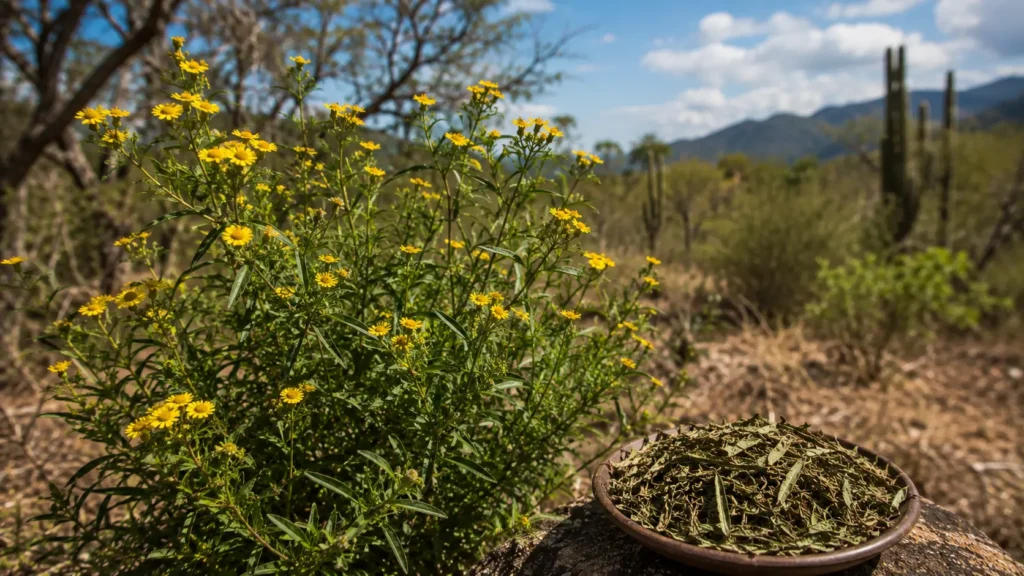
Calea grows as a branched shrub with green leaves and relatively slender stems.
As a member of the Asteraceae, the plant develops small compound flower heads rather than single large flowers.
In addition, the shape and size of the leaves and the plant’s general appearance can vary depending on growing site and developmental stage.
When the plant material dries, both colour and structure naturally change.
That is why a simple visual check is not always enough for reliable identification once the material has been dried, cut or ground.
In practice, visual assessment should therefore be combined with botanical documentation and traceability information.
The chemical profile of Calea zacatechichi
Phytochemical research on Calea zacatechichi has mainly focused on natural compounds called sesquiterpene lactones.
Researchers have identified several different structures within this group of compounds.
For example, scientific studies describe calealactones and other germacranolide-related compounds from leaves and stems.
At the same time, the plant’s chemical profile consists of more components than these most studied compounds.
That is why it is misleading to describe Calea as if the whole raw material consisted of a single so-called active compound.
Scientific literature is not a batch certificate. The fact that researchers identify a compound in a study sample does not automatically show what a specific commercial batch contains.
Sesquiterpene lactones in Calea zacatechichi
Sesquiterpene lactones are a large group of secondary plant metabolites.
They are particularly common within the family Asteraceae and can have very varied chemical structures.
In addition, some sesquiterpene lactones contribute to a bitter taste and act as part of plants’ natural chemical defence.
In research on Calea, researchers mainly describe germacranolide types and closely related structures.
Consequently, the term sesquiterpene lactones gives a more accurate chemical description than reducing the plant to a single compound.
Calealactones in Calea zacatechichi – what do the studies show?
Calealactones are natural sesquiterpene lactones that researchers have isolated from plants in the genus Calea.
A published phytochemical study analysed leaves and stems from material described as Calea zacatechichi.
The researchers isolated six germacranolides. Among other things, they characterised the compound calealactone D and examined several closely related structures.
The study also described calealactone E in the material analysed.
The researchers used advanced analytical methods such as NMR and mass spectrometry to determine the structures of the compounds.
In other words, these chemical names are based on laboratory analysis of specific research samples.
Read the study via
PubMed – study of germacranolides from Calea
.
Why does the chemical profile of Calea zacatechichi vary?
Botanical raw materials show natural biological variation.
Geographical origin, climate, soil, the plant’s developmental stage and harvest time can, for example, affect the composition.
In addition, the plant part matters a great deal. Leaves and stems do not necessarily contain exactly the same proportions of secondary metabolites.
Drying, storage and other processing can also affect the material after harvest.
That is why research results should be used to describe the species’ known phytochemistry, not as a substitute for batch-specific analytical data.
In practice, an exact content figure therefore requires relevant analysis of the raw material in question.
What does research show about Calea zacatechichi?
The scientific literature mainly consists of phytochemical analyses and various preclinical laboratory models.
For example, researchers have examined isolated sesquiterpene lactones and extracts in cell-based test systems.
Such studies can give information about the chemical properties and biological activity of molecules under controlled experimental conditions.
However, cell studies are not the same as clinical evidence for a botanical raw material.
At the same time, laboratory research can be valuable when the aim is to map which compounds a plant contains and how researchers can characterise them.
Laboratory results and product claims must be kept apart. Results from isolated compounds, cell models or specific extracts should not be transferred directly to a commercial botanical raw material.
See an example of earlier experimental research:
PubMed – laboratory study of plant compounds
.
Calea zacatechichi and modern safety research
Modern laboratory research gives reason for caution when discussing the safety of Calea.
A more recent study analysed plant extracts in neurobiological laboratory models. In addition, another research group has examined effects in cultured human kidney cells.
The researchers reported changes and toxicity signals under certain experimental conditions.
However, such laboratory results do not mean that a safe or unsafe level of use for a commercial raw material can be calculated.
Instead, they show why you should avoid assuming that historical use automatically means documented safety.
This information is not consumption advice. The article describes the safety research to put the scientific literature in the right context, not to give instructions on use.
Read the more recent study:
PubMed – modern laboratory study of Calea
.
See also the study in human kidney cells:
PubMed – laboratory analysis in proximal tubule cells
.
Calea zacatechichi as a botanical raw material
Botanical material from Calea can be found in several different physical forms.
Above all, it is important to distinguish ordinary dried plant material from powder, extract and standardised extract.
| Product form | Processing | What does the form describe? |
|---|---|---|
| Dried plant material | The producer harvests and dries the plant material | Botanical raw material with relatively clear plant structure |
| Crushed raw material | The producer breaks dried material into smaller pieces | Smaller physical particle size |
| Powder | The producer grinds the dried material | Finely divided botanical raw material |
| Extract | An extraction process transfers parts of the raw material’s chemical profile | A different product form from ordinary dried material |
| Standardised extract | The producer checks defined markers against a specification | Requires relevant analytical support |
Grinding is not extraction. A powder therefore does not automatically become an extract or a standardised raw material.
For current information about Aromexperten’s raw material, you can
read the product information here
.
How do you assess the quality of Calea zacatechichi?
A thorough quality assessment starts with correct botanical identity.
In addition, the product information should clearly state which plant part the raw material consists of and which physical product form it is.
Because Calea zacatechichi and Calea ternifolia are used in parallel in the literature, it is also valuable for the documentation to recognise both names.
It therefore helps to check the following:
- botanical name and relevant synonyms
- which plant part the raw material consists of
- geographical origin
- whether the material is whole, crushed, powdered or extracted
- batch number where available
- the supplier’s traceability information
- microbiological analyses where available
- heavy metal analyses where relevant
- chemical analysis if specific markers are stated
- storage and packaging
Can calealactones be used in quality control of Calea?
A chemical profile of sesquiterpene lactones can give valuable information about a botanical material.
However, the laboratory needs to choose an analytical method suited to the compounds to be identified or quantified.
For example, an ordinary microbiological test does not show the content of calealactone D.
Consequently, every analysis must be linked to the parameter the laboratory actually examines.
How do you store Calea zacatechichi?
Store dried botanical raw materials in a dry, cool place, protected from direct sunlight.
In addition, the packaging should be kept well sealed to limit contact with moisture, air and foreign material.
Finely divided material has a larger exposed surface than whole or coarsely crushed plant parts.
That is why the product’s physical form can affect how sensitive the raw material is during storage.
Finally, always follow the storage information for the product in question and keep the raw material out of the reach of children.
Calea zacatechichi and product classification
Ethnobotanical history or appearance in older literature does not automatically determine how a commercial product may be classified or marketed.
Instead, the product form, plant part, composition, intended use and current legislation need to be assessed together.
Aromexperten’s product is presented as a botanical raw material.
That is why this knowledge article also focuses on botany, raw material knowledge, chemistry, taxonomy and quality assessment.
This article does not describe consumption. It contains no instructions on ingestion, dosage, preparation, smoking, inhalation or medical use.
Frequently asked questions about Calea zacatechichi
What is Calea zacatechichi?
Calea zacatechichi is a still common synonym and trade name for the plant that Kew accepts as Calea ternifolia Kunth.
Are Calea zacatechichi and Calea ternifolia the same plant?
Yes. Kew treats Calea zacatechichi as a synonym of Calea ternifolia. That is why both names appear in scientific and commercial literature.
Why is Calea zacatechichi called Mexican Dream Herb?
Mexican Dream Herb is a common and commercial name for the plant. However, the name should not be interpreted as an instruction for use or a verified claim of effect.
Where does Calea zacatechichi grow naturally?
The species’ natural range extends from Mexico through parts of Central America to Colombia.
Which plant family does Calea zacatechichi belong to?
The species belongs to the family Asteraceae. In other words, it belongs to the same large plant family as sunflowers and daisies.
Which compounds have researchers found in Calea zacatechichi?
Research has mainly described various sesquiterpene lactones, including calealactones and other germacranolides.
What is calealactone D?
Calealactone D is a germacranolide that researchers isolated from plant material in a phytochemical study and whose structure they determined.
Do all Calea products have the same chemical profile?
No, this cannot be assumed. Botanical raw materials vary naturally, and different processing methods can also affect the profile. That is why exact batch information requires relevant laboratory analysis.
Is Calea powder the same as an extract?
No. Powder is finely divided botanical material. An extract, by contrast, requires a separate extraction process.
Is a Calea extract automatically standardised?
No. Standardisation requires the producer to define one or more chemical markers and check them against a set specification.
What does research say about the safety of Calea zacatechichi?
There are laboratory studies that have identified possible toxicity signals in experimental models. However, such studies do not provide any consumption instructions or a safe dose for a commercial raw material.
Is Aromexperten’s Calea intended for consumption?
The product is presented as a botanical raw material for its stated technical use. This article contains no instructions on consumption, dosage, smoking, inhalation or medical use.
Summary: what is Calea zacatechichi?
Calea zacatechichi is a well-known synonym and trade name for the species that Kew accepts as Calea ternifolia Kunth.
The species belongs to the Asteraceae and occurs naturally from Mexico through parts of Central America to Colombia.
Above all, chemical research has focused on sesquiterpene lactones, including several calealactones and other germacranolides.
At the same time, much of the research consists of phytochemical and preclinical laboratory studies. That is why the results should not be turned into clinical claims of effect about a commercial raw material.
Modern laboratory research has also identified possible toxicity signals under certain experimental conditions. Consequently, it is particularly important to keep botanical information, safety research and actual product classification clearly separate.
Finally, exact claims about a particular product batch require relevant analytical documentation. General literature about the species cannot replace a batch-specific analytical result.
Read more about the botanical raw material
On the product page, you will find current information about product form, available options, storage and the product’s stated intended use.
The product is presented as a botanical raw material. Always follow the product’s current labelling and stated technical intended use.
Sources on Calea zacatechichi and Calea ternifolia
-
Royal Botanic Gardens, Kew – taxonomic record for the synonym
-
Royal Botanic Gardens, Kew – Calea ternifolia Kunth
-
Phytochemical study of germacranolides from Calea
-
Experimental study of sesquiterpene lactones from Mexican plants
-
Laboratory study of Calea in human proximal kidney tubule cells
-
Modern laboratory study of Calea and neuroglial models
Last fact-checked:

 Best Sellers
