Svenska
 News
News Botanical Blends
 Mitragyna
 Kanna (sceletium tortuosum)
 Akuamma (Picralima nitida)
 Tongkat Ali (Eurycoma longifolia)
 Blue Lotus (Nymphaea caerulea)
 Sakae Naa
 Wild Lettuce (Lactuca virosa)
 Damiana (turnera diffusa)
 Zornia latifolia (Maconha Brava)
 CBD products
 Aromatherapy
Uncategorized
Tongkat Ali powder or extract? Differences explained
Jul
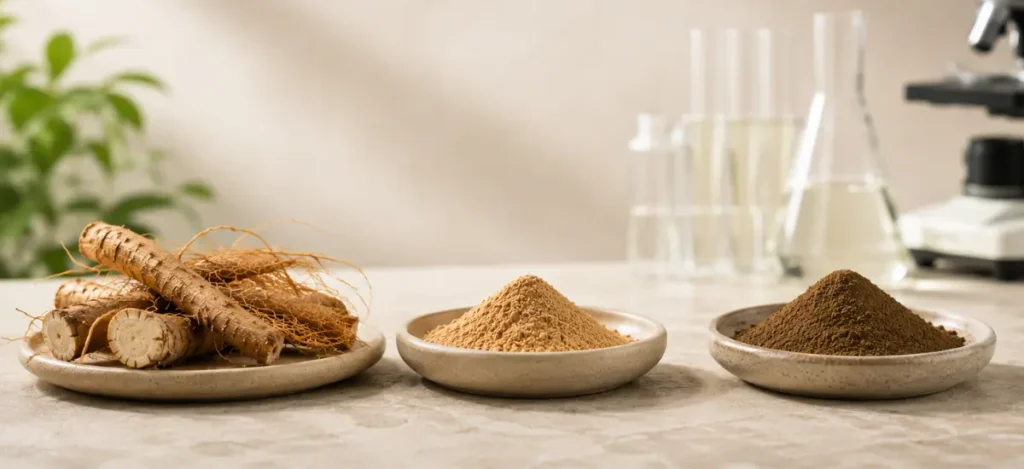
Comparison of botanical raw materials
What is the difference between Tongkat Ali powder and extract?
Root powder consists of ground and dried Eurycoma longifolia root, whereas an extract has undergone additional processing using a solvent.
A ratio such as 100:1 normally describes the amount of original raw material in relation to the resulting extract.
However, the figure alone does not show which substances the product contains, how pure it is, or how consistent the quality is between different batches.
Tongkat Ali powder or extract – quick comparison
Tongkat Ali is available in several raw material forms. Above all, root powder, ratio extracts and standardised extracts differ in how the producer processes the root and what documentation accompanies the product.
| Property | Root powder | 100:1 extract | Standardised Physta® |
|---|---|---|---|
| Starting material | Dried root | Root from Malaysia | Malaysian Eurycoma longifolia root |
| Processing | Drying and milling | Ethanol extraction | Water extraction |
| Stated ratio | Not applicable | 100:1 according to supplier information | Focus on defined analytical parameters |
| Standardised markers | None stated on the product page | No specific markers stated | Several parameters, including eurycomanone |
| Carriers | No additives according to the product page | None according to the product page | Check the current specification and COA |
| Batch-to-batch consistency | Natural variation may occur | Raw material and process may affect variation | The batch is checked against defined specifications |
In short, the raw material forms answer different questions. Root powder shows that the producer has milled the entire dried root. A 100:1 extract, by contrast, states an extraction ratio. A standardised extract additionally provides defined analytical ranges for selected parameters.
What is Tongkat Ali root powder?
Tongkat Ali root powder consists of dried, finely milled root from Eurycoma longifolia.
The producer does not perform any extraction, but retains both the water-soluble and insoluble parts of the milled plant material.
For this reason, root powder is often described as a less processed raw material form.
According to the product page, Aromexperten’s Tongkat Ali root powder contains 100% pulverised root with no extraction or additives. The origin varies between Malaysia and Indonesia depending on the batch.
However, less processing does not automatically mean better or worse quality.
First, the buyer needs to verify the correct species, plant part and country of origin. After that, drying, storage, microbiology, heavy metals and traceability are among the relevant factors.
In addition, natural variation between different plants can affect the chemical profile.
What is a Tongkat Ali extract?
When a producer manufactures an extract, a solvent is used to transfer certain constituents from the root into an extract solution.
The solvent is then removed in whole or in part, and the result may, for example, be a dry powder.
Extraction also changes the composition of the raw material. Some substances are readily carried over by the chosen solvent, while others largely remain in the plant residues.
For this reason, a clear product description should state both the plant part and the extraction solvent.
For extracts, it is also relevant to know the extraction ratio, physical form, any carriers, and analytical data.
According to the product page, Aromexperten’s Tongkat Ali 100:1 extract consists of ethanol-extracted root from Malaysia. The same page states that the product contains no added carrier and is not described as a brand-standardised extract.
What does Tongkat Ali 10:1, 50:1 and 100:1 mean?
An extraction ratio describes the relationship between the amount of plant material the producer uses and the amount of extract the process yields.
EMA uses, among other terms, the concept of drug extract ratio, DER.
Simplified, a stated 100:1 ratio can therefore describe 100 parts of plant material in relation to one part of obtained extract.
However, it is necessary to know exactly which type of ratio the supplier means.
EMA distinguishes, among other things, between genuine (native) DER and total DER.
The genuine ratio refers to plant material in relation to the extract itself, without excipients.
The total ratio, by contrast, may refer to the finished extract mixture, in which excipients may be included.
In addition, DER is often stated as a range because process yield can vary.
Therefore, a standalone marketing value such as 100:1 provides less information than a more complete declaration of raw material quantity, obtained native extract, solvent, process steps and any excipients.
In other words, DER primarily describes a manufacturing-related ratio.
A marker content, for example eurycomanone as a percentage, by contrast describes an analytical result.
The information therefore answers different questions and should not be used as if it were the same measure.
Why does the extraction solvent matter?
Water and ethanol have different properties. Therefore, they can extract different parts of the same root material.
A water extract and an ethanol extract therefore do not necessarily have the same chemical profile, even if the producer starts with the same plant species and plant part.
EMA’s guidelines also state that the declaration of an extract should include the name and composition of the extraction solvent.
The information therefore helps the reader understand the manufacturing process and compare different extracts in a more meaningful way.
Aromexperten’s 100:1 product states ethanol extraction, while our guide on what Physta® is describes Physta® as a standardised water extract. Therefore, the products should not be compared solely on how the powder looks in the packaging.
What is a standardised Tongkat Ali extract?
In standardisation, the producer selects certain analytical parameters and sets accepted ranges for them.
Each batch is then checked against the established specification.
In this way, the buyer receives more information about consistency between production batches.
WHO describes how marker substances can be used for quality control when not all relevant constituents are fully defined.
Markers can therefore help with, for example, identity, analysis and reproducibility.
At the same time, a single marker does not automatically constitute proof of all properties of the product.
Tongkat Ali Physta® uses several specified analytical parameters.
The published batch certificate includes, among other things, eurycomanone, total protein fraction, total polysaccharide content and glycosaponins.
In addition, the document reports physical, microbiological and heavy-metal-related values.
Standardisation therefore provides a different type of information than a standalone ratio.
However, it does not replace verification of identity, extraction solvent, contaminants, sampling, laboratory method or the origin of the documents.
How Aromexperten’s three Tongkat Ali raw materials differ
1. Tongkat Ali root powder
The root powder consists of dried and milled root with no extraction.
Therefore, the focus is on the original botanical plant material.
The product page also states Malaysia or Indonesia as the origin depending on the current batch.
2. Tongkat Ali 100:1 extract
The producer uses ethanol to produce the extract from Malaysian root.
The product page focuses on the stated 100:1 ratio and states no added carriers.
However, the product is not described as standardised against a named analytical marker.
3. Tongkat Ali Physta®
Physta® is a named, water-extracted and standardised raw material.
Here, the focus is instead on defined analytical parameters and batch documentation.
Read the technical deep dive in our guide What is Physta®?.
In summary, the products represent different forms of processing and documentation.
They should therefore not be described as interchangeable versions of exactly the same raw material.
How to assess the quality of Tongkat Ali powder and extract
Start with the product’s identity and then proceed to process and analysis.
A high ratio or a high marker content never provides the full picture on its own.
- First: Verify the scientific name Eurycoma longifolia.
- Next: Confirm which plant part has been used.
- Then: Check the country of origin and batch number.
- Next: Determine whether the product is root powder or extract.
- For extracts: Check the extraction solvent and its composition.
- In addition: Check whether the ratio refers to genuine DER or total DER.
- At the same time: Review any carriers and other excipients.
- Next: Check named markers and the associated analytical methods.
- Then: Review microbiology, heavy metals and moisture content.
- Finally: Match the COA and batch number to the actual product.
In addition, you should read reporting limits, footnotes and disclaimers.
It is also important to distinguish supplier information from independent laboratory or authority assessments.
Common misconceptions about Tongkat Ali extracts
“100:1 is always stronger than a standardised extract”
No. A ratio describes the amount of raw material in relation to extract yield.
Standardisation, by contrast, describes defined analytical ranges.
Without chemical analysis, it is therefore not possible to compare the actual content of a specific marker.
“Root powder and extract contain the same substances in the same proportions”
No. The extraction solvent and manufacturing process affect which substances are transferred to the extract.
Therefore, the proportions can change.
“Standardised means that authorities have approved the product”
No. Standardisation describes the product’s quality control.
However, it does not automatically establish legal status, safety or approval as food.
“A COA proves everything about the product”
No. A COA shows the parameters that the document actually reports for the specific sample.
The value of the document also depends on, among other things, sampling, the laboratory, analytical methods and the link to the correct batch.
Does the raw material form affect the product’s EU status?
Powder, ratio extracts and standardised extracts can differ both chemically and technically.
Therefore, each exact ingredient and intended use needs to be assessed under the relevant regulations.
A product’s technical specification therefore does not automatically constitute approval as food or a dietary supplement.
In 2021, EFSA assessed a specific standardised water extract from Eurycoma longifolia root as a novel food.
The panel considered that the data did not establish safety for the proposed conditions of use.
The conclusion applies to the assessed ingredient and application and should therefore not be simplified into a general statement about every possible Tongkat Ali raw material.
Aromexperten presents the compared products as ethnobotanical or technical raw materials.
The products are therefore not intended for consumption.
Short glossary
- Root powder
- Dried root that the producer has milled without extraction.
- Extract
- A preparation in which the producer uses a solvent to transfer certain constituents from the plant material.
- DER
- Drug extract ratio, a ratio between the amount of plant material used and the extract obtained.
- Genuine DER
- The ratio between plant material and native extract without excipients.
- Total DER
- The ratio between plant material and the total extract mixture, which may contain excipients.
- Standardisation
- Control of selected analytical parameters against defined ranges between batches.
- Marker substance
- A substance that the laboratory uses for identity, analysis or quality control.
- COA
- Certificate of Analysis, a document with specifications and analytical results for a raw material or batch.
Tongkat Ali powder or extract – what is the difference?
Tongkat Ali root powder consists of dried and milled root.
Therefore, this raw material form contains both soluble and insoluble parts from the original plant material and has no extraction ratio.
A 100:1 extract, by contrast, has undergone extraction.
According to the supplier information, the figure describes a ratio between the amount of raw material and the extract obtained, but it does not automatically show the levels of eurycomanone or other specific substances.
A standardised extract such as Physta® also uses defined analytical parameters.
Therefore, certain quality values can be compared against established specifications between batches.
At the same time, it is still necessary to review extraction solvent, purity, microbiology, heavy metals, sampling and documentation.
Overall, there is therefore no single figure that, on its own, determines which raw material is best documented.
A serious comparison instead weighs botanical identity, raw material form, manufacturing process, DER, analytical markers, carriers, batch data and intended use.
Frequently asked questions about Tongkat Ali powder and extract
What is the difference between Tongkat Ali powder and extract?
The producer makes root powder by milling dried root.
In extraction, by contrast, a solvent is used to transfer certain constituents into a new raw material form.
What does Tongkat Ali 100:1 mean?
The information normally describes a ratio between the amount of root used and the amount of extract obtained.
However, it does not, on its own, show how much eurycomanone or other specific substances the product contains.
Is 100:1 the same as 100 times stronger?
No. Extraction does not concentrate all substances to the same extent.
Therefore, chemical analysis is required to compare a specific marker content.
What does standardised Tongkat Ali extract mean?
It means that the producer has selected certain analytical parameters and checks each batch against defined specifications.
Is eurycomanone the same as the extraction ratio?
No. Eurycomanone is a chemical substance and can be used as an analytical marker.
The extraction ratio, by contrast, describes a relationship between plant material and extract.
Why do you need to know the extraction solvent?
Different solvents can extract different parts of the plant material.
Therefore, for example, water extracts and ethanol extracts can have different chemical profiles.
Is Physta® the same as Tongkat Ali 100:1?
No. Physta® is a named and standardised water extract.
Aromexperten’s 100:1 product, by contrast, is an ethanol extract where the product information focuses on the stated extraction ratio.
Where can I see the current Tongkat Ali Physta® batch?
The current batch, analytical values and associated COA are available on the product page for Tongkat Ali Physta®.
Which documentation should be checked for a botanical extract?
Check, among other things, species, plant part, origin, extraction solvent, DER, any carriers, analytical markers, microbiology, heavy metals, batch number and the current COA.
Are Aromexperten’s Tongkat Ali products intended for consumption?
No. Aromexperten sells the compared products as ethnobotanical or technical raw materials and therefore states that they are not intended for consumption.
Sources and method
This article is based on Aromexperten’s current product descriptions and supplements them with technical guidelines from EMA and WHO, as well as EFSA’s regulatory safety assessment.
Product information describes the current products, while authority sources are used to explain general quality concepts and regulatory issues.
-
Aromexperten: Tongkat Ali root powder.
-
Aromexperten: Tongkat Ali 100:1 extract.
-
Aromexperten: What is Physta®?
-
EMA: Guideline on quality of herbal medicinal products, revision 3.
-
EMA: Guideline on declaration of herbal substances and herbal preparations.
-
WHO: Guidelines for selecting marker substances of herbal origin for quality control.
-
EFSA: Safety of Eurycoma longifolia root extract as a novel food.

 Best Sellers