


 Svenska

 News
 Botanical Blends
 Mitragyna
 Kanna (sceletium tortuosum)
 Akuamma (Picralima nitida)
 Tongkat Ali (Eurycoma longifolia)
 Blue Lotus (Nymphaea caerulea)
 Sakae Naa
 Wild Lettuce (Lactuca virosa)
 Damiana (turnera diffusa)
 Zornia latifolia (Maconha Brava)
 CBD products
 Mushroom Extracts
 Aromatherapy
Botanicals
Hericenones and Erinacines in Lion’s Mane – What Is the Difference?
Sep
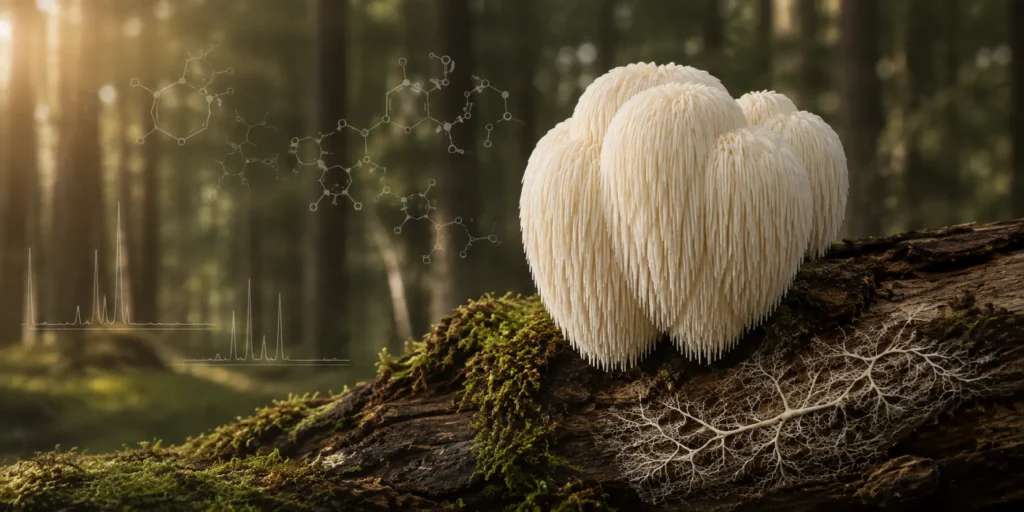
Hericenones and erinacines are two groups of secondary metabolites that researchers have studied in Lion’s Mane, Hericium erinaceus.
They are sometimes confused, but they are not the same compounds, and they are also associated with different parts of the fungus. Hericenones have mainly been identified in the fruiting body, while several erinacines have been identified in the mycelium.
In short: When comparing hericenones and erinacines, you first need to know which Lion’s Mane raw material the analysis refers to. The fruiting body and the mycelium are biologically different structures and can therefore have different profiles of secondary metabolites.
In this guide
- Hericenones vs erinacines – quick overview
- What are secondary metabolites?
- What are hericenones?
- What are hericenes?
- What are erinacines?
- Fruiting body vs mycelium
- What is erinacine A?
- How do laboratories analyse these compounds?
- Why do the levels vary?
- How should you interpret product information?
- What does this mean for Lion’s Mane extract?
- Summary
Hericenones vs erinacines – quick overview
Hericenones and erinacines both appear in research on Hericium erinaceus, but they belong to different chemical groups, and researchers have mainly identified them in different fungal structures.
| Property | Hericenones | Erinacines |
|---|---|---|
| Fungus | Hericium erinaceus | Hericium erinaceus |
| Mainly associated with | Fruiting body | Mycelium |
| Type of compounds | Aromatic secondary metabolites | Cyathane diterpenoids and closely related metabolites |
| Examples | Hericenones C, D, E, F, G and H | Erinacines A, C, S and several others |
| Raw material relevance | Can contribute to the characterisation of fruiting body raw material | Can contribute to the characterisation of specific mycelium raw materials |
The point is therefore not to declare one group “better”. Instead, these compounds help illustrate why the fruiting body and the mycelium do not automatically have the same chemical profile.
What are secondary metabolites?
Fungi produce many different types of chemical compounds. Some form part of basic structures and metabolism, while others are usually described as secondary metabolites.
These include many smaller molecules that researchers use when studying and characterising different fungal species.
Hericenones and erinacines are examples of such metabolite groups from Hericium erinaceus.
At the same time, they should be distinguished from, for example, beta-glucans. Beta-glucans are large polysaccharide structures, while hericenones and erinacines belong to entirely different chemical groups.
What are hericenones in Lion’s Mane?
Hericenones are a group of compounds that researchers have isolated and characterised from fruiting bodies of Hericium erinaceus.
Research began identifying several hericenones in earlier decades. Since then, researchers have continued to map the structures and analyse further closely related compounds.
A modern study of Lion’s Mane fruiting bodies used LC-MS/MS together with synthetically produced reference compounds to examine the presence of several hericenones and related compounds.
That is why hericenones mainly serve as an example of the specialised chemistry that researchers associate with the Lion’s Mane fruiting body.
Presence does not mean a standardised level.
The fact that researchers have identified a hericenone in Hericium erinaceus does not mean that every commercial fruiting body product contains the same amount. A specific extract requires relevant raw material analysis.
Hericenones and hericenes – are they the same thing?
No. Hericenes are closely related Lion’s Mane metabolites, but the term is not synonymous with hericenones.
Analytical studies have identified several hericenes together with hericenones in material from Hericium erinaceus.
The difference matters when a raw material specification states a combined value or uses wording such as hericenones/hericenes. In that case, you need to read the specification as it is actually written and not automatically assume that the entire analytical value consists of hericenones.
In practice: If a specification states “total hericenones/hericenes”, the value describes a defined analytical parameter for the raw material in question. It should not be simplified into a specific level of a single hericenone.
What are erinacines?
Erinacines are another group of secondary metabolites from Hericium erinaceus.
Researchers have mainly isolated several erinacines from mycelium. Erinacine A is among the most studied, but the literature also describes several other erinacines.
Chemically, erinacines differ from hericenones. The names should therefore not be used as if they described the same group of compounds.
Researchers have, for example, isolated both erinacine A and erinacine S from mycelium material of Hericium erinaceus.
At the same time, this does not mean that all Lion’s Mane mycelium contains identical amounts of erinacines. Strain, growing conditions and processing can affect the analysed profile.
Hericenones and erinacines show the difference between fruiting body and mycelium
One of the most useful aspects of the research on these compounds is that it clarifies the difference between Lion’s Mane fruiting body and Lion’s Mane mycelium.
In one study, researchers analysed mycelium, primordium and sporophore/fruiting body from Hericium erinaceus.
The researchers quantified erinacine A in the mycelium, while they analysed hericenones C and D in the fruiting bodies. They also observed variation between wild-growing and cultivated fruiting bodies.
This does not mean that the chemistry can be reduced to a simple rule where the fruiting body always contains only hericenones and the mycelium only erinacines. However, the results clearly show that the part of the fungus matters.
If you would like to understand the biological difference in more detail, you can read our guide on
Lion’s Mane – fruiting body or mycelium.
What is erinacine A?
Erinacine A is one of the most analysed erinacines from Hericium erinaceus mycelium.
Researchers use chromatographic methods, among others, to identify and quantify the compound in cultivated mycelium cultures.
A study from 2024, for example, compared several strains of Hericium erinaceus and analysed their production of erinacine A. The results showed variation between the strains.
This matters from a raw material perspective: the label “Lion’s Mane mycelium” does not automatically tell you what erinacine A content the material has.
To be able to state a specific level, the producer needs to analyse the raw material in question with a relevant method.
How do laboratories analyse hericenones and erinacines?
These compounds occur in much lower concentrations than the main structural components of the raw material. Laboratories therefore need to use sensitive analytical methods.
Researchers use, among other things, liquid chromatography together with UV detection or mass spectrometry.
In 2026, researchers published a method for the simultaneous determination of several relevant compounds in Hericium erinaceus raw materials and products.
The method covered, among others:
- hericenones
- hericenes
- erinacine A
- ergosterol
This is important for raw material documentation, because analytical methods make it possible to distinguish between a general claim about presence and an actual measured value.
Why can levels of hericenones and erinacines vary?
Lion’s Mane is a biological raw material. There are therefore several possible sources of variation.
The following factors, among others, can play a role:
- genetic strain of the fungus
- fruiting body or mycelium
- developmental stage
- growing conditions
- growth substrate
- time of harvest
- drying
- extraction method
- which analytical method the laboratory uses
A study of different Hericium erinaceus strains, for example, showed variation in erinacine A production in mycelium.
Another study observed differences in hericenones between wild-growing and cultivated fruiting bodies.
That is why you should not transfer an analytical value from a research study directly to a commercial product.
How should you interpret hericenones and erinacines on a product?
If a product states hericenones, hericenes or erinacines, you should first check which raw material the analysis refers to.
Ask, for example, the following questions:
- Is the raw material fruiting body or mycelium?
- Which scientific species name is stated?
- Which specific group of compounds has the laboratory analysed?
- Is a single compound or a total value stated?
- Which analytical method is used?
- Is the value a guaranteed specification or a result for a specific batch?
Above all, you should avoid interpreting the biggest number as automatically the best.
Chemical analytical values describe the composition of the raw material. They do not work as universal measures of quality, strength or physiological effect.
Hericenones and beta-glucans describe different things
It is also important to keep the different analytical parameters of a Lion’s Mane raw material apart.
Beta-glucans are polysaccharides that form part of the structural chemistry of the fungus. Hericenones, by contrast, are smaller secondary metabolites.
A raw material can therefore have both a beta-glucan value and a separate analytical value for hericenones or hericenes.
| Parameter | Type | What does it describe? |
|---|---|---|
| Beta-glucans | Polysaccharides | Part of the raw material’s glucan profile |
| Hericenones | Secondary metabolites | Part of the specialised chemistry of the fruiting body |
| Erinacines | Diterpenoid-related metabolites | A group of compounds mainly studied in mycelium |
You can read more about the first group in our guide on
beta-glucans in mushroom extracts.
What does this mean for Lion’s Mane extract?
When assessing a Lion’s Mane extract, you first need to identify which part of the fungus the producer uses.
If the raw material consists of 100% fruiting body, research on and analysis of fruiting-body-related metabolites such as hericenones and hericenes is particularly relevant for characterising the raw material.
If the product is instead based on mycelium, erinacines may be more relevant, depending on the raw material and analysis in question.
That is why it is misleading to automatically demand the same chemical markers from a fruiting body product and a mycelium product.
Aromexperten’s NordRelease® Lion’s Mane consists of 100% fruiting body of Hericium erinaceus. The raw material specification states at least 18% 1,3:1,6-beta-glucans and at least 0.05% total hericenones/hericenes.
Read more about the raw material and its documented specification on the page for
Lion’s Mane extract.
Analytical markers are not measures of effect
Hericenones and erinacines often appear in research literature that also investigates biological mechanisms.
This does not mean, however, that the presence of a certain compound in a commercial raw material automatically transfers the results of an experimental study to the product.
A research study may, for example, use an isolated compound, a specific mycelium strain or a standardised extract under controlled conditions.
Another raw material may have a completely different concentration and chemical profile.
Chemical identity and biological effect are two different questions.
An analytical value for hericenones, hericenes or erinacines describes the chemical composition of the raw material. It should not be turned directly into a medical or physiological claim.
Summary: hericenones and erinacines
Hericenones and erinacines are not the same group of compounds.
Both appear in research on Hericium erinaceus, but researchers have mainly associated them with different parts of the fungus.
Hericenones have mainly been identified and analysed in the fruiting body, while several erinacines have mainly been isolated from mycelium.
In addition, there are closely related compounds such as hericenes, which makes it important to read exactly what a raw material specification actually states.
Modern chromatographic methods can analyse several of these compounds separately. At the same time, research shows that concentrations can vary between fungal strains, developmental stages and types of raw material.
That is why you should always link a chemical analytical value to the right part of the fungus, the right raw material and the right analytical method.
Would you like to see documented mushroom raw materials? Explore the category of
mushroom extracts.
About this content: This article describes the chemistry, raw material identity and analytical research of Hericium erinaceus. Information about hericenones, hericenes and erinacines should not be interpreted as medical or physiological claims. Aromexperten’s mushroom raw materials are sold for technical and raw material purposes and are not intended for consumption.
Sources and further reading
-
Wang et al. – Uncovering Hericenones from the Fruiting Bodies of Hericium erinaceus through Interdisciplinary Collaboration
-
Array of Metabolites in Italian Hericium erinaceus Mycelium, Primordium, and Sporophore
-
Chen et al. – Erinacine S, a Rare Sesterterpene from the Mycelia of Hericium erinaceus
-
Isolation and Evaluation of Erinacine A Contents in Mycelia of Hericium erinaceus Strains
-
Simultaneous UHPLC-UV Determination of Hericenones, Hericenes, Erinacines and Ergosterol in Hericium erinaceus Raw Materials or Products
-
Hericenones From Hericium erinaceus – A Scoping Review of Structural Diversity

 Best Sellers
