


 Svenska

 News
 Botanical Blends
 Mitragyna
 Kanna (sceletium tortuosum)
 Akuamma (Picralima nitida)
 Tongkat Ali (Eurycoma longifolia)
 Blue Lotus (Nymphaea caerulea)
 Sakae Naa
 Wild Lettuce (Lactuca virosa)
 Damiana (turnera diffusa)
 Zornia latifolia (Maconha Brava)
 CBD products
 Mushroom Extracts
 Aromatherapy
Botanicals
Beta-Glucans in Mushroom Extracts – How to Interpret the Analytical Value
Sep
Beta-glucans in mushroom extracts are an analytical parameter that can give valuable information about the composition of the raw material.
At the same time, the percentage is easy to misinterpret. A higher beta-glucan value does not automatically mean, for example, that one mushroom extract is “stronger” or better than another. To interpret the value, you also need to understand the mushroom species, the part of the fungus used, the analytical method and the rest of the product documentation.
In short: Beta-glucans are glucose polymers that form part of fungal cell walls, among other things. When a laboratory analyses beta-glucans in mushroom extracts, the result is a chemical raw material value – not a measure of physiological effect.
In this guide
- What are beta-glucans?
- What do 1,3- and 1,6-beta-glucan mean?
- How are beta-glucans in mushroom extracts analysed?
- Total glucan, alpha-glucan and beta-glucan
- Beta-glucans vs polysaccharides
- What does the percentage mean?
- Can you compare two mushrooms by beta-glucan value?
- Lion’s Mane and Chaga as an example
- Mycelium, grain and alpha-glucans
- Why does the analytical method matter?
- What should you check?
- Summary
What are beta-glucans in mushroom extracts?
Beta-glucans are polysaccharides made up of many glucose units linked together by so-called beta-glycosidic bonds.
In fungi, beta-glucans – together with chitin, among others – are important structural components of the cell wall. That is why beta-glucans occur naturally in many different fungi and in different parts of the fungal organism.
The term beta-glucan does not, however, describe one single identical molecule. Instead, there are several structural variants depending on how the glucose units are linked, how the molecule branches and what molecular size it has.
This also means that two raw materials can both contain beta-glucans and still have different glucan profiles.
What do 1,3- and 1,6-beta-glucan mean?
When a raw material specification states, for example, 1,3:1,6-beta-glucans, the numbers describe how the glucose units are bonded together in the polysaccharide structure.
Fungal beta-glucans often contain beta-(1→3) bonds and beta-(1→6) branches. The structure can, however, vary between species and between different glucan fractions.
In other words, “beta-glucan” describes a chemical family rather than one single standardised molecule.
1,3 and 1,6 describe the bonding structure.
The numbers should therefore not be interpreted as a concentration, an extraction ratio or any measure of the product’s “strength”.
How are beta-glucans in mushroom extracts analysed?
Laboratories can use several methods for glucan analysis. An established method for mushroom and mycelium products is based on the laboratory first determining the amount of total glucan and then the amount of alpha-glucan.
The laboratory can then calculate the beta-glucan fraction from the difference between these values.
Total glucan is analysed
Alpha-glucan is analysed separately
Beta-glucan is calculated
The established AOAC-related method uses acid hydrolysis for total glucan and enzymatic treatment for the alpha-glucan fraction. The analysis then measures the released glucose.
That is why a beta-glucan value is not just an estimate based on the product’s weight. It is based on a defined analytical procedure.
Total glucan, alpha-glucan and beta-glucan – what is the difference?
To understand the analytical result, you need to distinguish between three terms.
| Analytical parameter | What does it describe? |
|---|---|
| Total glucan | The combined amount of analysable glucans within the method’s definition |
| Alpha-glucan | Glucans with alpha bonds, where starch, among other things, can contribute to the analytical value |
| Beta-glucan | Beta-linked glucans that are determined separately or calculated from the method’s total and alpha-glucan values |
In the classic enzymatic method for mushrooms, beta-glucan is therefore calculated as the difference between total glucan and alpha-glucan.
This is particularly important when analysing products that may contain starch or other alpha-glucan-rich components.
Beta-glucans and polysaccharides are not the same analytical value
A common misconception is that the words polysaccharides and beta-glucans mean the same thing.
Polysaccharides are in fact a much broader concept. The group includes many long carbohydrate molecules with different monosaccharides, bonds and structures.
Beta-glucans belong to this larger group, but not all polysaccharides are beta-glucans.
| Stated value | What do we know? |
|---|---|
| 30% polysaccharides | The product contains an analysed polysaccharide fraction, but the figure does not automatically tell you how much of it is beta-glucan |
| 30% beta-glucans | The analysis refers specifically to beta-glucan according to the definition of the analytical method used |
That is why you should check exactly what the supplier has analysed before comparing two products.
What does the beta-glucan percentage in a mushroom extract mean?
If a specification states, for example, 18% beta-glucans, it essentially means that the analytical method has determined a beta-glucan fraction corresponding to the stated share of the raw material under the conditions of the specification.
This is a useful raw material value, because the producer is then stating a measurable chemical parameter.
However, the value should not automatically be translated into:
- “strength”
- biological effect
- quality in every respect
- how good the product is compared with another mushroom species
- how much of other compound groups the raw material contains
The beta-glucan content is therefore one part of the raw material profile, not a complete measure of quality.
Can you compare mushroom extracts by beta-glucan percentage?
You can compare beta-glucan values, but the comparison needs the right context.
If two analyses refer to the same mushroom species, the same type of raw material and the same analytical method, the percentages can give relevant information about differences between the raw materials.
However, a direct comparison becomes much weaker when you compare completely different species.
Different fungi have different cell wall compositions, different chemical profiles and different secondary metabolites. That is why the beta-glucan percentage does not tell you which mushroom is “best”.
20% is not automatically “twice as strong” as 10%.
The beta-glucan content describes a chemical fraction of the raw material. It should not be used as a general measure of strength or effect between different mushrooms.
Beta-glucans in Lion’s Mane and Chaga – a clear example
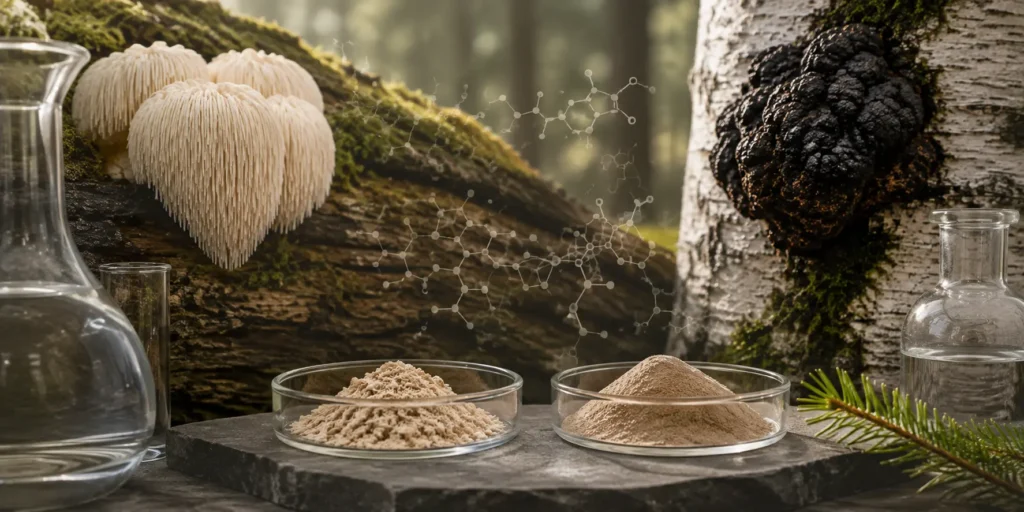
Aromexperten’s NordRelease® Lion’s Mane and Chaga clearly show why percentages need the right context.
NordRelease® Lion’s Mane consists of 100% fruiting body of Hericium erinaceus. The raw material specification states at least 18% 1,3:1,6-beta-glucans.
NordRelease® Chaga, on the other hand, is based on Chaga conk from Inonotus obliquus. Here the specification states at least 5% 1,3:1,6-beta-glucans.
This does not mean, however, that Lion’s Mane is “3.6 times stronger” than Chaga. On the contrary, these are two biologically and chemically different mushroom raw materials.
In addition, the specifications use other raw material markers. For Lion’s Mane, hericenones/hericenes are stated, among other things, while the Chaga specification also states inotodiol and betulinic acid.
That is why you should read the complete raw material profile of each species instead of isolating a single percentage.
Read more about each raw material on the product pages for
Lion’s Mane extract
and
Chaga extract.
Mycelium, grain and alpha-glucans – why is it relevant?
The analysis becomes particularly interesting when the producer grows fungal mycelium on grain.
Grain contains a lot of starch, and starch is an alpha-glucan. If a finished mycelium raw material contains significant amounts of residual growth substrate, the alpha-glucan value may therefore be high.
Megazyme, which developed the established K-YBGL method for yeast and mushrooms, also points this out in its method information. The company states that some commercial mycelium products grown on grain can contain very large amounts of starch.
Consequently, analysing both alpha- and beta-glucan can give more information about the carbohydrate profile of the raw material than a general polysaccharide value.
This does not mean, however, that mycelium is automatically a poor raw material. Mycelium is a legitimate fungal structure and is also used in research. What matters is transparency: the customer should be able to see what the raw material actually consists of.
If you would like to read more about that difference, see our guide on
Lion’s Mane – fruiting body or mycelium.
Why does the analytical method for beta-glucans matter?
Two laboratory results can only be compared correctly if you also understand how the laboratories obtained the values.
The classic method for mushrooms and mycelium uses acid hydrolysis to determine total glucan and a separate enzymatic analysis for alpha-glucan. The laboratory then calculates the beta-glucan fraction.
At the same time, researchers continue to develop the methods. A method study published in 2026, for example, examined how modern and more complex sample matrices can affect the analysis. Among other things, the researchers evaluated interference from resistant starch, trehalose and certain sweeteners.
This illustrates an important principle: the laboratory method and the composition of the sample matter when an analytical result is interpreted.
Do not just ask “what percentage of beta-glucan?”
Also ask which method the laboratory used and which raw material the analysis refers to.
Why can beta-glucan content vary between mushrooms?
Mushrooms are biological raw materials. Glucan composition can therefore vary between species and even between different structures of the same species.
Studies of mushrooms have, for example, shown differences in beta-glucan content between species and between different parts of the fruiting body.
In addition, growing conditions, developmental stage and subsequent processing can affect the final composition of the raw material.
Thus, you should not assume that all products with the same mushroom name have identical analytical values.
Does extraction affect the beta-glucan profile?
The extraction method affects which components the producer transfers from the original mushroom raw material to the finished extract.
Water extraction is often used for mushroom polysaccharides. At the same time, temperature, extraction time, particle size and the ratio of raw material to liquid can affect the process.
You therefore need to distinguish between the natural composition of the mushroom and the analysed composition of the finished extract.
If you would like to look more closely at the actual difference between powder and extract, you can read our guide on
mushroom powder vs mushroom extract.
How to assess beta-glucans in mushroom extracts
When you review beta-glucans in mushroom extracts, you should therefore not stop at the largest percentage on the label.
Instead, check several parts of the documentation:
- correct scientific species name
- which part of the fungus the producer uses
- whether the product is a powder or an extract
- extraction method
- specified beta-glucan content
- which type of glucan value is stated
- analytical method
- alpha-glucan or starch where relevant
- other species-specific raw material markers
- origin and traceability of the raw material
This way, you get a much better picture of the raw material than if you only compare a single percentage.
An analytical value is not the same as an effect value
It is also important to distinguish between chemical analysis and biological effect.
If the laboratory reports 18% beta-glucans, the figure describes the amount of beta-glucan that the analytical method has determined in the raw material. The analysis does not, in itself, say anything about how the material affects the human body.
In addition, the molecular structure of beta-glucans can vary. Branching, molecular mass, solubility and other structural properties can differ between glucans.
That is why a chemical percentage should not be turned into a medical or physiological claim.
Summary: what do beta-glucans in mushroom extracts mean?
Beta-glucans in mushroom extracts provide an analytical measure of a specific part of the raw material’s glucan profile.
In fungi, beta-glucans occur as important structural components of the cell wall, often with beta-(1→3) and beta-(1→6) bonds.
An established analytical principle determines total glucan and alpha-glucan separately and uses these values to establish the beta-glucan fraction.
At the same time, beta-glucans are not the same as total polysaccharides. You should therefore always check exactly what a declared percentage refers to.
In addition, the beta-glucan percentage should not be used as a general measure of strength between different mushrooms. Lion’s Mane and Chaga illustrate this clearly: they have different beta-glucan values, but also completely different raw material profiles and other chemical markers.
The best raw material assessment therefore combines the beta-glucan value with species identity, part of the fungus, extraction method, laboratory method and other quality documentation.
Would you like to compare documented mushroom raw materials? Explore the full category of
mushroom extracts.
About this content: This article describes mushroom chemistry, analytical methods and raw material documentation. Analytical values should not be interpreted as measures of physiological or medical effect. Aromexperten’s mushroom products are sold as botanical raw materials for technical and raw material purposes and are not intended for consumption.
Sources and further reading
-
McCleary & Draga – Measurement of β-Glucan in Mushrooms and Mycelial Products
-
Sweeney et al. – Advances in Enzymatic Measurement of β-Glucan in Mushrooms, Yeast, Algae, and Dietary Supplements (2026)
-
Free – Cell wall glucans of fungi: a review
-
Screening of beta-glucan contents in commercially cultivated and wild growing mushrooms
-
Leong et al. – Extraction of polysaccharides from edible mushrooms: emerging technologies and recent advances
-
The Mushroom Glucans: Molecules of High Biological and Medicinal Importance
-
Megazyme – β-Glucan Assay Kit (Yeast and Mushroom), K-YBGL methodology information

 Best Sellers
