


 Svenska

 News
 Botanical Blends
 Mitragyna
 Kanna (sceletium tortuosum)
 Akuamma (Picralima nitida)
 Tongkat Ali (Eurycoma longifolia)
 Blue Lotus (Nymphaea caerulea)
 Sakae Naa
 Wild Lettuce (Lactuca virosa)
 Damiana (turnera diffusa)
 Zornia latifolia (Maconha Brava)
 CBD products
 Mushroom Extracts
 Aromatherapy
Botanicals
How Are Mushroom Extracts Made? Water, Ultrasound and Freeze-Drying
Oct
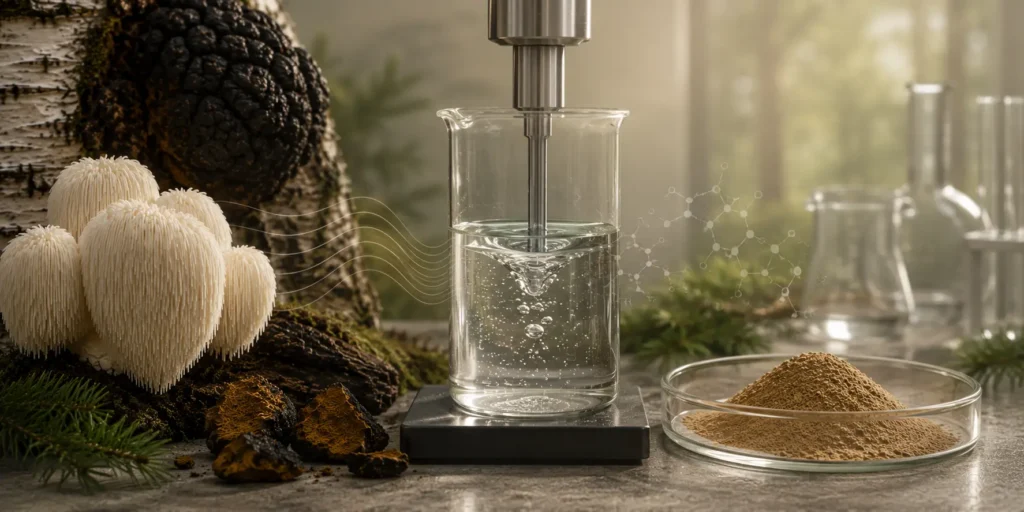
Mushroom extraction is about much more than grinding dried mushrooms into powder.
When making a mushroom extract, the producer treats a defined mushroom raw material with an extraction medium under controlled process conditions. The process may, for example, combine water with heat, ultrasound or other techniques. The producer then needs to separate, stabilise and dry the extract.
In short: In mushroom extraction, the producer starts with a defined mushroom species and part of the fungus. This is followed by processing, extraction and finally drying and analysis. A mushroom extract is therefore not the same as an ordinary finely ground mushroom powder.
In this guide
- What does mushroom extraction involve?
- 1. Mushroom extraction starts with the right raw material
- 2. Drying and size reduction
- 3. Water in mushroom extraction
- 4. Ultrasound-assisted extraction
- 5. What happens during ultrasound treatment?
- 6. Process parameters in extraction
- 7. Separation and concentration
- 8. Freeze-drying of mushroom extracts
- NordRelease® and mushroom extraction
- Powder and extract are not the same thing
- Laboratory analysis after extraction
- How do you assess the extraction process?
- Summary
What does mushroom extraction involve?
In mushroom extraction, the producer treats a defined mushroom raw material with an extraction medium under controlled conditions.
The aim is to transfer certain components from the solid mushroom material into an extract phase. Which components the process recovers depends, among other things, on the chemical composition of the mushroom, which part of the fungus the producer uses and which extraction method is used.
That is why the terms “mushroom extract” and “mushroom powder” are not synonymous. A powder may consist only of dried and ground mushroom, whereas an extract has gone through additional process steps.
Mushroom extraction starts with the right raw material
A good mushroom extraction process always starts with a clear raw material identity.
The producer first needs to establish which mushroom species and which biological structure the process starts from.
For Lion’s Mane, the raw material may, for example, consist of fruiting body or mycelium. For Chaga, the producer may instead use the characteristic Chaga conk.
These raw materials differ both biologically and chemically. That is why the same type of extraction process can produce different final profiles depending on which material the producer starts with.
The raw material comes first: Extraction can affect which components the producer recovers from the material, but the process does not make biologically different mushroom raw materials identical.
Drying and size reduction before extraction
Producers often dry the mushroom raw material before the actual extraction begins. They may then grind the material to reduce the particle size.
Size reduction increases the contact surface between the mushroom material and the extraction liquid. This way, the liquid gets better contact with the raw material.
Some processes also use more intensive physical cell processing before or during extraction.
This does not mean, however, that fine grinding alone creates an extract. Grinding mainly changes the physical structure of the material, whereas extraction means that components are transferred from the raw material into an extraction medium.
Water in mushroom extraction
Water is a common extraction medium in mushroom extraction, especially when the process targets water-extractable components such as various polysaccharide fractions.
Traditional hot water extraction usually combines water, temperature and time. Together, these factors affect how material is transferred from the solid raw material to the extract phase.
Modern process development may also combine water with other techniques, for example ultrasound.
That is why the term “water extraction” does not describe one single standardised process. Temperature, time, particle size, amount of water and mechanical treatment can differ considerably between extracts.
Water extraction is not just “mushroom + water”.
The actual process parameters determine how the extraction is carried out and what kind of raw material profile the producer obtains after processing.
Ultrasound-assisted mushroom extraction
One modern technique for mushroom extraction is ultrasound-assisted extraction, often abbreviated to UAE.
The method combines an extraction medium with ultrasound. The technique is used in research and industry to process various biological raw materials, including mushroom material.
The ultrasound creates rapid pressure changes in the liquid. Under the right process conditions, these changes can contribute to mechanical effects that improve contact between the extraction liquid and the raw material.
The result can be more efficient mass transfer than in a process where the raw material simply sits still in contact with the liquid.
What happens during ultrasound and cavitation?
A central mechanism behind ultrasound-assisted extraction is acoustic cavitation.
When ultrasound waves travel through the liquid, they create alternating high- and low-pressure phases. Small bubbles can then form, grow and finally collapse.
When the bubbles collapse, local mechanical forces and micro-movements occur in the liquid.
These effects can, among other things:
- improve contact between the raw material and the extraction liquid
- affect the physical structure of the mushroom material
- increase mass transfer from the raw material
- speed up parts of the extraction process
At the same time, the producer needs to control the process carefully. Intensity, time and temperature can affect the final result.
Process parameters in mushroom extraction
In mushroom extraction, several process parameters affect the final result.
Extraction therefore does not work as a simple on/off process. Instead, several variables interact throughout the processing.
| Parameter | Why does it matter? |
|---|---|
| Temperature | Affects solubility, mass transfer and the chemical environment of the raw material |
| Time | Determines how long the raw material is exposed to the process |
| Particle size | Affects the contact surface between the raw material and the extraction medium |
| Raw material/liquid ratio | Affects concentration and mass transfer in the system |
| Ultrasound intensity | Affects cavitation and mechanical treatment |
| Extraction medium | Affects which groups of compounds the process can transfer |
That is why two products that are both called “water extract” may still have gone through different processes and ended up with different chemical profiles.
Separation and concentration after extraction
After the actual extraction, the system contains both extracted components and solid raw material residues.
The producer therefore needs to separate the extract phase from the material that should not be carried over in the same form to the next process step.
The process may then include filtration, concentration or other separation steps, depending on which final product the producer wants to create.
Only then can the producer prepare the extract for stabilisation and drying.
Freeze-drying after mushroom extraction
After water-based mushroom extraction, the extract phase naturally contains a lot of water. To create a dry and manageable raw material, the producer needs to remove the liquid.
One method is freeze-drying, also known as lyophilisation.
First, the producer freezes the material. The pressure is then lowered so that frozen water can mainly leave the material through sublimation.
After drying, the producer can grind the dry extract into a more uniform powder.
That is why a finished mushroom extract can look like ordinary mushroom powder even though its process history is completely different.
NordRelease® and mushroom extraction
KÄÄPÄ Biotech describes NordRelease® as a process that combines ultrasound-assisted extraction (UAE) with purified water.
An important detail is that KÄÄPÄ does not describe NordRelease® as exactly the same process for every mushroom. Instead, the company states that the extraction conditions are adapted to each mushroom raw material and its chemical profile.
This matters when discussing mushroom extraction. Two mushrooms can use the same overall process technology and still require different parameters.
NordRelease® should therefore not be simplified to the raw material just being “boiled in water”. The process uses water together with ultrasound-assisted processing and subsequent process steps.
Defined mushroom raw material
Drying and grinding
Cell processing
Water + UAE
Freeze-drying
Analysis
Mushroom powder and mushroom extract are not the same thing
The finished form can cause confusion, because both an ordinary mushroom powder and a freeze-dried extract can look like a fine powder.
The difference therefore lies not mainly in appearance but in how the producer has processed the raw material.
| Raw material | Typical process |
|---|---|
| Mushroom powder | Drying + grinding |
| Mushroom extract | Raw material processing + extraction + separation + drying |
If you would like to read more about the difference, see our full guide on
mushroom powder vs mushroom extract.
Laboratory analysis after mushroom extraction
The mushroom extraction process itself tells you how the producer has processed the material. Laboratory analysis, on the other hand, provides measurable information about the finished raw material.
For mushroom extracts, analyses may include, for example:
- beta-glucans
- species-specific chemical markers
- moisture content
- microbiological parameters
- heavy metals
For some mushrooms, the producer may also specify other groups of compounds.
Lion’s Mane can, for example, be analysed for hericenones/hericenes, while Chaga can be characterised by inotodiol and betulinic acid.
That is why process documentation and laboratory analysis complement each other. One tells you how the raw material was produced, and the other describes parts of the analysed composition of the final material.
How do you assess quality in mushroom extraction?
It is not enough for a product to simply say “extracted”.
A more informative technical assessment of mushroom extraction looks at several parts of the process:
- which mushroom species the process starts from
- which part of the fungus the producer uses
- the geographical origin of the raw material
- which extraction medium the producer uses
- which extraction technique the producer uses
- how the final extract is dried
- which chemical parameters the laboratory analyses
- whether relevant analytical methods are stated
- microbiological control
- heavy metal control
This way, it becomes possible to assess the extract as a documented raw material instead of relying only on marketing terms.
You can read the full checklist in our guide on
mushroom extract quality.
Extraction of Lion’s Mane and Chaga
Aromexperten’s NordRelease® Lion’s Mane and Chaga provide two concrete examples of water-based and ultrasound-assisted extraction of mushroom raw materials.
The Lion’s Mane raw material is based on 100% fruiting body of Hericium erinaceus, while the Chaga raw material is based on Chaga conk from Inonotus obliquus.
Both use the NordRelease® technology and purified water. The raw materials, however, are biologically and chemically different. You should therefore not automatically assume that the producer uses exactly the same process parameters for both mushrooms.
Read more about the finished raw materials on the pages for
Lion’s Mane extract
and
Chaga extract.
Would you like to see the full range? Explore the category of
mushroom extracts.
Summary: mushroom extraction step by step
Mushroom extraction starts with a defined mushroom raw material and ends with a processed extract that can be analysed.
First, the producer chooses the right mushroom species and part of the fungus. The producer can then dry and grind the material.
In water-based extraction, water acts as the extraction medium. Ultrasound-assisted extraction can also use acoustic cavitation and mechanical effects to improve contact between the liquid and the raw material.
After extraction, the producer separates the extract phase from the remaining solid material. The process can then concentrate and dry the extract, for example by freeze-drying.
Finally, laboratories can analyse beta-glucans, species-specific chemical markers and various quality parameters.
That is why a clear description of the mushroom extraction is much more informative than the word “extract” alone. Raw material, extraction medium, process technology and analysis together need to create a clear picture of the final product.
About this content: This article describes technical processing, extraction processes and raw material analysis. It should not be interpreted as information about medical or physiological effect. Aromexperten’s mushroom raw materials are sold for technical and raw material purposes and are not intended for consumption.
Sources and further reading
-
KÄÄPÄ Mushrooms – NordRelease® ultrasonic-assisted extraction
-
Leong et al. – Extraction of polysaccharides from edible mushrooms: Emerging technologies and recent advances
-
Sun et al. – Application of ultrasonication in the production and processing of edible mushrooms
-
Advanced insights into mushroom polysaccharides: Extraction methods and structural characteristics

 Best Sellers
