Svenska
 News
News Botanical Blends
 Mitragyna
 Kanna (sceletium tortuosum)
 Akuamma (Picralima nitida)
 Tongkat Ali (Eurycoma longifolia)
 Blue Lotus (Nymphaea caerulea)
 Sakae Naa
 Wild Lettuce (Lactuca virosa)
 Damiana (turnera diffusa)
 Zornia latifolia (Maconha Brava)
 CBD products
 Aromatherapy
Botanicals
What is Tongkat Ali? Guide to Eurycoma longifolia
Jul
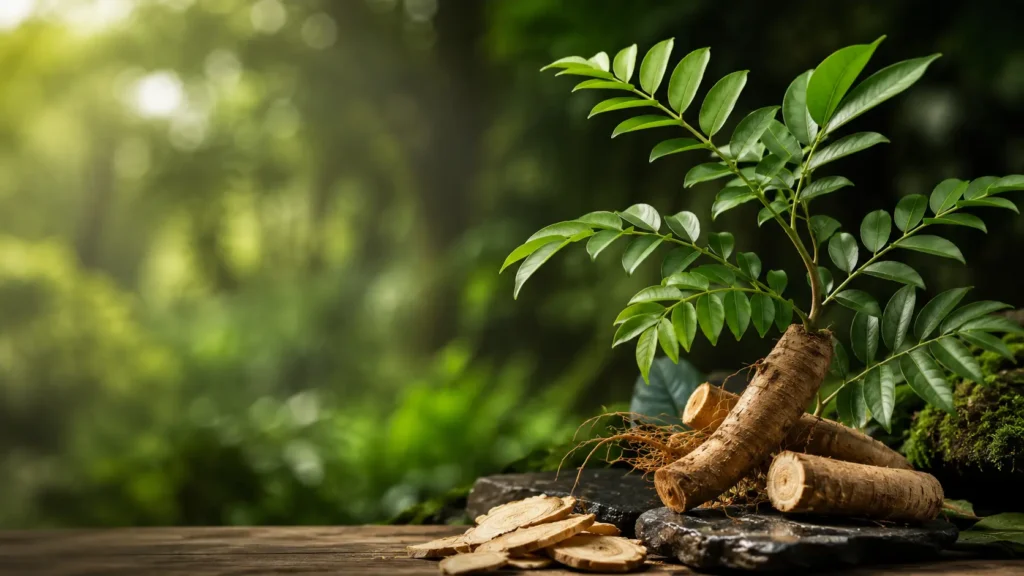
What is Tongkat Ali? It is the common name for Eurycoma longifolia, a tropical tree from Southeast Asia.
The plant is particularly associated with Malaysia, and producers primarily use the root as a botanical raw material.
Therefore, the raw material is available in several forms, including dried root, root powder, and various types of extracts.
Quick facts about the plant
| Scientific name | Eurycoma longifolia Jack |
|---|---|
| Plant family | Simaroubaceae |
| Plant type | Tropical tree |
| Natural distribution | Parts of Indochina and western Malesia |
| Most common plant part | Root |
| Common raw material forms | Dried root, root powder, and extract |
What is Tongkat Ali?
Tongkat Ali is a common name for the plant species Eurycoma longifolia Jack.
The species belongs to the family Simaroubaceae, which mainly consists of tropical trees and shrubs.
Many species in the family also contain distinctly bitter plant compounds.
The Royal Botanic Gardens, Kew’s international plant database accepts Eurycoma longifolia as a species name and describes the tree as a species from humid tropical environments with a natural distribution from Indochina to western Malesia.
Botanists scientifically described the species in the 19th century.
Tongkat Ali thus functions as a common name, while Eurycoma longifolia is the botanical name used by researchers and laboratories.
Other common names include longjack, pasak bumi, penawar pahit, tung saw, and bedara pahit.
The trade name “Malaysian ginseng” also occurs.
However, the species is not botanically related to true ginseng from the genus Panax.
Where does the species grow?
Eurycoma longifolia is native to Southeast Asia.
According to Kew’s botanical database, the species occurs naturally in several parts of the region.
- Malaysia
- Thailand
- Vietnam
- Cambodia
- Laos
- Myanmar
- Philippines
- Sumatra
- Borneo
Primarily, the tree grows in tropical forest environments.
The species thrives in warm and humid climates and occurs in both lowland areas and some higher-altitude environments.
At the same time, many associate the plant particularly with Malaysia.
The country has, among other things, played an important role in modern research, cultivation, and commercial development of standardized Eurycoma longifolia extracts.
What does the plant look like?
Eurycoma longifolia is not a small herb, even though it often appears alongside other botanical products.
Instead, it develops into a slender tropical tree that can grow several meters tall under favorable conditions.
The tree has long, pinnate leaves with many smaller leaflets.
Small flowers are arranged in branched inflorescences.
The fruits are elongated and turn dark red or almost black when ripe.
The tree also develops a long root.
Traditionally, people have primarily collected this part of the plant.
Today, producers use the root when manufacturing most commercial raw materials.
The root material has a distinct bitterness.
Naturally occurring substances in the quassinoid group contribute, among other things, to this characteristic.
What does the root contain?
The root constitutes a complex botanical raw material.
Several factors can therefore affect its chemical composition.
- the plant’s genetic origin
- habitat and soil type
- the tree’s age
- choice of root part
- harvest time
- drying and storage
- extraction method
- possible standardization
Researchers have identified several groups of substances in Eurycoma longifolia, including quassinoids, alkaloids, saponins, polysaccharides, peptides, and various phenolic compounds.
Eurycomanone
Eurycomanone is one of the most noted quassinoids in the plant.
Laboratories often use the substance as a chemical analytical marker for Eurycoma longifolia extract.
In other words, an analytical marker helps the laboratory control certain aspects of the raw material’s identity and composition.
However, a single substance does not explain the plant’s entire chemical profile.
Therefore, a high stated content of eurycomanone does not automatically mean high quality.
For a broader quality assessment, one also needs to examine, for example, identity, purity, manufacturing method, analytical methods, and the presence of undesirable substances.
An example of an extract where the manufacturer follows several analytical parameters is Tongkat Ali Physta®.
The documentation includes eurycomanone, protein fraction, polysaccharides, and glycosaponins.
However, these data constitute product and batch information, not an independent regulatory assessment.
Traditional Southeast Asian use
The plant has a long documented history of traditional Southeast Asian plant use.
Traditionally, people have, among other things, sliced, dried, or boiled the root material in water.
Historical sources describe use in contexts related to, for example, vitality, fever, bodily well-being, and male health.
Such traditional uses are of cultural-historical interest.
However, they should not automatically be interpreted as scientifically confirmed medical effects.
Traditional use can provide researchers with clues about which plants are interesting to investigate.
However, it does not in itself prove that a modern product works in a certain way or has established safety.
Furthermore, older preparations can differ significantly from modern extracts.
A simple water decoction of root, for example, is not necessarily chemically comparable to a laboratory-produced and standardized extract.
Root powder and extract are not the same thing
| Form | How the producer manufactures it | What to check |
|---|---|---|
| Dried root | The producer cleans, cuts, and dries the root. | Species, origin, purity, and storage. |
| Root powder | The producer grinds the dried root. | Identity, purity, and batch analysis. |
| Ratio extract | The producer extracts and concentrates certain constituents. | Extraction agent, ratio, excipients, and analytical data. |
| Standardized extract | The producer controls selected analytical values against defined specifications. | Markers, analytical method, specification, and COA. |
Products using the same plant name can therefore differ significantly.
Common forms are dried root, root powder, ratio extract, and standardized extracts.
Dried root
The producer harvests, cleans, cuts, and dries the root material.
Dried root is therefore a relatively simple botanical raw material form.
However, quality can vary depending on, among other things, species identification, origin, drying, and storage.
Root powder
The producer manufactures root powder by grinding the dried root.
The powder therefore contains both soluble and insoluble parts of the original plant material.
Root powder is thus not the same as an extract.
Therefore, a certain amount of ground root cannot automatically be equated with the same amount of extract.
Ratio extract
During extraction, the producer uses an extraction agent, such as water or ethanol, to transfer certain constituents from the root material to an extract solution.
Suppliers can, for example, state an extract as 10:1, 50:1, or 100:1.
However, such figures can be difficult to interpret without further information.
The ratio indication does not automatically show which substances the process has extracted or what concentration a certain analytical marker has in the final product.
Standardized extract
During standardization, the producer selects analytical parameters and controls them against defined specifications.
This makes it easier to compare certain values between different production batches.
However, standardization does not mean that all standardized extracts are identical.
Different manufacturers may use different extraction processes, specifications, and analytical markers.
For a more detailed review, you can read our guide Tongkat Ali powder or extract?.
What is Physta®?
Physta® is a trademarked and standardized water extract from the root of Eurycoma longifolia.
Biotropics Malaysia develops and manufactures the extract.
According to the manufacturer, the company uses controlled Malaysian root material and a water-based extraction process.
The manufacturer then analyzes several parameters to ensure that each production batch meets the defined specification.
Physta® therefore demonstrates how a manufacturer can define a botanical raw material in more detail through the manufacturing process, standardization, and batch analysis.
At the same time, one needs to distinguish between manufacturer information, published studies, and regulatory assessments.
The three source types answer different questions.
Read the full technical review in What is Physta®?.
What does the research say?
Researchers have conducted laboratory studies, animal studies, and human studies with Eurycoma longifolia.
They have, among other things, investigated various physiological and biochemical parameters under specific experimental conditions.
In addition, several human studies have used standardized extracts, including Physta®.
Product identity plays a major role because a research result from a specific extract does not automatically apply to root powder or another extract.
At the same time, the results need to be interpreted taking into account the limitations of the studies.
- number of study participants
- study duration
- which group the researchers investigated
- which extract the researchers used
- product specification
- funding and potential conflicts of interest
- whether the results can be transferred to other products
Therefore, a study of a specific extract cannot show that all raw materials from the same plant have the same composition or properties.
What does EFSA say about safety?
Safety cannot be determined solely based on the plant name.
The product’s composition, concentration, impurities, and intended use, for example, affect the assessment.
The European Food Safety Authority, EFSA, reviewed in 2021 a specific standardized water extract from Eurycoma longifolia root within the framework of an application for use as a novel food.
The EFSA panel considered that the available data were insufficient to establish the safety for the proposed use.
The panel raised, among other things, uncertainties related to genotoxicity.
Therefore, it is more correct to say that the data did not establish the safety for the assessed ingredient and use, rather than simplifying the conclusion to all forms of the plant being proven harmful.
Similarly, marketing claims about safety should be distinguished from independent regulatory assessments.
What are the regulations within the EU?
The fact that companies sell plant-based products as dietary supplements in other parts of the world does not automatically mean that the same use is permitted within the EU.
The EU’s Novel Food regulations cover foods and ingredients for which the operator cannot demonstrate a relevant history of consumption within the Union before May 15, 1997.
Depending on the exact ingredient and use, a special authorization may therefore be required before a product can be used as food.
At the same time, the regulatory question is separate from the botanical question.
A plant can thus have a long traditional history of use in Southeast Asia and still have a different legal status as food within the EU.
Aromexperten therefore presents its Tongkat Ali products as ethnobotanical or technical raw materials and not as food or dietary supplements.
The products are not intended for consumption.
How to assess the quality of a botanical raw material
Anyone comparing different raw materials should examine more than price or a high extract ratio.
Instead, start with botanical identity and then proceed with raw material form, process, and analysis.
- First: Check that the botanical name Eurycoma longifolia is stated.
- Then: Check which plant part the producer has used.
- Next: Confirm the raw material’s country of origin.
- Furthermore: Determine whether the material is root powder or extract.
- For extracts: Check which extraction agent the producer has used.
- Additionally: Examine any extract ratio and its definition.
- At the same time: Check if the producer standardizes the product against named analytical markers.
- Furthermore: Review documentation for microbiology and heavy metals.
- Then: Match batch numbers against the current certificate of analysis.
- Finally: Distinguish supplier information from independent laboratory and regulatory sources.
A Certificate of Analysis, COA, can provide important batch-specific information.
At the same time, sampling, analytical methods, laboratory, and the connection to the actual production batch affect how much information the document provides.
Brief glossary
- Eurycoma longifolia
- The scientific name for the plant commonly known as Tongkat Ali.
- Eurycomanone
- A quassinoid often used by laboratories as a chemical analytical marker.
- Standardization
- Control of selected analytical values against defined specifications between production batches.
- COA
- Certificate of Analysis, an analytical certificate that reports specifications and results for a raw material or batch.
- Extract ratio
- A ratio between the amount of plant material used and the extract obtained. It does not alone serve as a complete quality measure.
- Novel Food
- EU regulation for certain foods and ingredients lacking relevant documented consumption history within the Union before the established deadline.
Summary: What is Tongkat Ali?
In summary, Tongkat Ali is the common name for the Southeast Asian tree Eurycoma longifolia.
The species belongs to the family Simaroubaceae and occurs naturally in several parts of Southeast Asia.
Primarily, the root has a history of traditional plant use.
Today, the raw material is available in forms such as dried root, root powder, and various extracts.
Therefore, a standardized extract like Physta® is not the same raw material form as ordinary ground root.
Research is interesting, but the results need to be interpreted based on which product the researchers actually studied.
Therefore, results from a specific extract cannot automatically be transferred to all raw materials from the plant.
To understand a product, one should therefore start with botanical identity, plant part, origin, raw material form, extraction method, and documented analysis – not with a single marketing figure.
Frequently asked questions
What is Tongkat Ali?
Tongkat Ali is the common name for Eurycoma longifolia, a tropical tree from Southeast Asia.
Are Tongkat Ali and Eurycoma longifolia the same thing?
Yes. Tongkat Ali is a common name, while Eurycoma longifolia is the plant’s scientific name.
Which part of the plant is used as raw material?
Producers primarily use the root when manufacturing dried root, root powder, and various types of extracts.
Is the plant the same as ginseng?
No. The trade name “Malaysian ginseng” is sometimes used, but Eurycoma longifolia does not belong to the same botanical genus as true ginseng, Panax.
What is the difference between powder and extract?
Root powder consists of ground and dried root.
An extract, however, has undergone an extraction process where the producer uses a solvent to transfer certain constituents from the plant material.
Read more in our guide Tongkat Ali powder or extract?.
What does a 100:1 extract mean?
The information normally describes a ratio between the amount of plant material and the extract obtained.
However, the figure alone does not show the concentration of, for example, eurycomanone or the product’s complete chemical profile.
What is Physta®?
Physta® is a trademarked and standardized water extract from Eurycoma longifolia root.
Read more in What is Physta®?.
Where can I see the current Physta® batch?
The current batch, analytical values, and COA can be found on the product page for Tongkat Ali Physta®.
What is the regulatory status within the EU?
The regulatory status depends on the exact ingredient and area of use.
In 2021, EFSA reviewed a specific standardized Eurycoma longifolia root extract as a novel food and concluded that the data were insufficient to establish the safety for the proposed use.
Sources and method
The article distinguishes between botanical sources, scientific literature, regulatory assessments, and product information.
This makes it clearer what type of source each piece of information is based on.

 Best Sellers