Svenska

 News
 Botanical Blends
 Mitragyna
 Kanna (sceletium tortuosum)
 Akuamma (Picralima nitida)
 Tongkat Ali (Eurycoma longifolia)
 Blue Lotus (Nymphaea caerulea)
 Sakae Naa
 Wild Lettuce (Lactuca virosa)
 Damiana (turnera diffusa)
 Zornia latifolia (Maconha Brava)
 CBD products
 Mushroom Extracts
 Aromatherapy
Botanicals
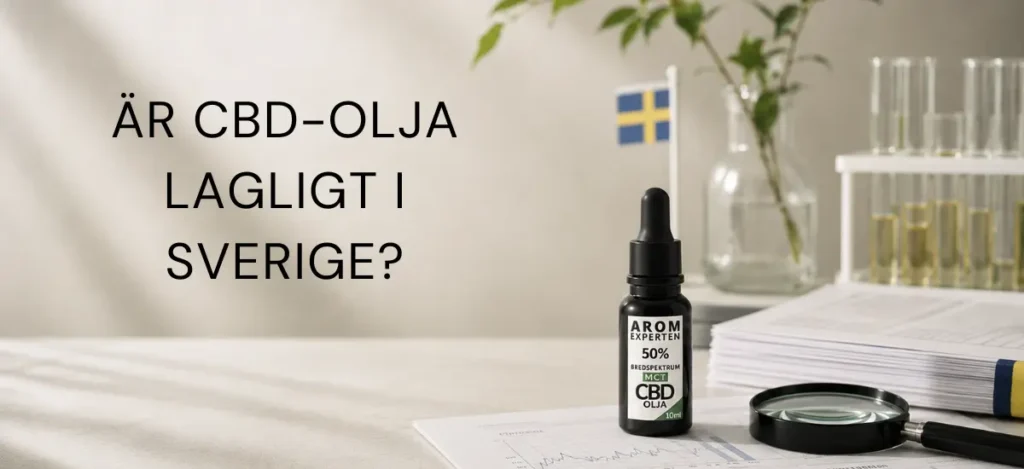
Is CBD oil legal in Sweden?
Jul
Cbd legal guide · HTML
Is CBD oil legal in Sweden? The question cannot be answered with a general yes or no. Authorities assess the product’s content, product form, intended use, and marketing. THC content, medicinal product classification, and food regulations all affect how a particular product is assessed.
This guide summarizes the most important parts of the regulatory framework. The text provides general information and does not replace legal advice regarding a specific product. For an overview of the assortment, product forms, and documentation, see Aromexperten’s CBD page.
Short Answer
There is no single rule that makes all CBD products either legal or illegal. The specific product needs to be assessed based on content, product form, area of use, and marketing.
Contents
Is CBD oil legal in Sweden? The short answer
Authorities do not assess all CBD products in the same way. Two products with similar names may be subject to different regulations depending on their content, intended use, and how the company presents them.
The specific product therefore needs to be reviewed. Key questions include whether the product contains THC, if it is marketed with medical claims, and if the company offers it as a food product.
Those comparing oil blends can start in the CBD oil category and read the specification for each product.
The phrasing “CBD is legal” is therefore too broad. The legal assessment depends on the specific product’s characteristics and how it is provided on the market.
Product classification affects what applies
Swedish authorities do not assess a product solely based on the product name. They weigh in content, form, intended use, and marketing.
Products containing CBD can thus be covered by different regulatory frameworks. A product can be assessed according to medicinal, food, or narcotics legislation depending on the circumstances.
For a retailer, this means that product text, labeling, and documentation must be consistent. This also applies to terms such as isolate, broad spectrum, and full spectrum, where the analysis should support what is stated on the label.
Read our guide on the difference between CBD isolate, broad spectrum, and full spectrum.
What applies if CBD oil contains THC?
In 2019, the Supreme Court ruled on a case concerning CBD oil that contained THC. The court classified the oil as a preparation constituting a narcotic, even though the THC content originated from industrial hemp.
The exemption for industrial hemp does not automatically follow when the plant material has been processed into such a preparation.
Important: for a CBD oil, it is not sufficient to refer to the raw material coming from industrial hemp if the finished preparation contains THC.
Read the Supreme Court’s ruling in case B 177-19.
Is there a permitted THC limit for CBD oil in Sweden?
It is misleading to use a general percentage limit for THC in finished CBD oil and describe everything below that level as legal in Sweden.
The Swedish Food Agency’s guidance describes that the Supreme Court’s ruling applies to THC content, and that Swedish narcotics legislation does not use a corresponding general THC concentration limit for such preparations.
Product text should therefore not use phrases such as “within legal THC limit” without clear legal support for that specific product form.
A laboratory result below LOQ is also not the same as a proven absolute zero content. The company should report the laboratory’s actual results along with the reporting limit and information on which sample the analysis applies to.
For a technical explanation, read the guide on COA, LOD, and LOQ.
Concentration and THC results are two separate issues. Our guide on what 10%, 25%, and 50% mean in CBD oil explains the difference between percentage, bottle volume, and declared amount.
When can a CBD product be classified as a medicinal product?
The Swedish Medical Products Agency states that a product can be a medicinal product if it has medical effects on the body, or if the company presents the product as something intended to prevent or treat disease. How the product appears to the customer also affects the assessment.
Phrasing regarding the treatment of disease or symptoms can therefore in itself affect the product classification.
If a product is classified as a medicinal product, approval is required before it may be sold. The Swedish Medical Products Agency describes that the authority has previously prohibited the sale of CBD oils assessed to be medicinal products without approval.
Read the Swedish Medical Products Agency’s information on cannabidiol.
Can CBD oil be sold as a food product or dietary supplement?
The Swedish Food Agency states that CBD oil and other products containing extracted cannabinoids are covered by the novel foods regulations. According to the agency’s guidance, extracted CBD is an unauthorized novel food and may not be placed on the food market until a relevant approval is in place.
A product does not automatically become a permitted food product just because the company avoids medical claims.
At the same time, the guidance distinguishes between extracted cannabinoids and certain plant parts that naturally contain CBD. Raw material and manufacturing method can therefore be significant for the assessment.
Technical and Aromatic CBD Products
Some companies present products for technical or aromatic use instead of as food, medicinal products, or consumer products.
Such a label does not mean that all other legal issues disappear. The product’s content, form, actual area of use, and marketing can still be relevant in the authorities’ assessment.
Product texts should therefore be consistent and avoid instructions on ingestion, dosage, inhalation, or medical use when the product is not sold for such purposes. A page that on one hand specifies technical use and on the other hand describes a usage experience contradicts itself.
The CBD page collects the product forms with links to the respective product specification. For botanical plant material, there is a separate category for CBD buds.
Can a COA prove that CBD oil is legal?
No. A Certificate of Analysis, COA, shows what the laboratory measured in an identified sample. The document can report cannabinoids, analysis results, method, as well as LOD and LOQ.
The laboratory report, however, does not provide a legal assessment. It does not determine how authorities classify the product form, area of use, or marketing.
A certificate is still the best basis for checking what a product actually contains. The crucial part is reading which sample it applies to.
Our own certificate as an example
Aromexperten’s published certificate, B2B-RCoA-225/1, is issued by LabCore in Ljubljana and applies to a sample named CBD Distillate Broad Spectrum. The analysis reports 79.83% CBD along with seven additional cannabinoids, while delta-9-THC, delta-8-THC, and total THC are reported below the laboratory’s limit of quantification of 0.05% by weight.
The certificate applies to the distillate, i.e., the raw material before dilution with carrier oil. It verifies the cannabinoid profile and raw material type, but not the declared concentration of the finished bottle.
The result applies to the analyzed sample. It should not be described as a general guarantee of absolute zero THC content, nor as a legal approval of the final product.
Open certificate of analysis B2B-RCoA-225/1
Also read the guide on CBD certificates of analysis.
Frequently Asked Questions about CBD Oil and Swedish Legislation
Is all CBD oil legal in Sweden?
No, a general statement cannot be given for all products. Content, product form, intended use, and marketing affect the assessment.
Is CBD itself classified as a narcotic?
CBD and THC are different substances. The Supreme Court’s ruling concerned a CBD oil that contained THC and was therefore classified as a narcotic.
Do the rules for industrial hemp automatically apply to finished CBD oil?
No. The Supreme Court has established that the exemption for industrial hemp does not automatically apply to a preparation containing THC.
Can CBD oil be sold as a dietary supplement?
The Swedish Food Agency describes extracted CBD as an unauthorized novel food. It therefore may not be placed on the food market until relevant approval is obtained.
Does the text “for aromatic use only” automatically make the product legal?
No. The product’s actual content, form, area of use, and marketing can still affect the legal assessment.
What does it mean that THC is below LOQ?
That the laboratory could not quantify THC above its reporting limit in the analyzed sample. This is not the same as proof of absolute zero content, nor is it a legal notice.
Does a COA prove that the product is legal?
No. A COA reports laboratory results for an identified sample but does not replace a legal assessment of the entire product.
Summary
CBD oil has no general legal status that applies to all products. Authorities weigh in content, product form, intended use, and marketing.
CBD oil containing THC may constitute a narcotic according to the Supreme Court’s ruling. Medical presentation can affect medicinal product classification, and extracted CBD is covered by novel food regulations when offered as a food product.
A certificate of analysis is important for describing a sample and checking what a product contains, but the document does not prove the product’s legal status.
Read more about CBD and documentation
Delve deeper into how laboratory results should be interpreted or compare product information for the different options.
Sources and Further Reading
-
Swedish Medical Products Agency – Cannabidiol, CBD
-
Supreme Court – Case B 177-19
-
Swedish Food Agency – Hemp Products
-
LabCore – Certificate of Analysis B2B-RCoA-225/1, CBD Distillate Broad Spectrum
Last fact-checked:

 Best Sellers